



Five students from the University of Buenos Aires (UBA) managed to position themselves among the top five teams in the international competition CanSat, which simulates a real aerospace mission. Their proposal: a wooden satellite, equipped with electronic sensors, seeds, water, and a chicken egg as biological cargo.
Behind the Hornero project, named in honor of the Argentinian national bird, there is a self-taught learning process, interdisciplinary collaboration, and a strong commitment to public education.
The CanSat competition, organized by the University Space Program of UNAM, brought together over 100 teams from universities around the world, with 40 finalists in the decisive stage in Mexico City.
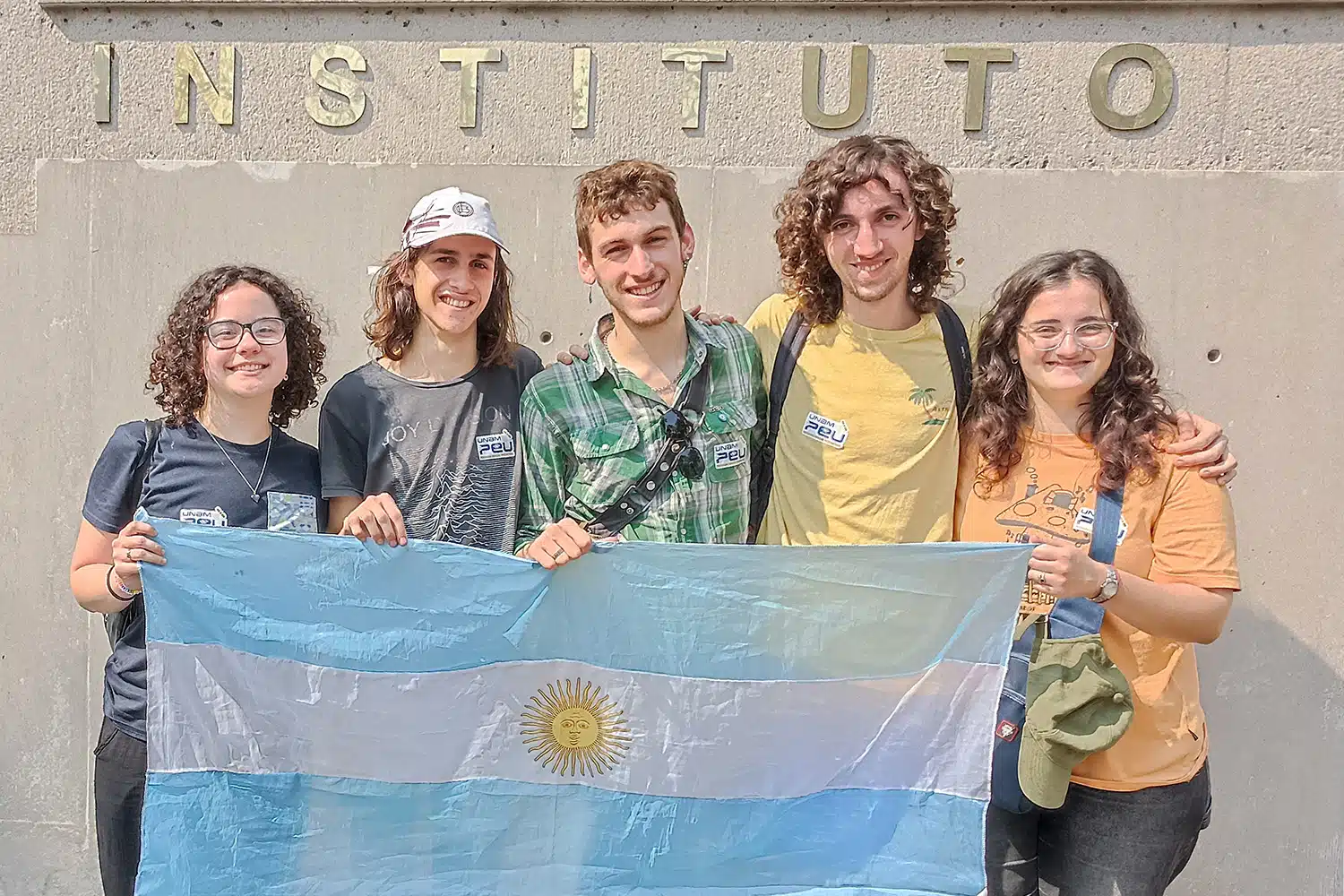
The Argentine representatives were: Clara Telesca, Pedro Monczor, Pilar Risso, Santiago Pérez Garber, and Juan Valle, all students of Physics and Chemistry at the Faculty of Exact and Natural Sciences of UBA.
Design of the wooden satellite and scientific objectives
The Hornero satellite had to meet specific requirements:
- Dimensions: Not to exceed 20 cm in height.
- Materials: Construction in wood.
- Technological capabilities: Sensors to measure speed, acceleration, temperature, pressure, and carbon dioxide.
- Descent system: 3D-printed autogyro, from 400 meters high.
It also included a biological payload, composed of:
- Chicken egg.
- Endemic seeds.
- Water, which had to withstand the impact of the launch.
The technical objective was to collect atmospheric data in real-time and transmit it to a ground station.
Challenges and progress in the competition
The team progressed in each phase of the competition:
- Second round: Quarterfinals among 65 teams.
- Third evaluation: Fifth among 49 teams.
- Launch classification: Score of 98.2, positioning them second and ensuring their passage to the final.
Thanks to this performance, the Faculty of Exact Sciences managed the funding for the trip, allowing the students to represent the country in Mexico.
Interdisciplinary work and technology applied in the wooden satellite
The Hornero satellite simulates a real scale model, incorporating systems such as:
- Energy and telemetry.
- Sensors and electronic boards.
- Structural design with pieces in a 3D printer.
Each stage of the design was based on own research, tests, and trials, integrating knowledge of carpentry, electronics, and programming.
Educational impact and international recognition
The five team members began their passion for space science at the Colegio Nacional Buenos Aires, where they met.
The project required:
- Support from teachers and technicians.
- Back-up from tutors, like Gonzalo Ciaffone.
- Self-management in construction, with recyclable materials and selected flight computers.
The final result placed Hornero in the fifth global position, but the real reward was having demonstrated the capacity of public university and the scientific autonomy of its students.
CanSat: an aerospace mission on a scale
The CanSat competition, with over a decade of experience, aims to:
- Promote technical training.
- Encourage scientific vocation.
- Integrate physics, engineering, electronics, and industrial design.
Students had to justify each technical decision, present rigorous documentation and demonstrate the functioning of each subsystem, replicating the evaluation process of the space industry.
The success of Hornero in CanSat shows that an idea born among friends, driven by knowledge and dedication, can become a true aerospace adventure.



