



In **Utah**, **United States**, one of the most astonishing living organisms on the planet can be found. It is **Pando**, an ecosystem made up of cloned trees.
Although it appears to be a common forest, it is actually **a single living being** connected by the same root system.
This superorganism, composed of approximately **47,000 genetically identical quaking aspens (_Populus tremuloides_)**, spans over more than **43 hectares** within the **Fishlake National Forest**.
Its estimated total weight exceeds **6000 tons**, making it **the largest organism in the world by mass**. However, it faces several threats.
## Pando, a millennia-old ecosystem essential for ecological balance
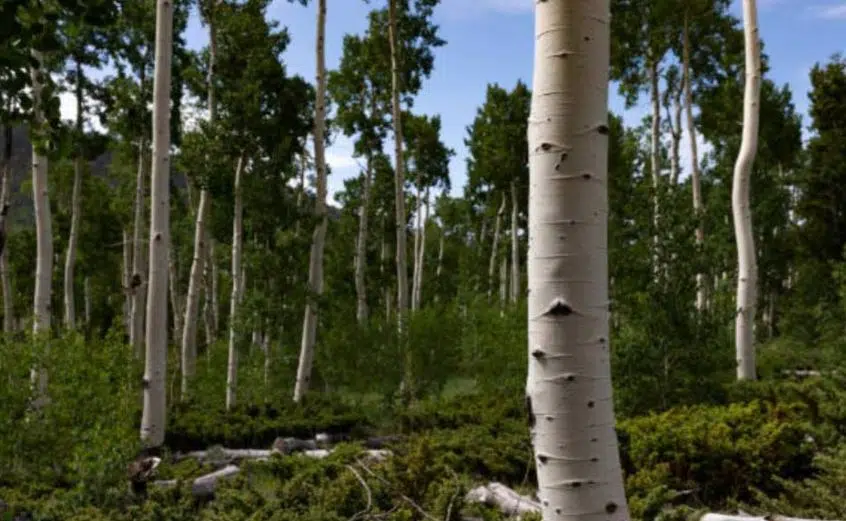
Pando, whose name means “I spread” in Latin, is not only a biological phenomenon but also an ecological cornerstone. Its age is estimated at **over 9000 years**, making it one of **the longest-lived living beings on the planet**.
This massive organism **houses a great diversity of animal and plant species**, playing a fundamental role in conserving local ecological balance.
Through its interconnected root system, it regenerates naturally, sending shoots that give rise to new trunks, all genetically identical.
Furthermore, the cloned forest contributes to **carbon storage**, **water regulation**, and **soil protection** against erosion, making it a key ally against climate change and biodiversity loss.
## Current threats and conservation efforts
Despite its millennia-old resilience, **Pando currently faces serious threats**. Researchers have warned that the pressure from grazing, **human activity, and climate change** is affecting its natural regeneration capacity.
One of the main issues is the overpopulation of **deer and elk, which feed on young shoots**, preventing new trees from replacing the older ones.
Without proper renewal, the organism is at risk of deteriorating progressively.
In response to this situation, scientists and environmental organizations are working on **conservation strategies** that include the installation of protective fences, genetic monitoring, and awareness campaigns to preserve this unique ecological treasure.
## Why is it so important to protect Pando?
Preserving Pando is not only a scientific or symbolic issue: it represents **a complete ecosystem in itself**, whose disappearance would severely affect numerous species dependent on its habitat.

Additionally, this superorganism is an **invaluable source of information** on ecological adaptation, clonal evolution, and response to climate change.
Pando is also an inspiration to promote the **development of sustainable conservation models**, integrating science with environmental education and responsible tourism.


