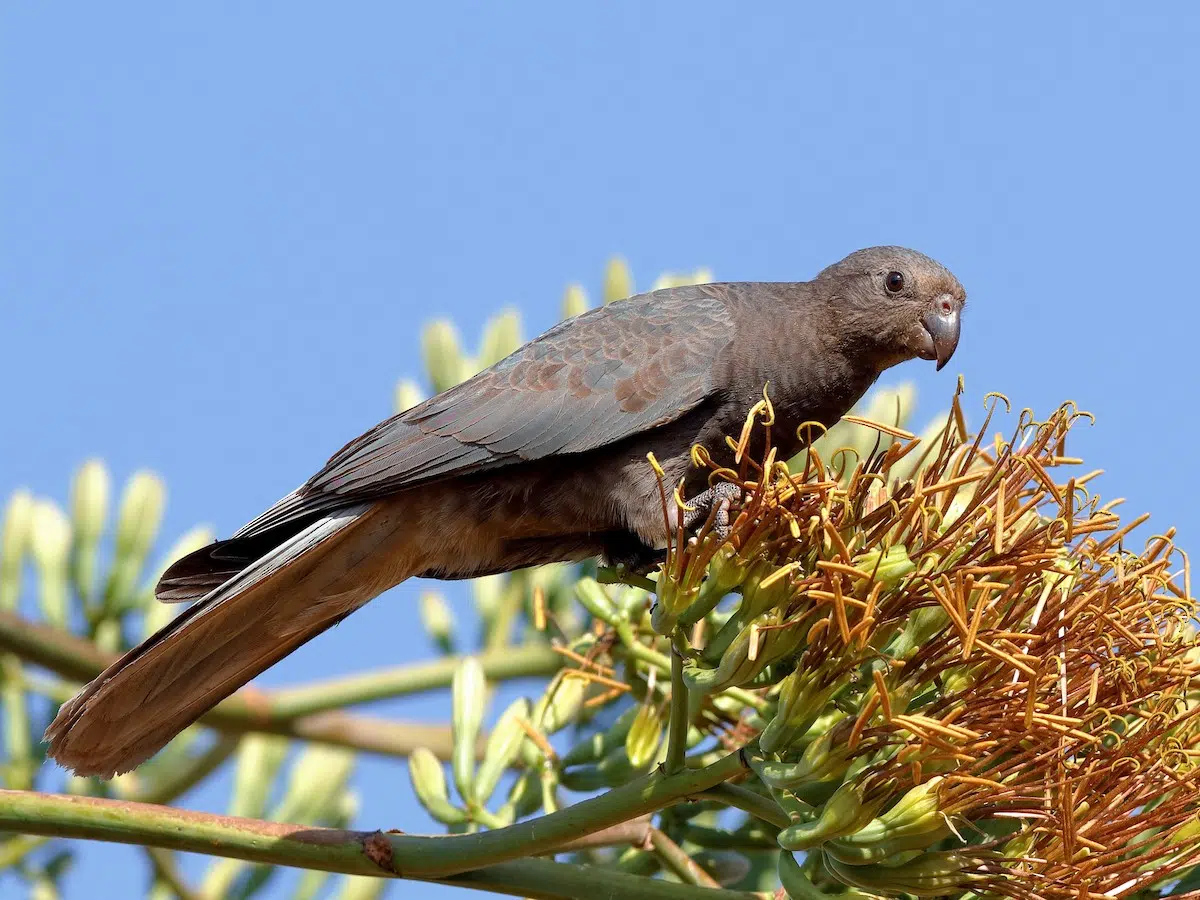
loro negro
The Black Parrot of Seychelles (Coracopsis barklyi) is a species exclusive to the archipelago, with a prominent presence on the islands of Mahé, Praslin, and Silhouette.
Its geographical isolation has favored the evolution of unique traits, clearly differentiating it from other parrots in the Indian Ocean, such as the Black Parrot of Madagascar (Coracopsis nigra), with which it was previously linked as a subspecies.
Dark plumage, robust body, and a key role in forest regeneration.
With a length that can reach 35 centimeters, this parrot presents plumage ranging from black to gray, and a strong body structure, making it an unmistakable figure in the lush forests of Seychelles.
Its diet is based on fruits, seeds, and flowers, positioning it as an essential agent in seed dispersal and regeneration of native flora.
Persistent threats and ongoing protection efforts. The Coracopsis barklyi is classified as “Vulnerable” by the IUCN, due to factors such as:
The decrease in native forests and the presence of introduced predators represent constant risks to its survival.
Legal protection, ecological restoration, and environmental education. Local authorities have implemented comprehensive strategies to protect the black parrot, including:
Thanks to these efforts, some populations have shown signs of recovery, although the species remains in a delicate situation.
Community participation and ecotourism as preservation tools. Beyond its biological uniqueness, the Black Parrot of Seychelles has become a symbol of the challenges and achievements in the conservation of island species.
Organizations like Nature Seychelles and the Seychelles Ornithological Society lead actions such as:
Preserving the Coracopsis barklyi is protecting the health of the archipelago.
The story of this endemic species recalls the fragile balance of island ecosystems and the urgency to protect them.
Its conservation not only ensures the survival of a unique species, but also strengthens the ecological resilience of the archipelago, leaving an invaluable natural legacy for future generations.
Mexico is intensifying its efforts to protect the endangered jaguar, one of the continent's most…
Ecuador will allocate 117.6 million dollars to implement an energy transition in the Galapagos archipelago…
In the arid landscape of northern Chile, a silent and clean train advances without emitting…
The continued use of forever chemicals in consumer products has once again become a subject…
The energy matrix of Peru has been mainly supported by two sources: hydroelectric plants, responsible…
Scientists have created an innovative formula to nourish sea urchin offspring, which are essential for…

