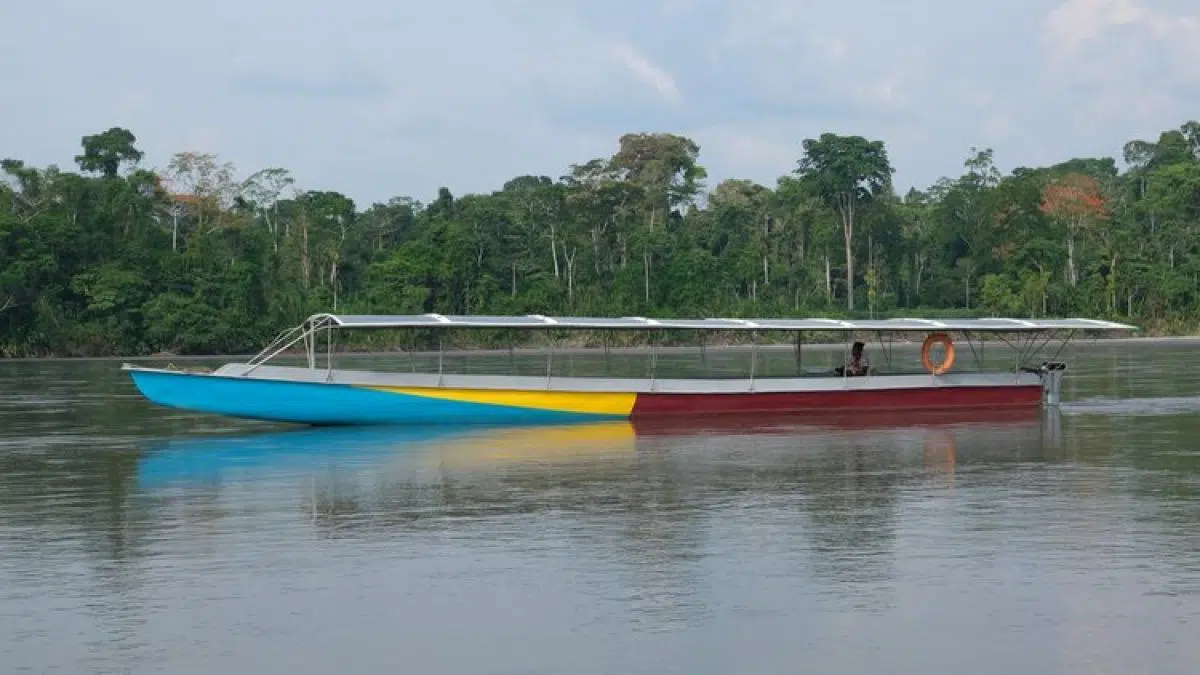
La Amazonía ecuatoriana reduce el ruido en sus ríos con embarcaciones solares y mediciones acústicas innovadoras. Foto: Primicias.
In the Achuar territory, in the Ecuadorian Amazon, scientists and indigenous communities are driving a key change. The replacement of combustion engines with solar boats is beginning to transform the soundscape.
In this regard, the noise that dominated the rivers for decades is starting to dissipate. Thus, the ecosystems are gradually regaining their natural conditions.
Moreover, this transition not only involves technological innovation. It also represents a new way of understanding the relationship between transportation, culture, and biodiversity.
To evaluate these changes, specialists apply the Acoustic River Index. This tool allows measuring acoustic pollution in river environments.
In this way, soundscapes become scientific data. Consequently, it is possible to monitor how the health of ecosystems evolves.
The first results are compelling. Solar boats generate an acoustic disturbance up to five times lower than gasoline engines.
On the other hand, the initiative is led by Kara Solar along with the National Institute of Biodiversity. This alliance combines local knowledge and applied science.
Sound is an essential component in the jungle. Many species depend on it to orient themselves, communicate, and reproduce.
However, combustion engines disrupt this balance. They emit frequencies close to 2,900 hertz that interfere with natural signals.
Therefore, the reduction of noise favors ecological recovery. As acoustic pollution decreases, vital processes for fauna are restored.
Likewise, this advancement allows for a better understanding of the dynamics of rivers. Listening to nature becomes a tool for environmental diagnosis.
Solar boats offer multiple environmental benefits. First, they significantly reduce acoustic pollution in rivers.
Additionally, they eliminate direct emissions of pollutant gases. This helps mitigate the impact of transportation on sensitive ecosystems.
On the other hand, they decrease the risk of fuel spills. Consequently, the water quality and aquatic life are protected.
Moreover, they represent a sustainable alternative for local communities. Their use strengthens regional economies without compromising the natural environment.
Finally, their implementation promotes more balanced development models. Technology and conservation are integrated into a single strategy.
The use of the Acoustic River Index marks an advancement in environmental monitoring. It allows for precise measurement of the benefits of clean technologies.
In parallel, the participation of the Achuar communities is fundamental. Their knowledge of the territory enriches the scientific research.
In this way, a collaborative approach is built. Conservation ceases to be external and is integrated into everyday life.
In conclusion, the Ecuadorian Amazon positions itself as a living laboratory. There, technological innovation and ancestral wisdom converge to protect one of the most biodiverse ecosystems on the planet.
Spain once again became the center of international debate on biodiversity conservation following the publication…
The NASA is fine-tuning the details for a crucial mission aimed at preventing the Swift…
In 2025, southern Europe experienced a devastating series of forest fires that marked a turning…
The celebration of the Football World Cup in North America intensifies the use of water…
The hidden impact of the green transition has been exposed by an indigenous leader, who…
Santa Cruz concentrates the largest network of forest protected areas in the country, and a…


