hormigas y robles
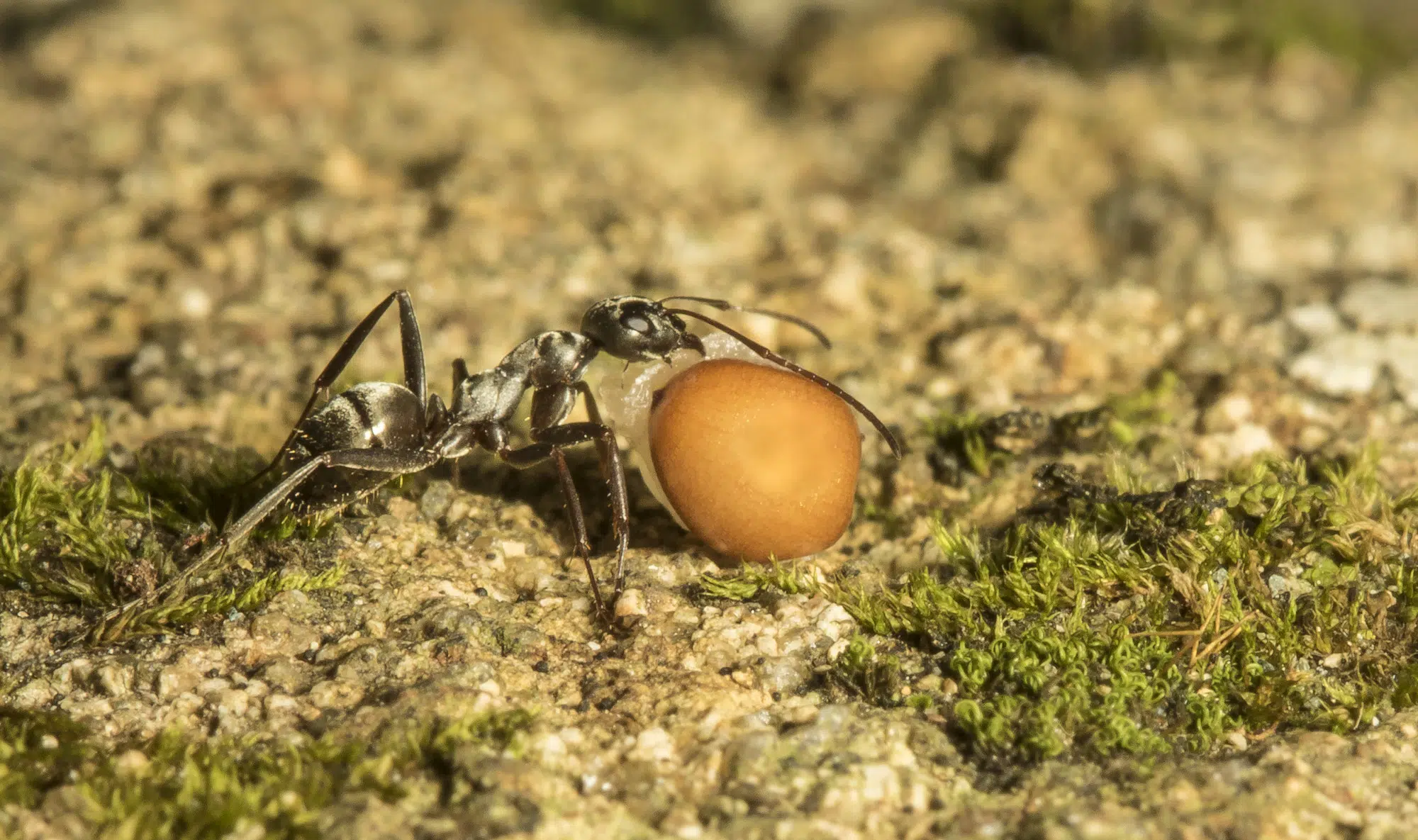
Five years ago, **Hugo Deans**, son of the entomology professor **Andrew Deans** (Penn State), found what he believed to be seeds next to an ant nest. His father quickly identified them as **oak galls**, plant structures induced by insects.
What he didn’t imagine was that those galls were part of an **intricate ecological network** involving **wasps, oaks, and ants**.
## Enlarged myrmecochory: more than seed dispersal
Wasps manipulate oaks and ants to protect their offspring.
The study, published in *American Naturalist*, describes a **complex form of myrmecochory**, where **wasps induce the formation of oak galls**, which are then **transported by ants to their nests**, providing **protection for wasp larvae**.
This interaction surpasses the classic model of myrmecochory, in which **ants [disperse seeds](https://noticiasambientales.com/medio-ambiente/las-plantas-y-su-estrategia-para-atraer-animales-que-dispersan-sus-semillas/)** in exchange for food.
“The wasps not only manipulate the oaks, but also manipulate the behavior of the ants,” explained Deans.
## Edible caps: the chemical lure that activates collaboration
**Ants respond to compounds similar to those found in dead insects.**
The galls have a **fleshy pale pink cap**, rich in **fatty acids similar to those found in dead insects**, the main food source for ants.
Experiments showed that ants **carry galls with caps**, but **reject those without caps**, treating them the same as seeds with **elaiosomes**.
“It is no coincidence that caps and elaiosomes share chemical compounds,” noted **John Tooker**, co-author of the study.
## Experimental evidence: recordings and chemical analysis
**The galls** were found inside the nests, without caps and in good condition.
The team confirmed the hypothesis by **documenting the behavior of the ants**, which **stored the galls in their nests** after consuming the caps.
Chemical analysis revealed the presence of **specific fatty acids**, explaining the attraction and transport.
## Evolutionary implications: Who manipulated whom first?
The abundance of galls may have shaped the behavior of **ants and myrmecochorous plants**.
Although it is not yet known which part of the system evolved first, researchers suggest that the **interaction between oaks and ants** could have **predisposed ants** to collect structures with edible appendages, later favoring the evolution of **myrmecochorous plants** such as **bloodroots**.
“Galls could have been a driving force of natural selection in ants,” proposed **Robert J. Warren II** from SUNY Buffalo.
A team of astronomers has unveiled intriguing findings while observing the stellar system CD-35 2722,…
The coastal dunes of California not only beautify the landscape but also play a vital…
Ecuador has taken a crucial step in the conservation of the Amazon by formally establishing…
Heavy metal pollution in schools in Peru threatens the health of thousands of students. These…
Chile takes a step forward in the protection of whales, facing the challenge of increasing…
Three 16-year-old students developed Plas-Stick, a biodegradable powder made from discarded tamarind seeds capable of…

