



Every cup of coffee consumed daily leaves a footprint. Not only in the daily routine, but also on the planet. The remains that end up in the trash now have a new destination: to become sustainable bricks that help reduce emissions and waste.
Researchers in Australia have developed an innovative technique to mix coffee grounds with clay and an alkaline activator, obtaining an ecological building material. The cooking process is done at only 200 °C, a much lower temperature than that required for traditional bricks.
This low temperature implies a drastic reduction in energy consumption. While conventional manufacturing emits large amounts of carbon dioxide, the new process can reduce these emissions by up to 80 %.
The result is not only greener but also stronger. The bricks exceed by double the minimum structural standards in Australia, demonstrating that sustainability and performance can go hand in hand.
 Coffee bricks are made from the remains of this same infusion.
From waste to input: a circular solution
The use of coffee waste in construction represents a concrete response to two environmental challenges: excess organic waste and high emissions from the building industry. By recycling about 10,000 tons of coffee grounds annually, their decomposition in landfills is avoided, where they would generate methane, a highly polluting gas.
This project, which is already preparing for commercialization with the company Green Brick, also redefines how materials are evaluated. Beyond the price, their traceability, impact, and contribution to a circular economy matter.
If applied on a large scale, this innovation can transform the way cities are built, with more efficient and less polluting processes. Besides, it can be easily adapted to contexts where coffee is a daily consumption, allowing local solutions with local resources.
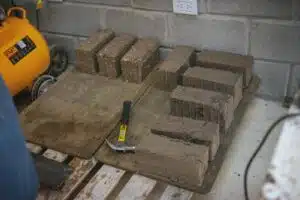 ecological bricks
Other ecological uses of coffee grounds
In addition to bricks, coffee waste has multiple ecological applications. In gardening, they are a natural fertilizer rich in nitrogen, ideal for compost or as a pest repellent. They can also be used as a base for producing bioplastics, ink, cosmetics, and even sustainable textiles.
In cleaning, coffee grounds act as a gentle exfoliant or abrasive for tough surfaces. They can also absorb odors in the refrigerator or footwear. These household and small-scale uses help reduce the amount of daily waste and make the most of an everyday resource.



