No to salmon farms in cages, as established by Provincial Law No. 1355
From the laboratories at the end of the world, the Argentinian scientific community has raised a resounding and unified voice against the installation of floating sea cage salmon farming projects, particularly in the pristine waters of Patagonia.
The warning is clear: “No to Salmon Farms”; this industry not only represents a serious threat of environmental contamination, but also falls far short of being a true source of genuine employment for local communities.

No to Salmon Farms: the alarming environmental cost: a fragile ecosystem at risk
Scientists, backed by research from the National Scientific and Technical Research Council (CONICET) and the Southern Center for Scientific Research (CADIC), have detailed with concern the multiple negative impacts that salmon farms have on delicate marine ecosystems.
One of the most critical points is the direct contamination of the waters. Fish feces, uneaten food residues, and the indiscriminate use of chemicals –such as antibiotics and anti-fouling agents for the cages– accumulate on the seabed, causing eutrophication (an excess of nutrients that alters the biological balance) and the consequent degradation of benthic ecosystems (those of the seabed).
Furthermore, there is an imminent concern about the transmission of diseases and parasites between farmed salmon and native species.
The most cited example is the sea louse, a parasite that proliferates in the dense populations of caged salmon and can decimate wild fish populations.
Another significant risk is the escape of farmed salmon, which, being non-native and often genetically modified, can compete with native species for food and habitat, disrupt food chains, and, in the worst-case scenarios, cause genetic contamination by interbreeding with wild populations.
The scientific community emphasizes that the dependence on antibiotics in massive salmon farming also contributes to the serious global problem of antimicrobial resistance, with implications for human and animal health.

Myths about employment and threats to local economies
Contrary to the “development and employment” narrative that often accompanies the promotion of salmon farming, experts categorically refute this promise, especially in the context of Tierra del Fuego.
They explain that the salmon industry is highly technified and automated, which translates into a minimal generation of genuine and quality job positions on a large scale for local residents.
The economic benefits, they warn, often end up concentrated in the hands of large corporations, many of which are of foreign origin, as has been the case in neighboring countries.
Beyond the scarcity of employment, the installation of these farms can have a direct detrimental impact on existing and sustainable economic activities in the region.
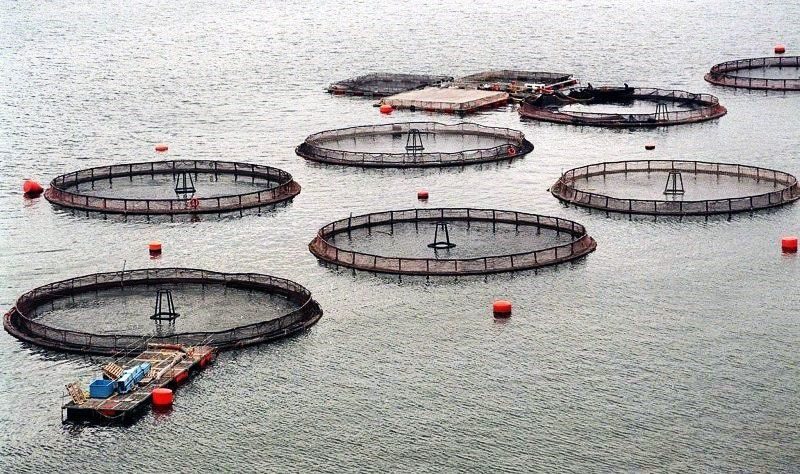 Salmon Farms[/caption>
The water contamination directly threatens artisanal fishing, an activity with deep cultural and economic roots in Patagonia.
Similarly, the alteration of the marine landscape and the potential environmental degradation seriously compromise tourism, a vital industry for the economy of Tierra del Fuego, which is based on the image of pristine and wild nature.
A warning with Chilean echoes: the need to protect the Patagonian identity
The concern of Argentinian scientists is not merely theoretical; it is based on the painful experience of countries like Chile, one of the largest producers of farmed salmon.
 salmon farms
The echoes of the environmental and social crises that salmon farming has faced in Chile, including massive disease outbreaks, widespread contaminations, and conflicts with local communities, resonate as a severe warning for Argentinian Patagonia.
Scientists emphasize that the Beagle Channel and the Fuegian fjords have unique oceanographic and ecological characteristics, making them particularly vulnerable to the negative externalities of an intensive industry like cage salmon farming.
The protection of these ecosystems is not only an environmental issue, but is intrinsically linked to the social and environmental sustainability of the region, and to the preservation of the identity and way of life of its inhabitants, for whom the sea and its resources are fundamental pillars.
Given this scenario, the scientific community advocates for the promotion of productive alternatives that are truly sustainable, such as responsible artisanal fishing, the development of nature tourism, and other forms of aquaculture that do not pose the same environmental risks, such as shellfish farming.
They acknowledge that if aquaculture is a path to explore, priority should be given to systems of high containment and recirculation (RAS), which, although more costly, drastically minimize the impact on natural water bodies.