



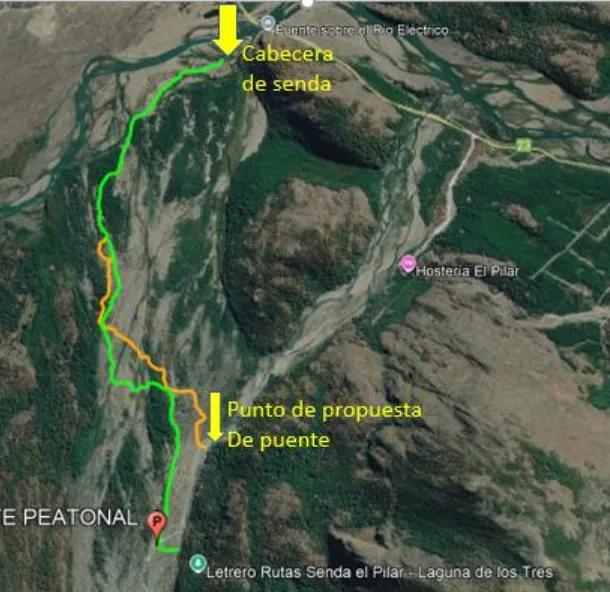
The federal judge Claudio Vázquez has decided to suspend the opening of a new trail in the Río Eléctrico area, within the Los Glaciares National Park, until the corresponding legal and environmental requirements are met.
The measure is a response to a protective action filed by residents of El Chaltén, concerned about the clearing of native forests and the lack of an Environmental Impact Assessment (EIA).
Tourism development vs. environmental conservation: a recurring conflict
The opening of the trail revives the debate on the balance between public use and ecosystem protection.
The controversy began in March 2025, when works to open a path in the Río Eléctrico valley started. Residents reported the cutting of young lenga trees and demanded explanations from the then president of the National Parks Administration (APN), Cristian Larsen, who was visiting the area.
The APN argued that the intervention was of low scale, within an area already designated for touristic use, and did not require an EIA. It also questioned the legitimacy of the protective actions, arguing that they did not suffer direct harm.
 This is how the new trail in Los Glaciares National Park looked like. Photo: AhoraCalafate
The judicial ruling: grounds and scope
The court considers that the APN acted arbitrarily and did not comply with current regulations
Judge Claudio Vázquez dismissed the APN’s arguments and ordered the immediate halt of the works, stating that:
- The Environmental Impact Assessment for the entire project was not submitted
- The necessary administrative authorizations were not obtained
- No citizen participation was ensured
- Safety and hygiene regulations were not followed
- There was intervention in an area protected by the Law 26.331 on native forests
- The Santa Cruz Environment Secretary did not receive any studies or requests
The ruling does not definitively prohibit the work, but demands that all legal and environmental procedures be followed before continuing. Additionally, any environmental restoration work has been deferred until a decision is made on whether the full route to Laguna de los Tres will be executed.
A key precedent for protected areas management
This ruling sets a significant precedent in terms of environmental protection, emphasizing that no project can start without meeting legal requirements.
It also highlights the active role of citizens in defending ecosystems, and the need for state and private entities to respect current regulations.
Citizen participation and environmental legality: pillars for sustainable development
The case of El Chaltén and the new trail in Los Glaciares National Park serves as a reminder that tourism must be planned with ecological and community criteria in mind.
The opening of trails in natural areas requires responsible planning, institutional transparency, and dialogue with local communities.
The protection of native forests, biodiversity, and the natural heritage cannot be subject to tourist interests without a rigorous assessment of their impacts.
Cover photo: Passporter



