



The Congo River, the second largest in the world after the Amazon and the deepest on the planet, is a vital artery that traverses Zambia, Democratic Republic of the Congo, Republic of the Congo, and Angola.
Its constant flow, fed by rains from both hemispheres, makes it a unique ecosystem, full of biodiversity and cultural richness.
An indescribably immense river
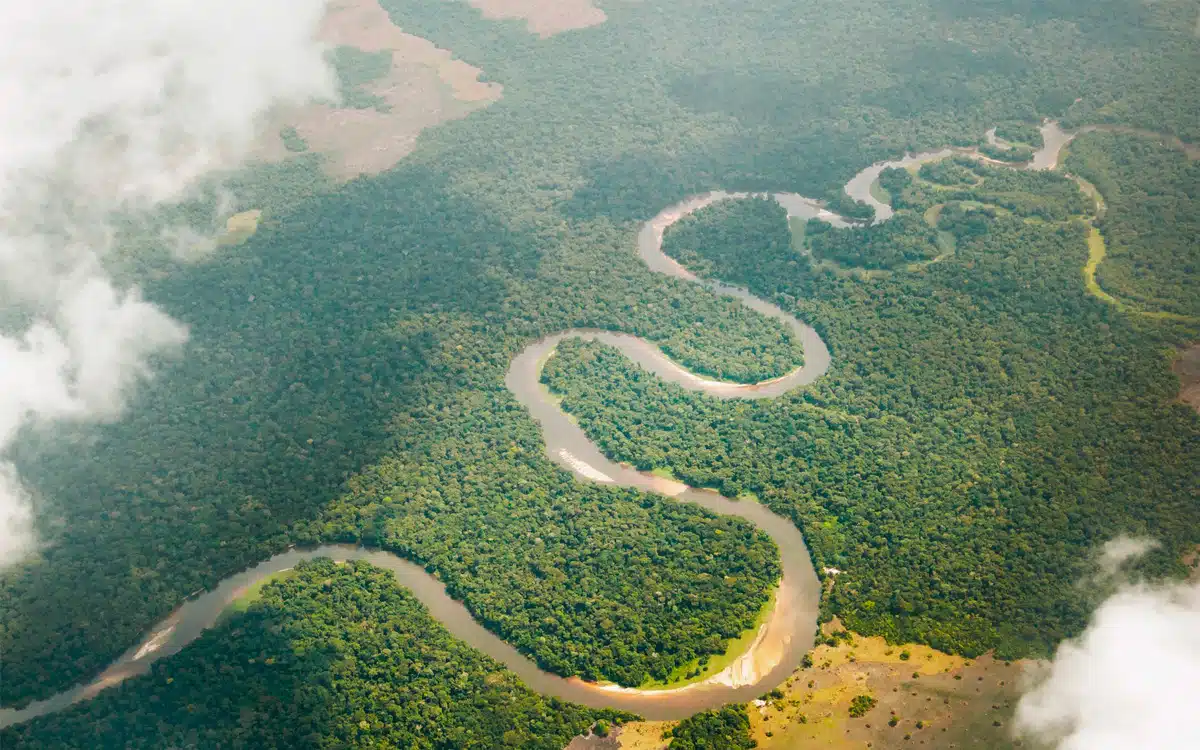
Discovered by Europeans in 1482, the Congo stands as a constant sensation of grandeur. Its reddish waters, laden with dissolved earth, even carry entire islands with palm trees, floating towards the rapids that flow into the Livingstone Falls, visible from Kinshasa by the steam rising into the sky.
The experience of contemplating the river is overwhelming: at sunset, its waters change color, shifting from bluish-gray to pink, while the banks are tinged with tropical shadows. It is a natural spectacle that conveys both majesty and enigma.
The deepest river in the world
The Congo holds the title of the deepest river on the planet, with whirlpools that intimidate even the most experienced navigators. Its waters hide an extraordinary biological wealth:
- Nearly 700 species of continental fish.
- 80% endemic, unique in the world.
- Species adapted to extreme conditions, capable of surviving buried in silt during the dry season or in environments with very little oxygen.
This mosaic of micro-habitats makes the Congo a natural laboratory of evolution and resilience.
Reddish waters and living culture
The reddish hue of its waters, similar to dissolved brick, permeates daily life. The river’s sand blocks, used to build houses, acquire a pink color reminiscent of the inside of the shells that abound on its banks. These shells, once used as currency — the cowries — now form part of local art and crafts.
The river is not just nature: it is also history and culture, a space where life flows with the same force as its waters.
The Congo and its people
Life around the river is marked by constant interaction with the water. On the banks, women wash clothes, search for gold, or cultivate small subsistence gardens. Their colorful pagnes shine like flowers in contrast to the greenery of the riverbank.
However, potable water remains a challenge. In markets and paths, children are seen carrying deformed bottles, while abandoned plastics bury streams. The Congo is abundance and scarcity at the same time: water is everything, and it is nothing.
A river of titles and contrasts
The Congo is:
- The second largest river in the world in basin area, after the Amazon.
- The second longest in Africa, after the Nile.
- The deepest on the planet, with areas exceeding 220 meters.
Its course is complex, full of rapids and waterfalls, but it also offers stretches of calm that resemble lakes. Finally, it flows into the Atlantic Ocean, drawing a plume of land over the water that extends for dozens of kilometers, a natural spectacle of epic proportions.
The Congo River, origin and destination
The Congo River is more than a watercourse: it is a symbol of the origin and expansion of life, a space where nature, culture, and humanity intertwine.
Its endemic biodiversity, unparalleled depth, and historical role make it one of the most fascinating and essential rivers on the planet.



