



The Ischigualasto Provincial Park, in San Juan, Argentina, popularly known as “Valley of the Moon”, celebrates an increase in visitors after becoming the setting for the global launch of Coldplay’s latest album.
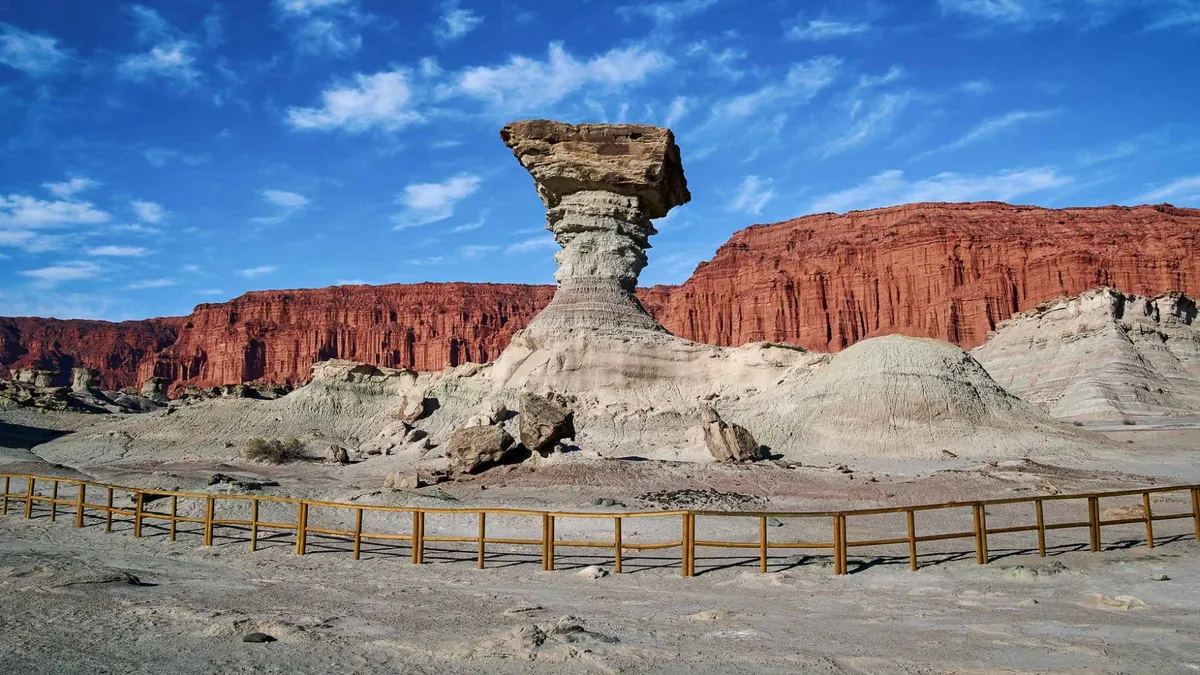
The British band chose the emblematic geoform of the Mushroom to perform a mapping during the presentation of Moon Music, which drew international attention to this site declared a UNESCO World Heritage Site.
History and fossil discovery
Before its paleontological value was revealed, locals already recognized the uniqueness of the place. In the small town of Baldecitos, the guide Victorino Herrera was key to the discovery that would change the park’s history.
In 1959, a team from the National University of Tucumán, funded by the newly created CONICET, arrived in Ischigualasto in search of fossils. Herrera guided them to the remains of a primitive dinosaur, named in his honor as Herrerasaurus ischigualastensis, which inhabited these lands 231 million years ago.
“The dinosaurs we find here are all more or less similar to each other because they are among the first that existed,” explains researcher Colombi, highlighting the importance of this unique record of the Triassic Period.
A park of monumental scale
Ischigualasto Park spans 63,000 hectares, equivalent to three times the city of Buenos Aires. About 90 people work there, and in 2024 it received more than 120,000 visitors, establishing itself as one of the main paleontological and tourist destinations in Argentina.
The formation of the Andes Mountains not only exposed the fossils but also transformed the region’s climate, blocking the humid winds from the Pacific and creating a mountain shadow desert.
“Tourists believe there is little life, but there are many endemic species adapted to high temperatures, solar radiation, and scarce precipitation,” notes Stella Maris Giannoni, a CONICET researcher.
Paleontological and scientific value
Ischigualasto Park is considered a unique and almost complete record of the Triassic Period, making it a natural laboratory for studying the origin of dinosaurs and the first mammals.
- Triassic Record: continuous sequence of the three sub-periods (upper, middle, and lower).
- Evolution of life: fossils illustrating the transition of the first vertebrates.
- Fossil deposits: abundance of remains that allow the reconstruction of paleoenvironments.
Worldwide recognition
- World Heritage: declared by UNESCO in 2000 for its exceptional universal value.
- Protected Area: recognized by the Government of San Juan in 1971, mainly for its paleontological value.
Geological and scenic beauty
The desert landscape of Ischigualasto, with its eroded formations and changing colors, has earned it the nickname “Valley of the Moon”. Among its most emblematic geoforms are:
- The Mushroom: symbol of the park and scene of Coldplay’s mapping.
- Erosive formations: unique natural sculptures created by the action of wind and water.
Current challenges
The discovery of fossils is a race against time and erosion, which threatens to destroy key pieces of life’s history. Added to this is the underfunding of scientific research in Argentina, which hinders the continuity of paleontological projects.
Climate change also poses a risk, altering ecosystems and accelerating erosive processes that endanger both fossils and endemic biodiversity.
The Ischigualasto Park is much more than a tourist attraction: it is a unique testimony to the origin of dinosaurs and the first mammals, a desert landscape of incomparable beauty, and a symbol of Argentine science.
Its international recognition and growing popularity make it an essential destination for those seeking to understand the history of the Earth. However, its future depends on the ability to preserve its fossils, protect its biodiversity, and sustain the scientific research that keeps it alive as one of the main Jurassic destinations on the planet.



