



Durante milenios, diversas culturas de South America used a construction material that became a symbol of resistance and versatility: bamboo. Its archaeological presence in homes, bridges, and shelters demonstrates that it was one of the most valued resources in seismic and humid areas.
Although for much of the 20th century it was associated with low-resource rural constructions, scientific research in recent decades has transformed that perception. Today, bamboo — and especially the species guadua angustifolia — is considered a star material in seismic engineering worldwide.
Colombia and guadua angustifolia
Colombia is the main exporter of guadua angustifolia, a native bamboo recognized for its great structural resistance.
Its weight-resistance ratio surpasses that of many conventional woods and, in some studies, has even been compared to steel in specific resistance.
The key to its seismic behavior
Guadua has an anatomical structure of extremely resistant longitudinal fibers. This characteristic, combined with its natural flexibility, allows constructions to absorb and dissipate seismic energy without collapsing.
Instead of breaking in a brittle manner, guadua structures tend to deform and recover their original position, reducing the risk of catastrophic failures.
Besides its technical performance, guadua offers unique environmental advantages:
- Grows quickly.
- Stores large amounts of carbon.
- Can be cultivated sustainably.
- Requires less energy for processing than steel or cement.
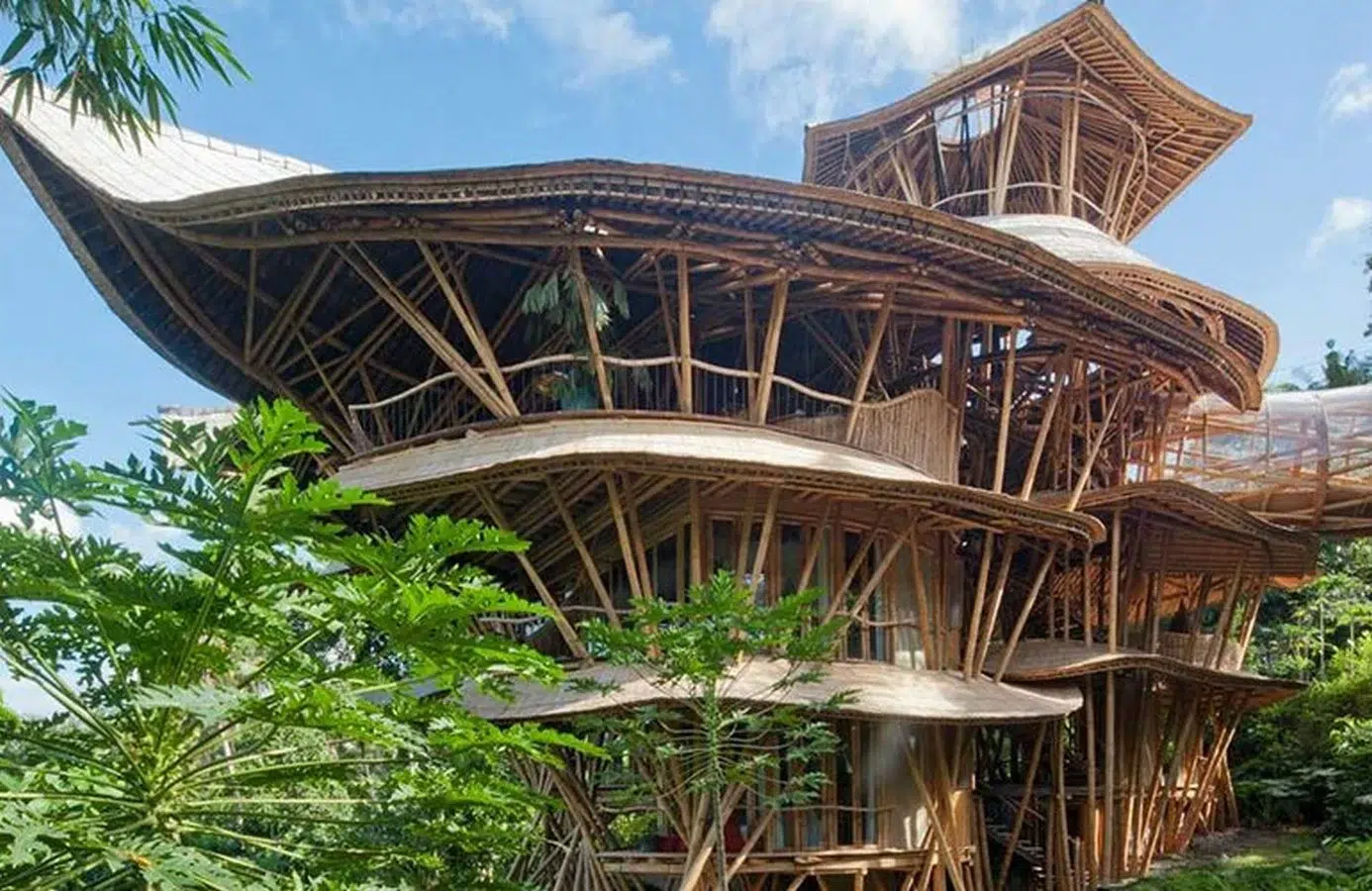
Modern advances and scientific validation
At the end of the 20th century, Colombian researchers — including architect Simón Vélez and teams from the National University of Colombia — developed standardized techniques that consolidated the potential of guadua:
- Secure metal joints.
- Preservative treatments against pests and moisture.
- Certified modular systems.
Thanks to these advances, guadua obtained formal certifications and began to be recognized as a suitable material for large-scale projects.
Experimental tests and seismic performance
In full-scale tests conducted in Japan and laboratories in South America, guadua constructions showed exceptional performance.
Complete structures withstood earthquake simulations equivalent to magnitudes greater than 7 without presenting serious structural failures. These results confirmed what ancestral communities already knew: guadua is a reliable material in earthquake-prone regions.
Pillar of contemporary bioarchitecture
Today, guadua has become a pillar of bioarchitecture and ecological construction strategies. Its use is expanding in seismic countries seeking safe, lightweight, and sustainable alternatives.
The combination of ancestral tradition, scientific validation, and proven performance in real earthquakes has transformed guadua into a contemporary reference for sustainable construction.
The guadua angustifolia has ceased to be seen as a rural material to become a global protagonist of seismic architecture. Its resistance, flexibility, and environmental benefits position it as a strategic alternative to conventional materials, offering structural safety and sustainability in a world that demands innovative solutions to face the challenges of climate change and urbanization in seismic zones.


