



An exceptional spider web could transform the design of industrial materials of the future, according to a new study conducted by CONICET.
It is the web of the Australian slingshot spider (Asianopis subrufa), which showed unique properties combining high strength and reversible elasticity.
The discovery involved researchers from Argentina, Germany, and Australia and was published in PNAS, the official journal of the National Academy of Sciences of the United States.
There, for the first time, scientists managed to describe at a physical and microscopic level the materials of this type of spider web, which possesses an architecture not seen until now in any other spider species.
This particular spider web possesses extraordinary strength, resistance, and durability thanks to various physical and chemical processes.
Therefore, its study could open a new and wide range of new applications in the materials industry.

The web of the Australian slingshot spider, an inspiration for the materials industry
The web of this species presents a novel architecture that could revolutionize the manufacturing of artificial materials.
In particular, its radial threads have a core of two thick viscoelastic fibers and a sheath of thinner, more rigid folded fibers.
“We managed to understand the function and structure of the threads that support the sticky web, called radii,” said Martín Ramírez, a researcher at CONICET in the Arachnology Division of the Argentine Museum of Natural Sciences.
These radii are initially very elastic and become more resistant as they stretch.
Another surprising finding is that this spider species controls the elasticity of these radii at the time of their production.
It does so through stretching and relaxing movements with its hind legs.
“The more cycles applied, the more loops accumulate in the sheath and the more elastic the thread produced is,” Ramírez pointed out.
Moreover, the elasticity is reversible: the radii recover their original length when the tension is relaxed.
This spider species is the only one that constructs this type of composite fibers, making this discovery particularly relevant for materials science.
The applications of this spider web for material design
The effect observed in the studied spider web could be replicated in artificial fibrous materials.
The technique would consist of attaching rigid micro or nanofibers to stretched elastomers, producing the formation of loops when the elastomer relaxes.
“This approach opens promising perspectives for material design,” added the Argentine researcher.
Currently, the microscopic structure of spider web threads is continuously studied to inspire a diversity of material designs, whether elastic, adhesive, deployable, or resistant fibers.
Possible industrial applications include:
- Artificial ligaments and tendons for medicine
- Innovative parachutes with greater safety
- Resistant fabrics for industrial and sports use
- Improved and more efficient surgical sutures
- New materials for sustainable construction
The potential of these spider webs to revolutionize the materials industry lies in their unique combination of mechanical properties.
The ability to be simultaneously elastic and resistant is difficult to achieve in conventional synthetic materials.
The Asianopis subrufa, a nocturnal hunter with a unique strategy
The Asianopis subrufa measures about 25 millimeters in body length, and its long legs span approximately 6 centimeters in total.
It has two huge eyes that are very sensitive in the dark, making it a highly efficient nocturnal hunter.
This spider inhabits Australia and New Zealand. It feeds on a variety of insects such as ants, beetles, crickets, and other spiders.
Its color ranges from tawny to pinkish brown or chocolate brown, and it poses no danger to humans.
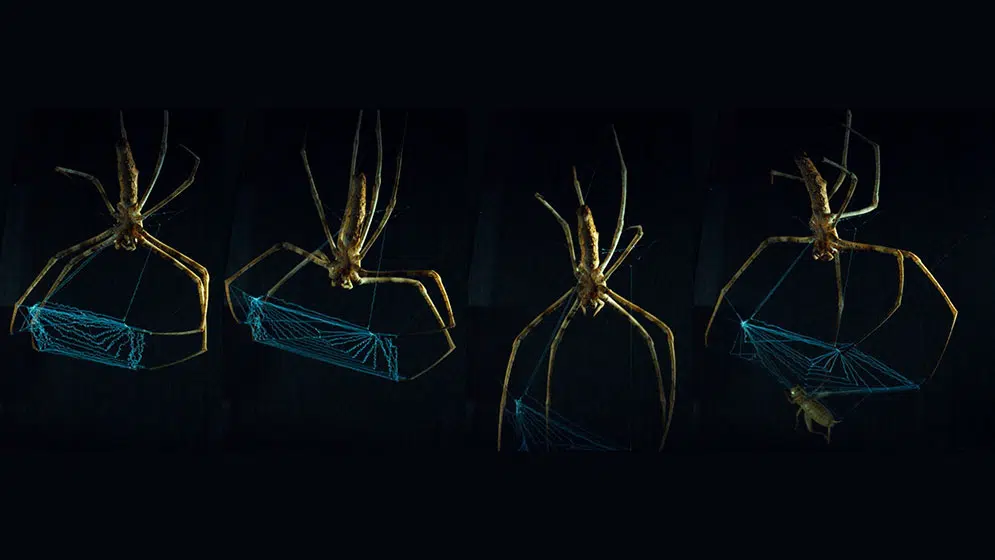
Like all spiders of the Deinopidae family, it weaves a special adhesive web that it holds between its legs.
Its frontal attack, visually controlled, consists of quickly lunging with the sticky web over an insect walking below.
The backward attack is triggered by vibrations in the frequency of wing flapping. It consists of expanding the web upwards and backward to catch a flying insect in mid-flight.
“The hunting maneuvers of these spiders require great elasticity, maneuverability, and resistance,” explained Ramírez.
The elastic and resistant radii are fundamental for the operation of the adhesive webs.
In addition to contributions in ecology, genetics, and evolution, the work can inspire industrial developments through biomimetics, a discipline that studies nature’s strategies to solve human problems.

International recognition for the study
A microscopic image of two exceptional silk threads of this spider, taken by Ramírez, won last December the 2025 Photography Competition of the Royal Society, the oldest scientific society in the United Kingdom.
This society included prominent figures such as Isaac Newton, Charles Darwin, Albert Einstein, and many other personalities of world science.
The image titled “Hypnotic Spider Threads” was taken with a scanning electron microscope.
It shows a close-up of 0.05 millimeters long of the silk of the Asianopis subrufa.
“When I was taking the images of the silk strands in our electron microscope at the Argentine Museum of Natural Sciences, I found myself facing a spectacular image,” recalled the scientist.
“I felt it was a beautiful, powerful, hypnotic image, and at the same time full of biological and physical meaning,” he added.
“It is a great honor to have been the winner of this prestigious competition,” concluded Ramírez, a doctor in Biological Sciences from UBA with a postdoctoral fellowship at the American Museum of Natural History in New York.
The research involved five working groups from institutes in Germany, Australia, and Argentina, led by Jonas Wolff and his team from the University of Greifswald in Germany.


