



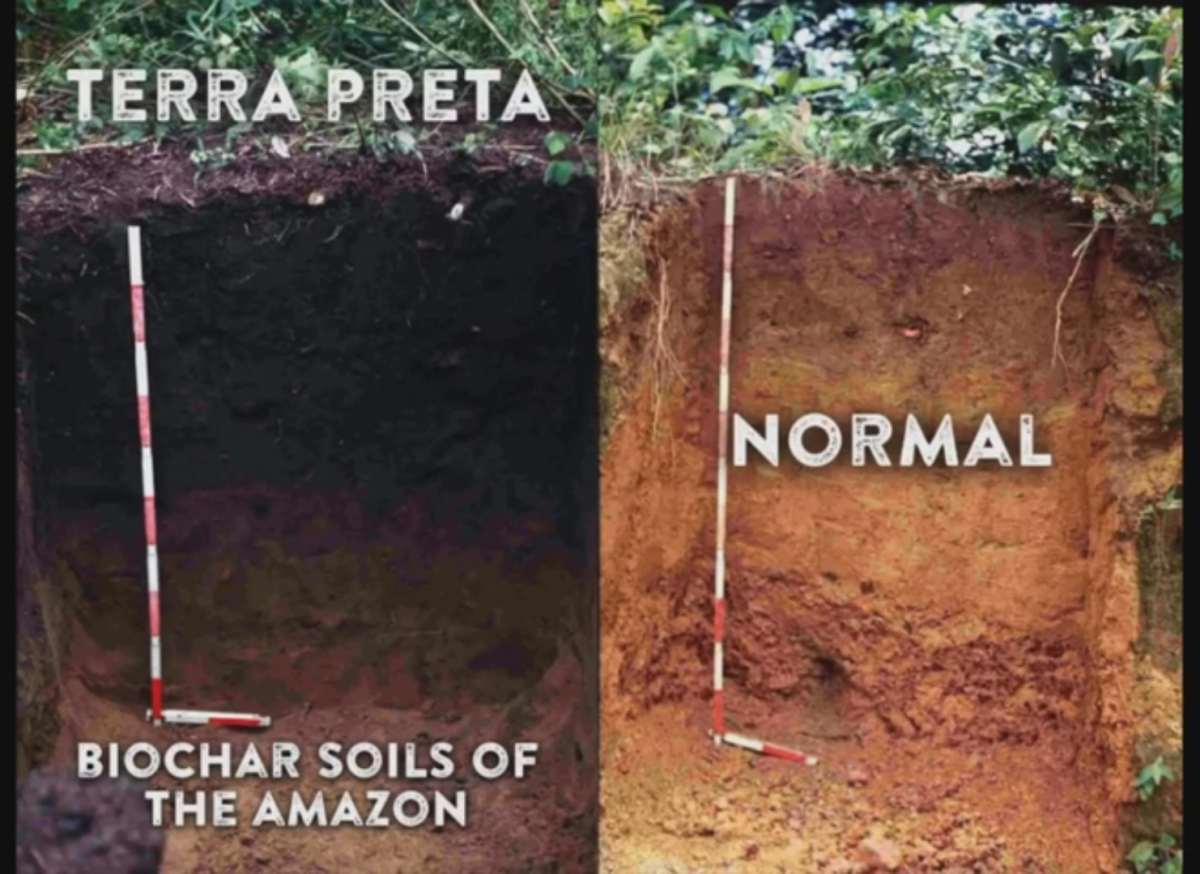
A study conducted in the Brazilian Amazon demonstrated that small doses of terra preta —the black soil created by indigenous communities centuries ago— can increase tree growth in degraded soils by up to 50%.
With less than a cup of this material, researchers observed significant improvements in forest regeneration, opening new perspectives for ecosystem restoration.
Origin and characteristics
The Amazonian terra preta is distinguished by its dark color, spongy texture, and nutrient richness. It was created by indigenous communities by mixing charcoal (biochar), food scraps, fish bones, and pottery fragments.
This soil has remained stable for centuries thanks to the action of charcoal, which retains water and nutrients and serves as a support for microbial communities.
The experiment
The study, coordinated by Tsai Siu Mui, tested the effect of small amounts of terra preta on degraded soils. The results were clear:
- Greater growth and survival in two tree species with different strategies.
- The slow-growing species benefited the most, showing that more vulnerable systems appreciate microbial support.
- The chemical effect was limited, confirming that the key lies in the microbial reprogramming of the soil.
Microbiome and restoration
Terra preta promotes the proliferation of beneficial fungi and bacteria, which reorganize life around the roots. This generates:
- Greater microbial diversity and recycling of organic matter.
- Better water retention and resistance to climate stress.
- Reduction of pathogens, decreasing diseases and mortality in critical stages.
- Emergence of organisms that act as natural biological control.
Interestingly, some nitrogen-fixing bacteria decreased, although the soil already contained more available nitrogen, raising questions about the sustainability of the balance in the long term.
Implications for reforestation
The study suggests that restoration cannot be uniform: each species and each context require specific strategies. Degraded soils could be the most recoverable if this approach is leveraged.
The key is to stop seeing the soil as a passive support and recognize it as a living system that determines the success of regeneration.
Ancestral technology, modern solutions
Terra preta is an indigenous ecological technology that modern science is just beginning to decipher. Researchers do not seek to extract this protected soil but to replicate its processes: identify microorganisms, induce balances, and apply biochar in combination with compost and local microorganisms.
This approach is already being explored in regenerative agriculture projects in Brazil and Africa, and it connects with European Union policies on soil health and carbon capture.
The research shows that the future of forest restoration may depend on looking back and learning from ancestral practices. The Amazonian terra preta is proof that indigenous observation and knowledge can offer lasting solutions to the climate crisis and soil degradation.


