



The Astronomical Observatory of Castel Gandolfo once again became the setting for a special day following the recent visit of Pope Leo XIV to the facilities located in the Italian town of Castelli Romani. There, the Pontiff toured the scientific center, shared a moment with researchers, and highlighted the value of the work developed by specialists dedicated to the study of the universe.
The activity marked the second visit of the Pope to the Vatican Observatory. During the meeting, he was received by Sister Raffaella Petrini, President of the Governorate of the Vatican City State, along with Archbishop Emilio Nappa and lawyer Giuseppe Puglisi-Alibrandi.
Additionally, the director of the Observatory, Jesuit Richard Anthony D’Souza, and Guy Consolmagno, current president of the Vatican Observatory Foundation, participated. After a brief prayer in the chapel of the complex, the Pontiff greeted the scientific, religious, and administrative staff working at the site.
The Astronomical Observatory of Castel Gandolfo is considered one of the most important scientific centers linked to the Vatican. Its history reflects decades of astronomical research and international cooperation aimed at studying the cosmos and various space phenomena.
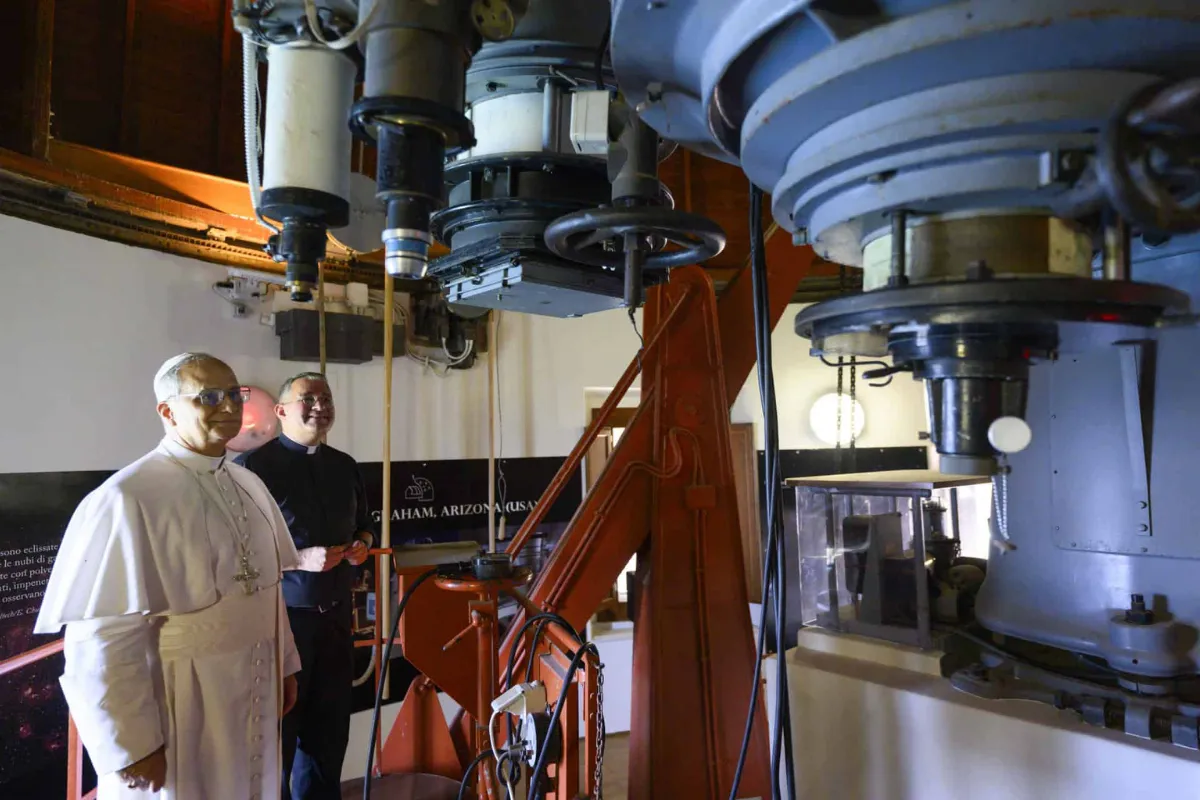
Astronomical research and deep space monitoring
The Castel Gandolfo facilities house equipment dedicated to astronomical observation and the analysis of celestial bodies. Research related to galaxies, stars, meteorites, and physical processes of the deep universe is conducted there.
Furthermore, the Observatory participates in international scientific projects that seek to understand the origin and evolution of the solar system. Specialists work together with universities and research centers from different countries to exchange information and expand knowledge about space.
Moreover, the institution also promotes educational programs and scientific outreach activities. In this way, the complex has become a bridge between astronomy, environmental education, and reflection on the place humanity occupies within the planet.
The presence of scientists, religious figures, and international experts allows for an interdisciplinary perspective on topics related to the universe, climate change, and the environmental future of the Earth.
The environmental and scientific functions of the observatory
The Vatican Observatory plays a significant role in the monitoring of astronomical phenomena that help to better understand the natural processes affecting the planet. Through the observation of solar behavior, cosmic radiation, and other space events, researchers obtain useful information for various scientific fields.
Additionally, these studies allow for a deeper understanding of the influence of space on terrestrial climate systems. The collection of astronomical data indirectly contributes to research related to atmospheric variations, solar activity, and global environmental changes.
On the other hand, the observatory promotes the preservation of scientific knowledge through historical archives, astronomical collections, and training programs for new generations of researchers. This task strengthens the development of a more accessible science connected to contemporary environmental challenges.
In turn, collaborative work between international scientific institutions fosters the creation of joint strategies to study phenomena impacting biodiversity, ecosystems, and the planet’s climate stability.
A scientific center that keeps the exploration of the universe alive
The recent visit of Leo XIV once again highlighted the role played by the Astronomical Observatory of Castel Gandolfo within global scientific research. In times marked by the climate crisis and the need to strengthen environmental knowledge, these spaces are gaining increasing importance.
While research on the universe and its phenomena continues, the observatory maintains its commitment to science, education, and international cooperation. From Italy, the complex continues to function as a meeting point between astronomy, technology, and environmental reflection.



