



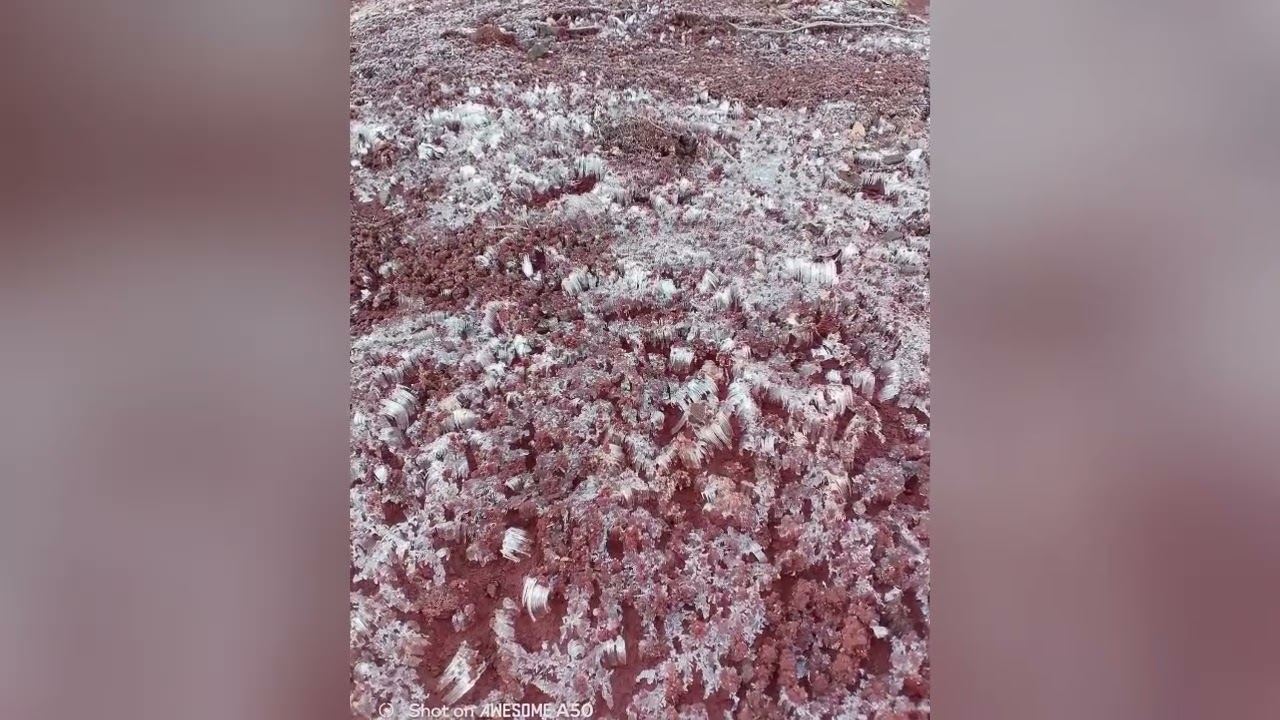
The intense polar wave affecting a large part of the country left an unusual scene in Misiones. Residents of Oberá and Leandro N. Alem recorded a natural phenomenon known as “ice needles” or pipkrake this Thursday. The delicate structures emerged from the ground, surprising residents and meteorology enthusiasts.
Images quickly circulated on social media, showing the fine ice columns protruding from the red earth, an uncommon spectacle in the region.
Necessary conditions for their formation
Agrometeorologist José Olinuck explained that pipkrake requires a very specific combination of factors:
- Air temperature: must drop below 0 °C.
- Soil temperature: remains just above the freezing point.
- High humidity: the ground must be saturated with water.
- Exposed surface: occurs in disturbed soils or without plant cover, such as plowed fields or low areas.
Subsoil water slowly rises by capillarity, overcoming the force of gravity. Upon contact with the cold air, it gradually freezes and forms ice needles that grow upwards.
Prone areas
Olinuck noted that in his meteorological station in Colonia Guaraní, favorable conditions for this phenomenon often occur, as it is a low area prone to intense frosts.
In general, pipkrake is observed in cold regions of the world, but its appearance in Misiones is infrequent, which explains the surprise and interest it sparked among residents and photographers.
Social and scientific impact
The phenomenon generated great repercussion on social media and local media:
- Residents shared photos and videos of the ice emerging from the ground.
- Weather enthusiasts took the opportunity to document a rare event in the province.
- Schools and educational media highlighted it as an example of how extreme weather conditions can produce curious natural phenomena.
This type of event also serves to disseminate science, bringing the population closer to concepts of physics and meteorology, such as capillarity, freezing, and the interaction between soil and atmosphere.
Relation to the polar wave
The appearance of pipkrake in Misiones is directly linked to the polar wave affecting a large part of the country. The extreme temperatures not only caused frosts and white landscapes in Patagonia and the center of the country but also generated unique phenomena in subtropical regions like Misiones.
The record of ice needles in Misiones constitutes one of the most striking images of the winter of 2026. Although it is a known meteorological phenomenon in cold climates, its appearance in the Misiones jungle makes it an exceptional event.
Beyond curiosity, this episode reinforces the importance of observing and understanding the natural processes that occur in our environment, even in extreme conditions.


