



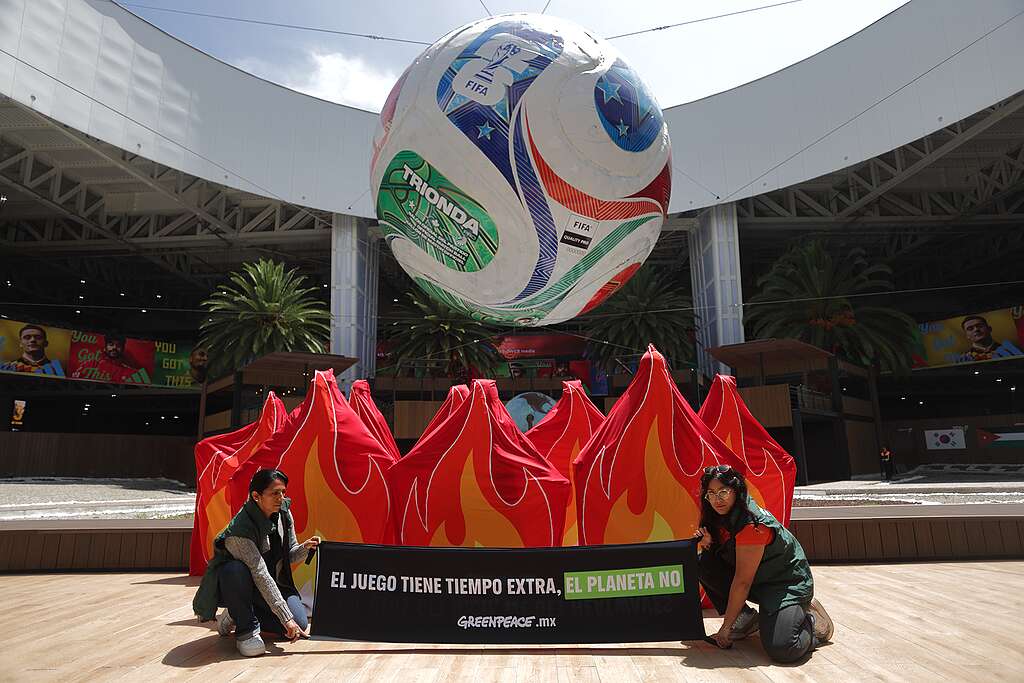
Activists from Greenpeace Mexico carried out an intervention at the Terminal 2 of the Mexico City International Airport (AICM) to highlight the impacts of climate change in the context of the 2026 World Cup.
Under the slogans “The game has extra time, the planet does not” and “If the climate changes, the game changes”, the organization sought to leverage the global attention of the 2026 World Cup to remind that the climate emergency is already altering our lives.
With a giant ball as the stage, the activists simulated flames representing extreme heat, attracting the attention of national and international travelers.
Messages and Demands
The action underscored the need for:
- Protection of marine and terrestrial ecosystems.
- Just and sustainable energy transition, without oil or fracking.
- Strong climate policies from the Mexican government.
Ornela Garelli, campaign director of Greenpeace Mexico, emphasized that climate change is no longer a future threat but a reality affecting millions of people with heatwaves, droughts, fires, floods, and extreme weather events.
Football Under Climate Pressure
The world’s most popular sport has also been forced to adapt:
- Mandatory hydration breaks in professional matches.
- Schedule modifications due to extreme temperatures.
- Suspensions due to lightning storms, such as the France-Iraq match interrupted for two hours.
The 2026 World Cup will be the first to implement hydration breaks in all matches, reflecting how the climate crisis even alters sports activities.
Impacts of the 2026 World Cup
The tournament, jointly organized by the United States, Mexico, and Canada, with 48 teams, could become the most polluting in football history:
Carbon Emissions and Transportation
- A record generation of 9 million tons of CO₂ equivalent is estimated.
- The vast North American distances will require millions of plane and ground transport trips, doubling the impact of previous editions.
Exposure to Extreme Heat
- Numerous matches are held in venues with temperatures exceeding 26 °C and up to 28 °C, increasing the risk of heat strokes.
- Intensive use of air conditioning in stadiums will be required, increasing energy consumption.
Sustainability Challenges
- Massive consumption of resources and waste generation.
- Sponsors linked to fossil fuels question the coherence of FIFA’s climate strategies.
- The unprecedented size of the event will test the response capacity of host cities.
Greenpeace Mexico’s action at the AICM is a reminder that the climate crisis affects all aspects of our lives, including football.
The 2026 World Cup, with its carbon footprint and associated risks, symbolizes the challenges of a planet that needs urgent and collective decisions. As the organization noted: “The game has extra time; the planet does not”.


