



Evolution does not always move in a straight line and, in some cases, takes circular forms. That is why a population of lizards from the western United States and northern Mexico has become key to science. There, competition does not eliminate rivals, but rather keeps them in balance.
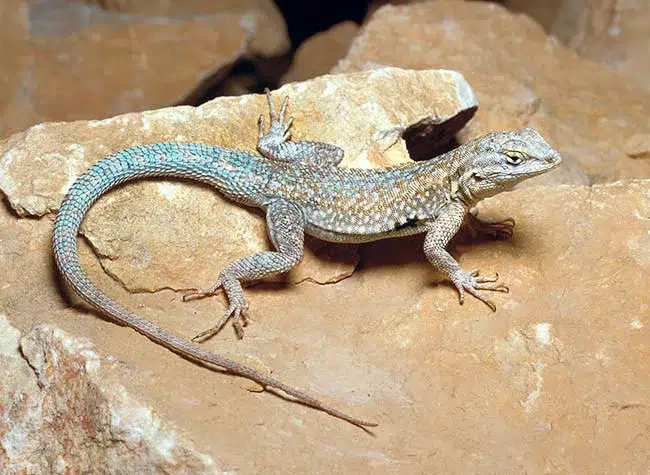
This phenomenon is observed in the side-blotched lizard, a species that defies the classical rules of dominance. Thus, natural selection does not reward a single winner.
Instead, it maintains multiple active strategies at the same time.
Thanks to this dynamic, the ecosystem sustains its genetic diversity. In this way, competition becomes a driver of stability. Nature, once again, avoids extremes.

Three strategies, one territory
The system is based on the coexistence of three types of males clearly differentiated. Each uses a different reproductive tactic to survive and reproduce. However, none is invincible.
The orange-throated males are the most aggressive and dominant. Therefore, they control large territories and watch over several females at the same time. However, that control has weaknesses.
The blue-throated males choose to defend smaller areas. Additionally, they establish stable bonds and actively protect their partners. This fidelity gives them advantages over certain rivals.
Meanwhile, the yellow-throated males use stealth. Thus, they mimic female behavior to infiltrate foreign territories. This strategy allows them to reproduce without direct confrontation.
A cycle without permanent winners
The relationship between these strategies functions as a circular game. In this scheme, the oranges overcome the blues through strength. However, that advantage does not last forever.
The blue males manage to stop the yellows thanks to their constant vigilance. In turn, the yellows take advantage of the oranges’ oversights. Thus, the cycle restarts over and over again.
When a tactic becomes dominant, another finds a way to displace it. Therefore, none prevails definitively. This continuous turnover sustains behavioral and genetic diversity.
A key model for evolutionary biology
This behavior has made the species an emblematic case study. In fact, it helps to understand how evolution can preserve diversity. The strongest does not always win, but rather the most balanced system.
Moreover, this model demonstrates that competition does not always reduce options. On the contrary, it can generate long-term coexistence. Thus, nature maintains multiple active solutions.
In a context of accelerated environmental changes, this balance becomes even more valuable. Therefore, understanding these mechanisms is key to conservation. Diversity is, in itself, a survival strategy.
The species and its conservation status
The side-blotched lizard (Uta stansburiana) inhabits arid and semi-arid areas of North America. It adapts to deserts, scrublands, and rocky areas with great thermal amplitude. This flexibility has allowed it to thrive for centuries.
Currently, the species is not endangered. However, habitat fragmentation and climate change pose increasing threats. Therefore, its stability is not guaranteed in the long term.
The loss of natural habitats can alter the delicate balance between strategies. If one disappears, the entire system weakens. Conserving this lizard also means protecting a living lesson in evolution and biodiversity.


