



The **tepezcuintle**, whose name comes from the Nahuatl **tepetl** (hill) and **itzcuintli** (dog), is a **large and elusive rodent**, [close to the capybara](https://noticiasambientales.com/animales/entre-rios-rescate-de-un-carpincho-en-diamante-destaca-el-trabajo-entre-comunidad-y-autoridades-ambientales/) in the genealogical tree of American fauna.
It lives in **burrows near water**, has **nocturnal and solitary habits**, and despite its peculiar beauty, it is little known.
Characteristics of the tepezcuintle
Its size varies between 60 and 80 centimeters in length, and it can weigh between 7 and 12 kilograms. In addition, it has a large head with **prominent cheeks, short ears, and a short, almost hairless tail**.
It lives in the vicinity of watercourses in **tropical forests**, from the **south of Mexico** and Central America, through Paraguay and the northeast of Argentina.
They play an [important role in seed dispersal](https://noticiasambientales.com/medio-ambiente/las-plantas-y-su-estrategia-para-atraer-animales-que-dispersan-sus-semillas/), contributing to the regeneration of forests.
The capybara conquers the world: plush toys, memes, and songs
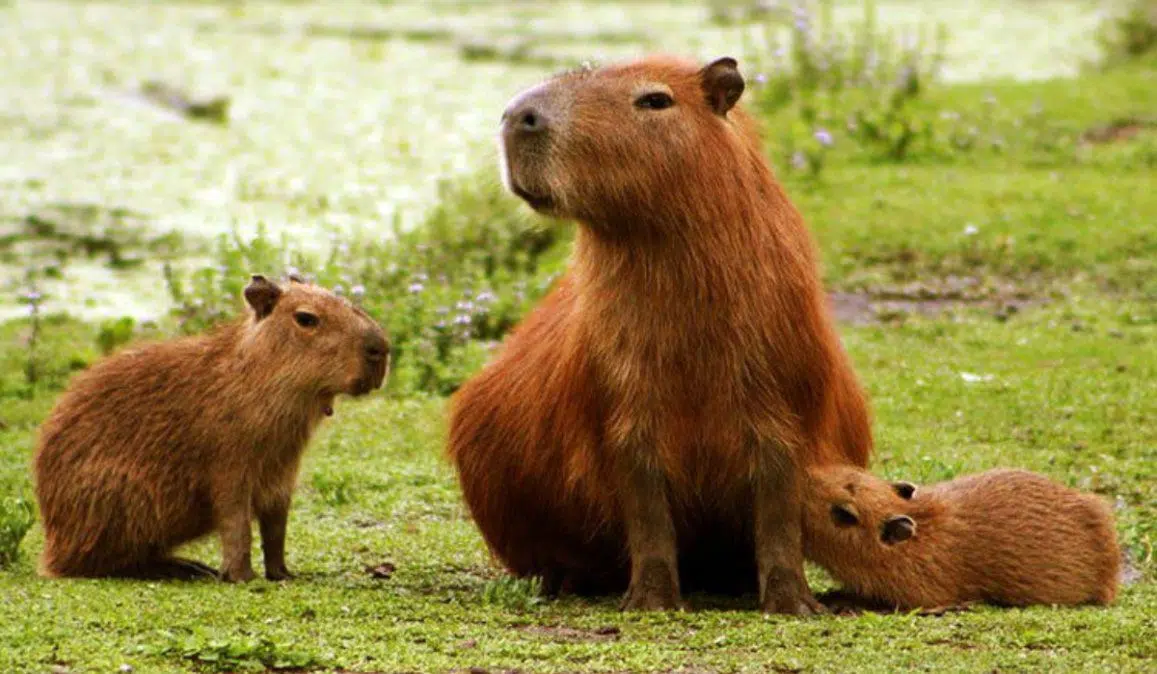
In recent years, the **capybara** has become a global celebrity. Without many knowing where it lives —or even having seen it— its presence multiplied in **video games, merchandising, songs, and memes**, gaining a place in the collective imagination.
Its image: **serene, calm, and surrounded by relatives**, has made it a symbol of relaxation, even facing **predators like lizards** with calm.
What is a capybara and where does it live?
The **capybara** is the **largest rodent on the planet**, with a length exceeding **one meter thirty**, **65 cm in height**, and **up to 65 kilos in weight**.
It lives in **South American wetlands**, from **Colombia to Argentina**, forming **social groups of 10 to 20 individuals**, led by a **dominant male**, although females also choose their mates. It has **webbed feet**, an adaptation that makes it a **great swimmer**.
Close relatives in Mexico: tepezcuintles and agoutis
In Mexico, although there are no current capybaras, there are their **biological relatives**. The **tepezcuintle** (Cuniculidae family) has brown fur with **dotted white lines** like a “little deer,” and lives in **burrows near water**, from Tamaulipas to Brazil. It weighs between **7 and 10 kilos**.
Other relatives are the **agoutis or agoutis**: smaller species, weighing between **2 and 4 kilos**, that sit like rabbits and have diurnal habits. The **Mexican agouti** is dark and lives in Veracruz, Oaxaca, Tabasco, and Chiapas. The **Central American agouti**, more reddish, is found from Mexico to Costa Rica. Both species are **heavily hunted** and are part of the **traditional peasant diet**.



