



On the southern coast of Santa Cruz, where the continent juts out into the Atlantic, the guanacos of Monte León National Park star in a story of movement, adaptation, and conservation.
Their migratory behavior was included in the World Atlas of Ungulate Migrations, coordinated by the UN Convention on the Conservation of Migratory Species, with participation from 92 scientists and conservationists worldwide.
Science in the field: technology and care to study wildlife
Satellite collars allow mapping movements and understanding migratory patterns.
The team from Rewilding Argentina, led by scientist Emiliano Donadío, placed GPS collars on wild guanacos, with batteries lasting three years. Each device records eight daily locations and sends the data every 24 hours to a web platform.
The procedure is supervised by veterinarians, who monitor vital signs and ensure the animals’ immediate recovery.
“Guanacos are true ecological engineers: they disperse seeds, regulate vegetation, and feed large predators,” highlights Donadío.
Partial and altitudinal migrations: a survival strategy
More than half of the guanacos move seasonally in and out of the park.
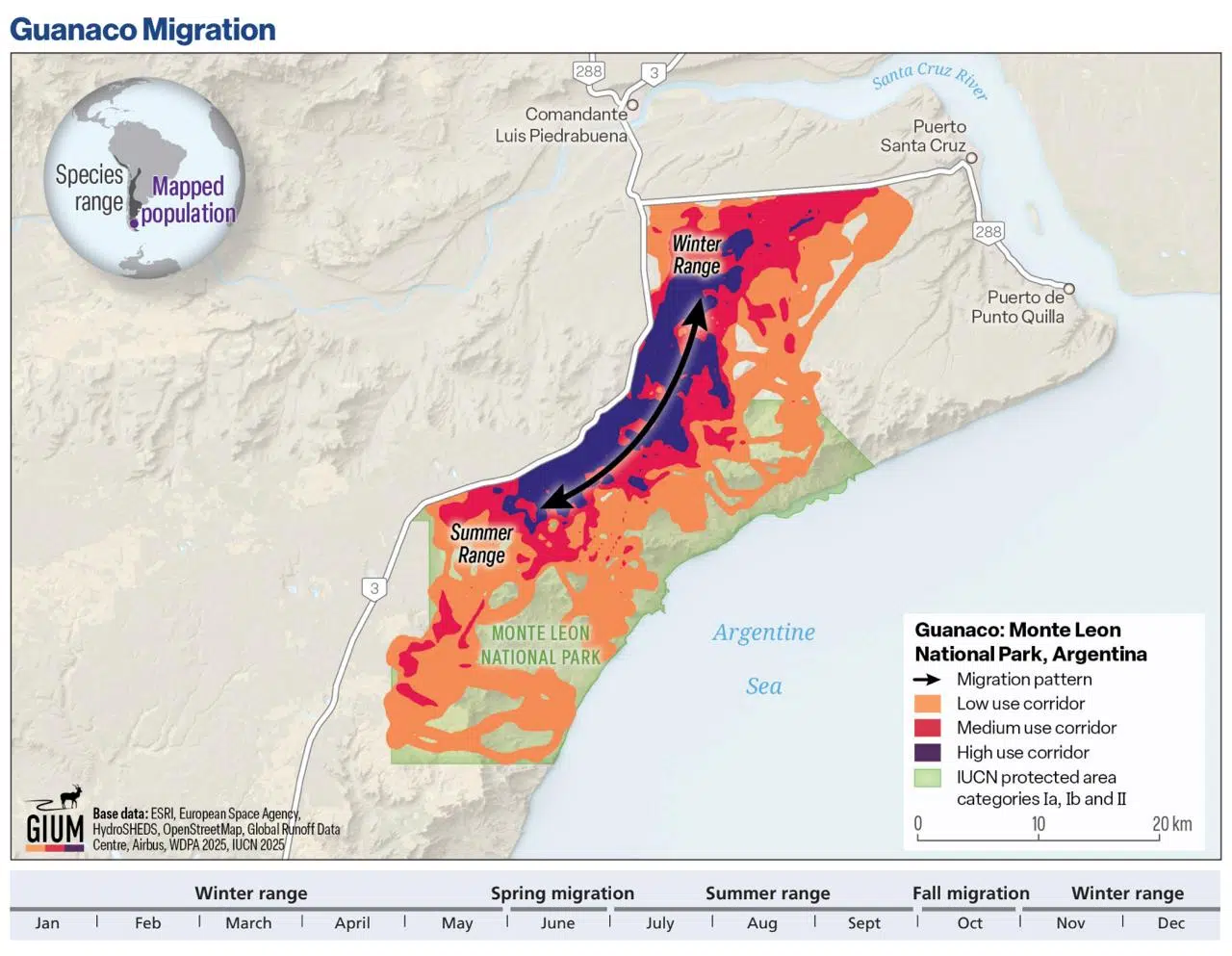
The study revealed that guanacos migrate from areas near the Santa Cruz River to higher areas in the south of Monte León National Park, where grasses turn green after winter.
In September and October, they make the reverse journey seeking climatic protection. However, not all migrate: about 50% remain in the same area year-round, which shows a diversity of ecological strategies.
Physical limits and conservation challenges
Protected areas do not always encompass key ecological processes.
“The wintering area is outside the park. That shows that often protected areas are not enough to conserve processes like migration,” warns Donadío.
Moreover, guanacos avoid crossing routes 3 and 288, unlike what happens in Patagonia Park with route 40. This behavior raises questions about the impact of road infrastructures on ecological connectivity.
Coexistence and territorial planning
Lands neighboring the park are key to conserving migration and promoting nature tourism.
Guanacos use private lands as wintering areas, highlighting the importance of working with rural landowners to foster coexistence. Nature tourism emerges as a viable tool to generate income and preserve wildlife.
“Conservation is a shared effort between the State, science, and local communities,” concludes Donadío.



