



The story of the carpinchos in Nordelta added a sad episode these days. It turns out that, according to the group “La Voz de los Carpinchos“, formed by neighborhood residents, they claim that in the last six months, 46 animals have died.
As they denounced through social media, among other issues, due to run-overs and new construction advances in their habitat. “It should be embarrassing,” they expressed.
“Embarrassment”: denunciation of capybara deaths and strong demand
“Saying that 46 capybaras died in 6 months should be embarrassing for those in charge of protecting them,” they stated in a recent post from the group’s social media.
“Evidently, not enough is being done or, rather, nothing to prevent this disaster. The latest deforestation literally left them on the street, and as an immediate response to this, the deaths and the request for ‘relocation’ to continue building everything appear,” they wrote.
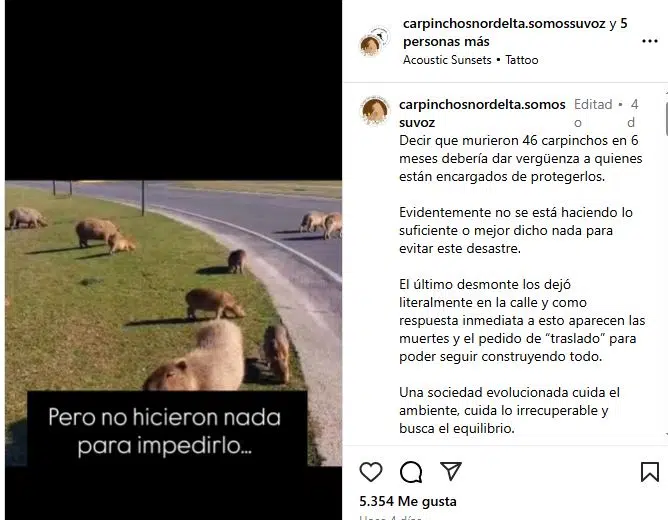 The social media post to demand. (Photo: Instagram- @carpinchosnordelta.somossuvoz).[/caption>
“An evolved society takes care of the environment, takes care of what is irrecoverable, and seeks balance. From THE VOICE OF THE CAPYBARAS, we want to express our sadness and concern because in that number, the drowned babies are not counted for not being able to get out of the lagoons, those who die of questionable death by wounds or who knows why,” they questioned in the same text.
“CARING FOR THE CAPYBARAS IS CARING FOR OUR FAUNA, EVERYONE’S FAUNA! That’s why we ask you to join us, so we are more every time,” they demanded at the end.
Capybaras in Nordelta: how the story began
It is worth remembering that capybaras are in the Nordelta neighborhood because it is their natural habitat. It was built on an area of wetlands of the Paraná Delta, which is the ecosystem typical of these rodents.
By urbanizing the area, natural spaces were fragmented, forcing the animals to move. The lack of natural predators in the urban environment of Nordelta, combined with the abundance of water and garden grass, created ideal conditions for their reproduction.
For this reason, the capybara population also grew considerably and began to interact more frequently with the inhabitants.
 What happens with the capybaras in Nordelta.[/caption>
The presence of these animals exposes the conflict between the advancement of urbanization and the conservation of native ecosystems.
Relocation, control, controversy, and an official measure that reopens the debate: the latest proposal
The future of the capybaras in Nordelta is back in the spotlight. After a meeting between the Secretary of Tourism, Environment, and Sports of the Nation and representatives of the Asociación Vecinal Nordelta (AVN), it was decided to move forward with a relocation plan to an island in the Paraná Delta.
The pilot test will involve the relocation of three capybara families, about 70 individuals, to a 60-hectare reserve. The costs of the operation will be covered by the AVN, which justified the measure by pointing out that in the first half of 2025 alone, 43 individuals were run over.
Moreover, the implementation of a population control program using contraceptive vaccines was announced, which will be applied with darts and managed with SENASA authorization. This less invasive alternative to capture aims to mitigate uncontrolled reproduction.
However, environmental organizations and animal rights defenders expressed their rejection of vaccination and relocation, warning about their possible consequences. The decision once again exposes the tension between urban development and wildlife conservation.



