



In the Drina River, in Bosnia and Herzegovina, tons of garbage create a new ecological disaster in the east of the nation.
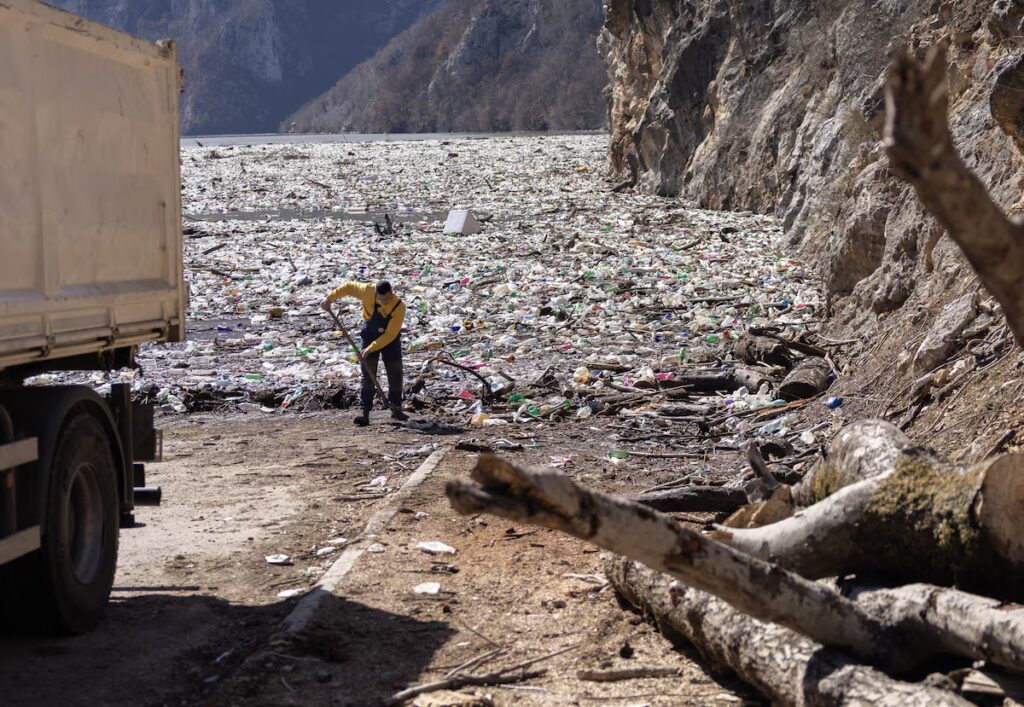
There, machines work tirelessly to remove the waste accumulated next to a hydroelectric plant in Visegrad.
The problem repeats every winter when rains wash away waste from illegal landfills in Bosnia, Serbia, and Montenegro.
In this process, the garbage accumulates downstream in the Drina, forming a thick layer of plastic, furniture, and appliances.
“This is a clear example of the lack of political will and inactivity of all competent institutions,” said Dejan Furtula, an activist who leads the environmental group Eko Centar.
“They meet year after year and make promises, but these scenes repeat themselves,” he added.

The garbage in the Drina River: a disaster caused by three countries
The waste comes from illegal landfills located upstream in Bosnia, Serbia, and Montenegro.
The phenomenon occurs because several smaller tributaries from across the region flow into the Drina River and add garbage to its pollution.
As a result, year after year, the emerald green surface of the Drina River is covered by a layer of garbage that includes plastic bottles, pieces of wood, rusty barrels, appliances, and even dead animals.
Additionally, Furtula claims there are also medical waste among the debris: “This is an ecological disaster,” stated the activist.
“The Drina River is rich in fish, and you can imagine the toxins released here from the garbage, there’s practically everything, it’s a great catastrophe,” he warned in an interview with Euronews.
The problem of garbage in the Drina River reaches its peak during the winter months, when swollen rivers sweep away the illegal landfills located on their banks.
In summer, these same rivers are frequented by rafting enthusiasts and nature lovers.
Unfulfilled promises and European aspirations at risk
The authorities of the three countries committed to working together to solve the problem.
Even though the Environment Ministers of Bosnia, Serbia, and Montenegro held a meeting on-site in 2019, years later no solution is in sight.
The situation illustrates how, decades after the devastating wars of the nineties in the former Yugoslavia, the region remains lagging behind the rest of Europe in terms of environmental protection.
For example, besides the pollution of rivers, many countries in the Western Balkans suffer from other environmental issues. One of them is the extremely high level of air pollution in several cities.
Despite this, Bosnia, Serbia, and Montenegro aspire to join the European Union, but the entity requires addressing environmental protection as a key condition for block membership.
In this regard, Furtula proposed several options to tackle the problem:
- Mapping the illegal landfills in the three countries
- Installing surveillance cameras in various municipalities
- Placing barriers to prevent all waste from reaching Visegrad
When removed from the river, the garbage ends up in the local landfill, where it burns slowly and releases toxic particles into the air. Furtula described this as a “vicious circle” that pollutes his city.
“It comes from three countries, Montenegro, Serbia, and Bosnia,” the activist noted about the garbage in the Drina River. “But no one wants to admit it’s theirs,” he concluded.



