



It’s no news that the cattle industry is responsible for a large part of the emissions of polluting gases worldwide, but what is new is the solution found by a group of scientists from the Polytechnic University of Valencia (UPV) and the Miguel Hernández University (UMH), along with the Livestock Beef Interprofessional Organization.
It is an “innovative composting protocol” aimed at reducing emissions of polluting gases and increasing the fertilizing value of cattle manure. According to the UPV statement, this protocol will help improve the environmental and economic sustainability of the Spanish livestock industry.
The educational institution added that the project arose as a necessity of the sector to improve efficiency and reduce the environmental footprint, a process that took about two and a half years to materialize.
After the research, the team of experts developed a method that allows optimizing the composition of compost piles and their management on farms, achieving a significant reduction in emissions and a higher concentration of nutrients in the final compost product. For this reason, the researchers ensure that it provides a double benefit: reducing environmental impact and increasing the value of compost as a natural fertilizer.
 Livestock is one of the industries that emits the most polluting gases.
The interdisciplinary approach was key to success
According to the teams of the different institutions, the success of the project lies in the multidisciplinary collaboration carried out in the two phases of the research. The first phase involved the characterization of manure from different cattle farms in Spain. This served to develop a calculation tool that allows farmers to reach the appropriate manure dosage in the field according to their needs.
Then, in the second phase, the team managed to design and validate the advanced composting protocol, with the application of monitoring and control systems in the laboratory, in addition to real tests carried out throughout Spain. The results validated the protocol as the “Best Available Technique” (BAT), as, due to its economic viability, it can be implemented on any farm.
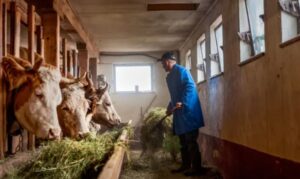 Livestock
The cattle industry, one of the largest greenhouse gas emitters
The cattle industry is one of the largest emitters of greenhouse gases worldwide due, mainly, to enteric fermentation. This natural process occurs during livestock digestion, especially in ruminants like cows and sheep, which release large amounts of methane, a gas with a much higher global warming potential than carbon dioxide.
Furthermore, livestock production requires extensive land areas for grazing and forage cultivation. This often involves deforestation, reducing the planet’s capacity to absorb CO₂ and further contributing to climate change. Deforestation also disturbs entire ecosystems, releasing carbon stored in soils and vegetation.
The intensive use of synthetic fertilizers and manure in crops destined for livestock generates nitrogen oxides, another potent greenhouse gas. Added to this is the energy used to transport animals, food, and derivative products, which further increases the sector’s environmental footprint.


