



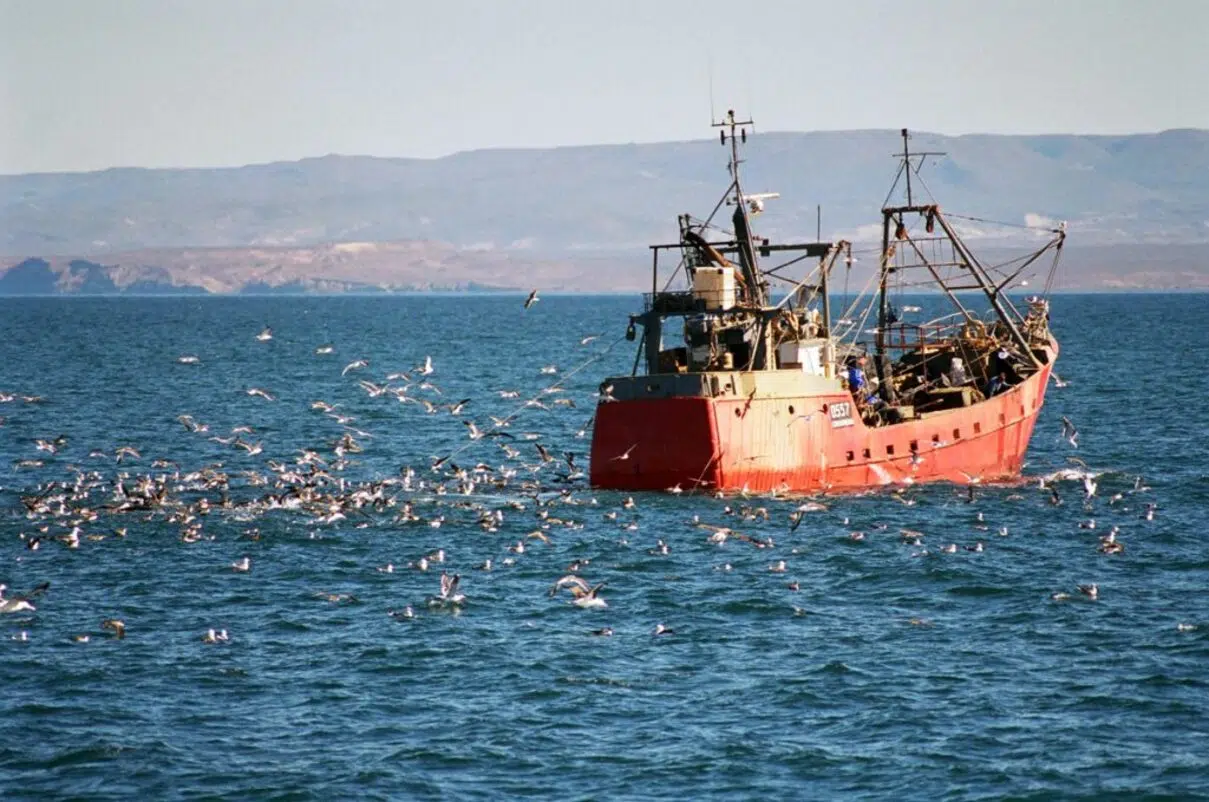
The incursions of foreign fishing vessels in the Argentine Sea, mainly from China, Taiwan, and South Korea, confirm a problem that repeats year after year. These industrial fleets operate intensively in the so-called Mile 201, just outside the Exclusive Economic Zone (EEZ), generating a significant environmental and economic impact.
Recent satellite images show true floating cities of large vessels, visible even from space, exerting increasing pressure on the fishing resources of the South Atlantic.
Mile 201 and the legal difficulty
The high seas are not under national sovereignty, which limits the control and sanction capabilities of coastal countries like Argentina.
- Within the EEZ, interventions by the Argentine Naval Prefecture (PNA) are usually effective.
- Outside the 200 miles, legal tools are practically nonexistent.
- Between 2019 and 2024, intensive fishing in that strip grew by 65%, increasing the pressure on migratory species like the Illex argentinus squid.
Ecological and economic impact
The squid, a key species in the South Atlantic trophic chain, supports predators like whales, dolphins, hake, and tuna. Its overexploitation can trigger a domino effect affecting both marine fauna and coastal communities that depend on these resources.
The economic losses are equally severe: illegal fishing generates an estimated loss of US$ 1 billion annually, equivalent to 30%–50% of what Argentina exports in the fishing sector.
Control actions and complaints
The Argentine Naval Prefecture uses advanced electronic platforms like the Coast Guard system to monitor incursions. In cases of illegal entry into the EEZ, warning shots and arrests are made, as happened with the Chinese vessel Hua Shun Yu 809 and the Vanuatu-flagged Bao Feng.
Additionally, international reports denounce slave labor, physical abuse, and labor abuses in these fleets, especially those of Chinese origin, adding a humanitarian dimension to the conflict.
The role of the High Seas Treaty
In this scenario, it is imperative to move towards stricter regulation of fishing in international waters. The full implementation of the United Nations High Seas Treaty appears as a key tool:
- Creation of marine protected areas.
- Requirement of environmental impact assessments.
- Establishment of a global protection framework for a maritime frontier that is currently too fragile.
Illegal fishing in the Argentine Sea is an environmental, economic, and sovereignty issue that demands urgent responses. The pressure on migratory species, the million-dollar losses, and the reports of labor abuses make Mile 201 a symbol of the fragility of the oceans in the face of uncontrolled exploitation.
The effective implementation of the High Seas Treaty and international cooperation are indispensable steps to ensure the sustainability of resources and the defense of national interests.



