



The telecommunications sector produces between 4.5 and 5 billion SIM cards per year. More than 50% of them become worthless after just one use (especially in travel). In turn, it generates more than 15,000 tons of plastic waste per year. This is why eco-friendly SIM cards are becoming increasingly significant.
Digital technologies solve this problem, and eSIM with global coverage is another step forward in reducing pollution. It lowers the PVC and chip modules manufacturing. It also reduces the packaging and transportation materials that companies use to deliver physical SIMs to retail stores.
What Is Eco-Friendly SIM?
Eco-Friendly SIM is a more environmentally friendly version of a traditional plastic SIM card, that is either smaller in size (half-cards like iSIM, nano-SIM need less plastic), or made of recycled or biodegradable plastic, or embedded into devices (eSIM with multiple digital profiles).
The eco-friendly SIM card is designed to reduce excess materials and use fewer harmful substances than traditional versions. It is intended to minimise environmental impact. There are two main categories.
1. Optimized physical SIMs
Initially, the SIM card size was 25×15 mm, but over time it became 12.3×8.8 mm, which is twice smaller. Manufacturers are also experimenting with recycled PVC. Some operators have reduced their usage of plastic by approximately a third. This is a positive change, but it doesn’t solve the problem.
2. Digital eSIM profiles
eSIM is a small built-in chip that contains one or several digital profiles. Its eUICC chip is soldered into the device straight at the factory. You don’t need to replace it, and it’s pretty much always thrown out with the device. There are no ongoing packaging, delivery, or similar operations. For people, this eliminates the necessity of constantly purchasing new cards before traveling or changing numbers. Removing a disposable physical object from the equation fundamentally solves the problem.
Marketing slogans and advertising claim that cards are harmless, but there are serious doubts about this. As for embedded SIMs, this is where we see a step forward in terms of environmental friendliness.
Environmental Impact of Traditional SIM
Even though we already know that a standard card is very small in size, it still leaves a pollution footprint. This is largely due to its production, distribution, and disposal.
What the Footprint is Made of
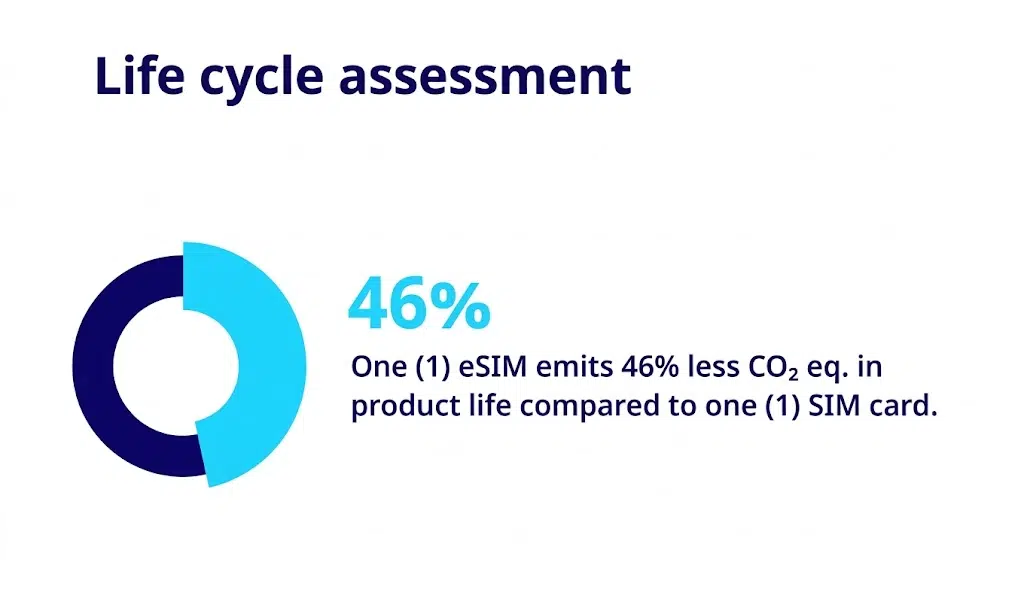
The standard version includes PVC or ABS and a built-in chip module with gold-plated contacts. The microchip unit is pressed and glued to the plastic during the lamination process, making recycling impossible. Disposal is challenging as the plastic, metals, and silicon require separation for sorting. Therefore, the greatest harm is caused not by the size of each unit, but rather by their volume, which, as we mentioned earlier, amounts to approximately 5 billion per year. Over its entire life cycle, a single SIM card generates 229 g of CO₂ emissions, which is 46% more than an eSIM, which generates 123 g of CO₂.
Distribution and Replacement
It requires individual blister packs, cardboard backing, and holders. All of this material goes to warehouses and then to retail stores around the world. These are huge distances for transportation by any means. Don’t forget that switching carriers or losing your SIM card creates demand for a new one. For a tourist who takes several trips a year, that’s at least three new cards. Multiply that by millions of travelers, and the amount quickly adds up. But digital SIM cards are radically different in this regard.
Eco-Friendly SIM – Manufacturing, Retail, and Travel
We may observe a fundamental contrast between digital and traditional variants if we track their entire lifecycle.
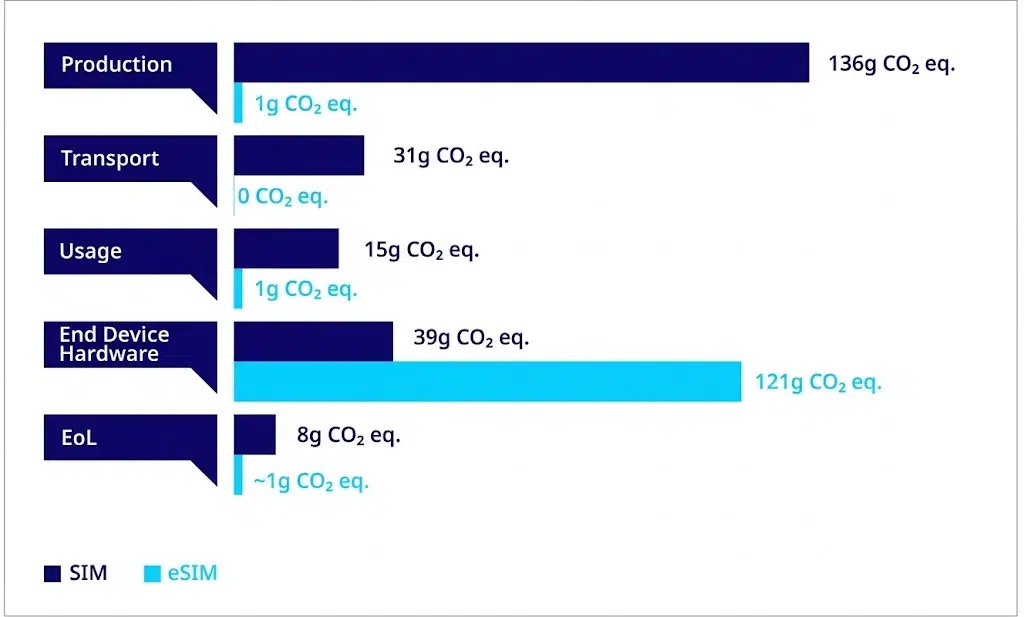
Source: https://embeddedcomputing.com/application/consumer/smartphones-and-wearables/sim-v-esim-a-study-on-environmentally-friendly-sim-solutions
Manufacturing: No physical SIM Unit Produced for Each Trip
The purchase of a standard SIM card immediately triggers a chain reaction and creates demand for a new detachable unit. It contains the following:
- PVC body.
- Chip module with connectors.
- Printed packaging and PIN materials.
We have already discussed how three trips mean producing three separate cards. When using eSIM, there is no need to purchase additional SIMs for each destination. It is because you download the profile to the built-in chip that is already in the device.
Distribution and Retail Impact of Eco-Friendly SIM
SIM logistics consists of:
- Individual packaging.
- Delivery to airports and retail stores.
- Warehousing and inventory tracking.
- Point-of-sale service by staff.
On the other hand, activating a digital SIM is simple. You just scan a QR code or install an app. There is absolutely no extra physical equipment needed. In other words, we completely eliminate the production and transportation stages.
Eco-Friendly SIM – Travel Example
Let’s take the example of a tourist who visits Japan, South Korea, Thailand, and Vietnam in one month. It immediately becomes clear that this person needs to buy four different physical cards. Each one comes in factory packaging and is thrown away after use. When loading an eSIM through a provider like Airalo, Holafly, or Ohayu (https://ohayu.com/), the user installs four profiles on the same built-in chip. So he can forget about plastic, air transport, and packaging waste.
Source: https://www.gi-de.com/en/group/press/press-releases/independent-study-by-fraunhofer-izm-for-g-d-confirms-esim-as-an-environmentally-friendly-sim-solution
Consequently, reducing emissions is achievable and has a significant impact. Yes, this doesn’t completely eliminate the harm caused by the telecommunications industry. Nevertheless, in this case, one component disappears entirely.
eSIM vs Physical SIM – Impact Comparison
| Impact Category | SIM | Embedded SIM |
| Plastic | Card, holder, and packaging | Almost absent |
| Carbon Impact | ~229 g CO₂ eq. per unit | ~123 g CO₂ eq. per unit |
| Production Impact Share | ~59% of total emissions | ~2% of total emissions |
| Transport & Logistics | Requires l delivery | Digital download |
| Lifecycle Waste | Must be disposed of | Minimal wastage |
| Annual Disposal Waste | 20,000 tonnes annually | Virtually zero |
What eSIM Does Not Solve
Switching to an embedded SIM helps to reduce pollution and logistics costs. Unfortunately, this will not make the mobile communications sector completely environmentally friendly, and here’s why.
- Network infrastructure consumes a significant amount of energy. Base stations, cell towers, and fibre optic backbone cables operate continuously.
- Data centres, which process traffic and store subscriber data, consume electricity.
- The environmental impact of device production remains the same. Phone production accounts for the majority of emissions over its lifecycle, and eSIM compatibility doesn’t change that.
These limitations are relevant to the context. Digital SIM addresses one specific waste stream, not the entire carbon footprint of the telecommunications industry.
How Travelers Can Reduce Connectivity Waste
Switching to an electronic identity subscriber module reduces individual trash, but you can further improve the entire process.
- Use an eSIM instead of purchasing temporary cards. This eliminates plastic and packaging for each trip.
- Reuse the same eSIM profile for multiple trips to the same country if the provider allows you to top up your account.
- Avoid SIM kiosks at airports if digital activation is available. These cards come in packaging and are shipped by mail.
- Before purchasing a new device, check its compatibility with a digital SIM.
When an Eco-Friendly SIM is Not an Option
Not all phones support embedded SIMs. Most older models and some budget devices don’t have a built-in chip. Furthermore, in some countries, a physical option is required in all circumstances. This concerns operators as well, as some haven’t yet switched to supporting and providing online services. Therefore, in such cases, try to reuse the standard solution, as this will slightly reduce the amount of rubbish.
Conclusion
SIMs require plastic production, chip manufacturing, and global logistics. Travel increases replacement frequency. Often, one trip equals one card.
Embedded SIMs eliminate this recurring waste stream. An independent life cycle assessment shows a reduction of 46% and 123g CO2e versus 229g for a physical card.
This does not make mobile networks carbon neutral. The energy of the infrastructure remains. But for travellers, an eco-friendly SIM card is currently the most practical way to reduce large-scale material consumption.



