



A team of Spanish students has developed **HelioCone**, an innovative system of **passive lighting** that is installed on the **facades of buildings** to **redirect natural light** towards interior spaces that lack windows or are far from them.
The project was presented at the **James Dyson Award**, one of the most prestigious design competitions internationally.
Inspiration from the library: how the idea was born
An everyday observation gave rise to a design that **combines art, physics, and functionality**.
“We saw how a white sign outside reflected sunlight and distributed it throughout the room, even in the most distant areas,” the students recount.
Based on that experience, the team —composed of **Andrea Carazo, John Alexander Bennett, Andrea Johana Curi Vásquez, Paula Carrasco, and Santiago García-Cubillana**— began working on an **efficient and sustainable solution** to improve natural lighting in educational and residential spaces.
Optical principle: internal reflection without moving parts
HelioCone uses angled surfaces to **capture and channel sunlight without the need for energy**.
The device is based on the phenomenon of **internal reflection**, which allows **maximizing the entry of sunlight** through a hemispherical structure composed of **five concentric cones**.
These cones, designed with **precise angles**, capture both **direct and diffused light**, even on **facades with low solar exposure**.
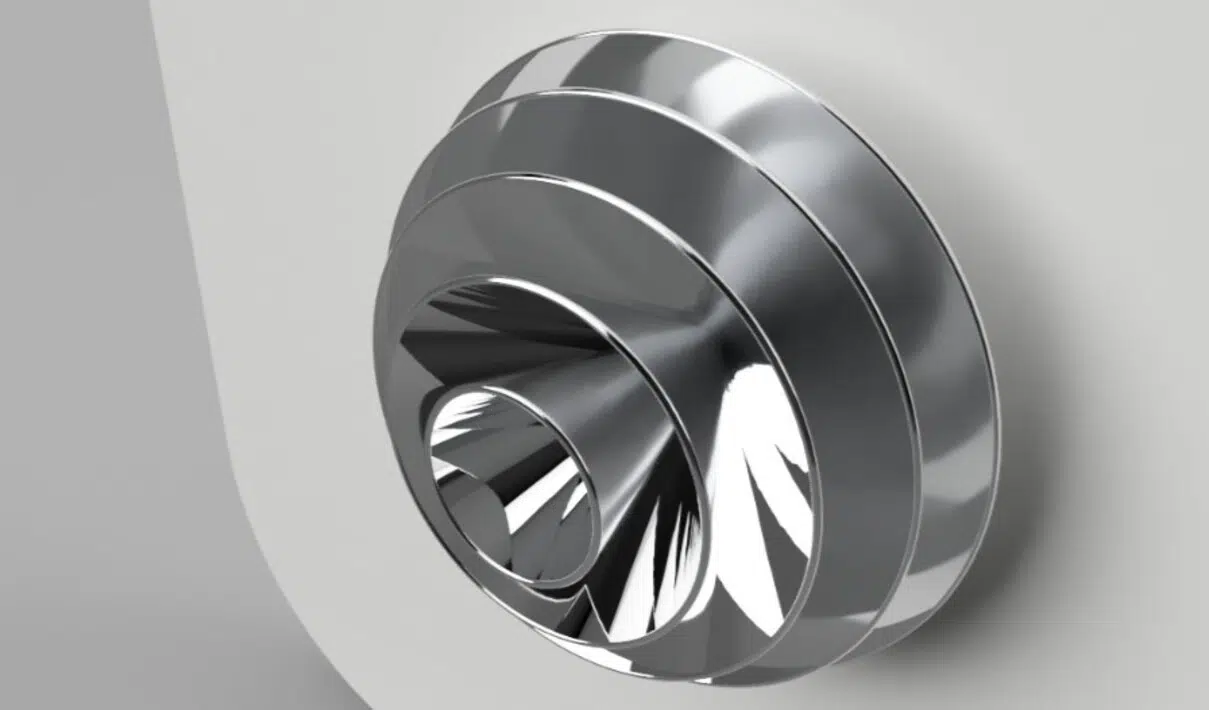 The design that allows for passive lighting
From facade to interior: optical fiber as a light channel
**The system transports natural lighting** from the outside to corridors, basements, or windowless rooms.
Once captured, the light is channeled through **optical fiber**, allowing its distribution to interior areas of the building. This technology offers a **sustainable alternative to artificial lighting**, reducing energy consumption and improving visual comfort.
Key differences compared to other solutions
**Optimized geometry and maintenance-free design** as competitive advantages.
Unlike other systems, HelioCone does not require **motors or moving components**, minimizing maintenance. Its **specific geometry** allows for **efficient collection of solar light**, even under low incidence conditions.
“It is an intersection of art, physics, and functionality, created to overcome the ordinary and redefine how light coexists in space,” affirm its creators.
Path to commercialization: prototypes and collaborations
The team is working on physical tests and seeking partnerships to apply the design in **sustainable housing**.
Currently, the students are focused on:
- Perfecting the optical geometry
- Conducting light measurements with physical prototypes
- Exploring collaborations with sustainable architecture initiatives
- Seeking funding to scale the project



