



A team from the Indian Institute of Technology Gandhinagar (IITGN) developed an advanced material from cow dung capable of capturing carbon dioxide with 58% more efficiency than previous versions.
The study proposes transforming an abundant organic waste into a sustainable, stable, and low-cost adsorbent, providing an innovative solution to the climate crisis.
Climate Context
Carbon capture, utilization, and storage (CCUS) is considered key to curbing global warming, especially in hard-to-decarbonize sectors like cement, steel, or aviation.
However, current technologies tend to be expensive, energy-intensive, and generate secondary waste. Therefore, the search for more efficient and less polluting solid materials has become a scientific priority.
The NDPC Material
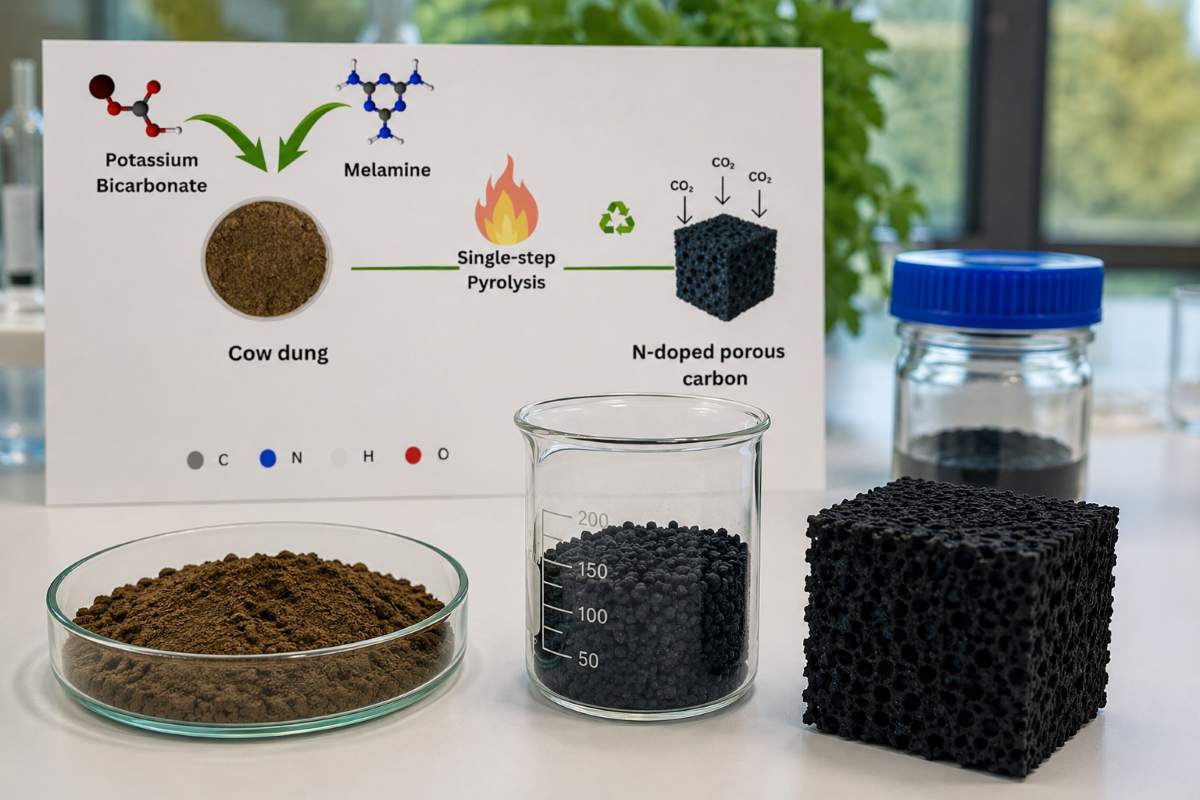
The Indian team created a nitrogen-doped porous carbon (NDPC) using:
- Cow dung.
- Melamine.
- Potassium bicarbonate as an activating agent.
The pyrolysis process (heating without oxygen) generated an ultra-porous structure with a specific surface area of 1,153 m² per gram, equivalent to several tennis courts in a single gram of material.
Highlighted Properties
- Greater chemical affinity: the incorporated nitrogen increases the capacity to trap CO₂ molecules.
- Less aggressive activation: the use of potassium bicarbonate reduces environmental risks compared to other corrosive compounds.
- Proven durability: maintained its performance after ten adsorption and desorption cycles.
- Low-temperature capture: reduces energy expenditure and climate footprint.
Potential Impact
This advancement opens the possibility of:
- Circular economy: transforming livestock waste into technological materials.
- Reduction of industrial emissions: applicable in sectors with high CO₂ emissions.
- Rural benefits: creation of industrial chains in countries with significant livestock activity (India, Brazil, United States, Europe).
- Environmental mitigation: reduces issues associated with dung, such as methane emissions, water pollution, and bad odors.
Computational Innovation
The study combined physical tests with advanced molecular simulations, accelerating the design of climate materials. This approach allows anticipating which structures will work best before manufacturing them, reducing research time and costs. Computational intelligence applied to sustainable materials is changing the pace of innovation.
Pending Challenges
- Large-scale validations.
- Real cost analysis.
- Comprehensive life cycle studies.
The research demonstrates how an agricultural waste can become a technological resource to tackle climate change. Cow dung, transformed into nitrogen-doped porous material, represents a step towards more sustainable and accessible solutions for carbon capture.
The circular economy ceases to be an abstract concept when an agricultural waste gains technological value and becomes a tool to reduce greenhouse gases.



