



A new nanofiber-based filter proposes to transform home ventilation, offices, and public spaces into an active tool against the excess of carbon dioxide in the atmosphere. The innovation takes advantage of a constant and already existing flow: the air circulating daily in buildings.
The proposal avoids large industrial plants and invasive works. Instead, it proposes a distributed capture, integrated into the current urban infrastructure, without changing habits or occupying new land.
The system was designed to be incorporated into conventional ventilation equipment, which opens the door to a gradual and massive implementation in cities around the world.
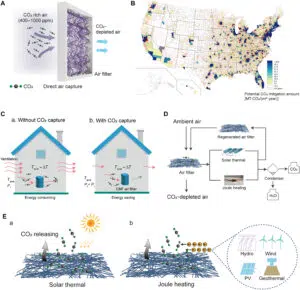
Direct capture, building by building
Unlike centralized carbon capture models, this approach decentralizes climate action. Each building becomes a small mitigation point, adding local impacts with global effects.
The estimated potential is significant. If these filters replaced the current ones in ventilation systems, they could remove up to 596 megatons of CO₂ per year, a figure comparable to removing millions of vehicles from circulation.
The strength of the model lies in its scalability. It can grow progressively, accompanying energy efficiency plans and building renovation, without relying on megaprojects.
Less emissions and lower energy consumption
CO₂ capture within buildings also reduces the need to incorporate outside air to maintain good indoor air quality. This decreases the demand for heating and cooling.
As a result, buildings could significantly reduce their energy consumption in climate control. Less energy used implies fewer associated emissions and lower operating costs.
Thus, the technology not only captures carbon but also avoids indirect emissions, reinforcing its positive environmental impact.
Durable materials and circular logic
The filter combines carbon nanofibers with reusable materials, designed to regenerate periodically instead of being discarded. This reduces waste and extends the system’s lifespan.
Regeneration can be integrated into urban waste management schemes, allowing the captured CO₂ to be recovered for storage or industrial reuse.
This approach reinforces a circular economy logic, where carbon capture does not generate new environmental liabilities.

Environmental benefits of this initiative
The main advantage is the direct and distributed reduction of atmospheric CO₂ without new infrastructures or high energy consumption. Each building contributes to climate mitigation from its daily operation.
It also reduces the pressure on energy systems and improves urban efficiency by decreasing the demand for climate control and associated emissions.
Additionally, improving indoor air quality benefits people’s health and well-being, generating a positive environmental and social impact at the same time.
A silent tool for climate transition
These filters propose a discreet but constant decarbonization, integrated into daily life. They do not require large individual gestures, but rather design and public policy decisions.
Combined with energy efficiency and air quality standards, they could become a new urban standard.
The central idea is simple: if CO₂ is everywhere, the solution can also be everywhere, even in something as common as a ventilation system.



