



Imagine you are in the Red Rock Canyon in Utah, or amidst the pine forests of the Rocky Mountains. The first light of dawn illuminates your tent; you rise from your sleeping bag and, with just the press of a button, you can prepare a cup of Italian coffee in this secluded corner away from the hustle and bustle of civilization, or charge your drone that filmed the starry sky the night before.
It is no longer science fiction, but the daily routine of every camper who carries a solar generator.
According to Statista data, in the United States alone, more than 40 million people venture into the wild each year. However, the most attractive campsites are often the most primitive: without power poles or outlets. For the ‘modern nomads‘ seeking extreme experiences, electricity not only means that the mobile phone doesn’t turn off, but also that they enjoy safety, comfort, and freedom.
Today we are going to delve into why portable power stations are completely transforming the outdoor lifestyle, and how, as a user, to choose the one that best suits your needs.
1. The power of silence: why stop using the gas generator?
If you’ve ever been awakened by the roar of a neighbor’s gas generator in the middle of a quiet forest, you’ll understand why solar generators are the light of civilization in the camping world.
1. Saying goodbye to decibel anxiety.
A traditional gas generator is essentially a small internal combustion engine that usually generates more than 70 decibels of noise during operation. In many national parks and state parks in the United States, authorities impose strict noise limits, typically requiring that the level not exceed 60 decibels throughout the day, and even prohibit the use of generators at night. In comparison, solar generators (like the PIFORZ series) have no pistons inside, do not generate additional mechanical noise beyond the fan, and operate at a noise level of only about 7 decibels — something similar to the sound of your breathing.
2. Breathing fresh air.
The carbon monoxide emitted by gas generators not only pollutes the environment but also poses a safety hazard. They are not suitable for use in enclosed spaces like tents or caravans. In contrast, solar generators produce no emissions and have no unpleasant odor; you can place them next to your pillow to power a CPAP machine without worrying about any health risks.
3. “Free” power supply.
Gasoline has to be purchased, stored, and carried on your shoulders. If it runs out in the middle of the desert, your equipment becomes a mere stone. In contrast, the solar generator can ‘recover’ itself just by receiving sunlight.
2. Discovering how a solar generator works: how does it work?

Although we call it a “generator“, it actually resembles more of an intelligent energy management center. A high-performance solar generation system is mainly composed of four key components:
Solar panels:
It is the ‘capturer’ of the system, responsible for capturing photons and converting them into primary electric current.
Battery system:
This is the central energy storage unit. Currently, the industry standard has fully focused on lithium iron phosphate (LiFePO4) batteries. Compared to old lead-acid batteries or conventional lithium batteries, lithium iron phosphate ones offer a lifespan of more than 3500 cycles and remain stable and safe even under extreme temperature conditions.
Charge controller (MPPT):
It is the brain of the system. MPPT (Maximum Power Point Tracking) technology allows real-time monitoring of the solar panels’ voltage, ensuring that the maximum energy per watt is extracted even on cloudy days or with low sunlight.
Pure sine wave inverter:
This is the most neglected part: it converts the direct current (DC) from the battery into a stable alternating current (AC). PIFORZ insists on using pure sine wave inverters, as only this way can it be ensured that your expensive laptop or precise medical equipment is not damaged due to voltage fluctuations.
3. Selection guide: your camping style defines your capacity
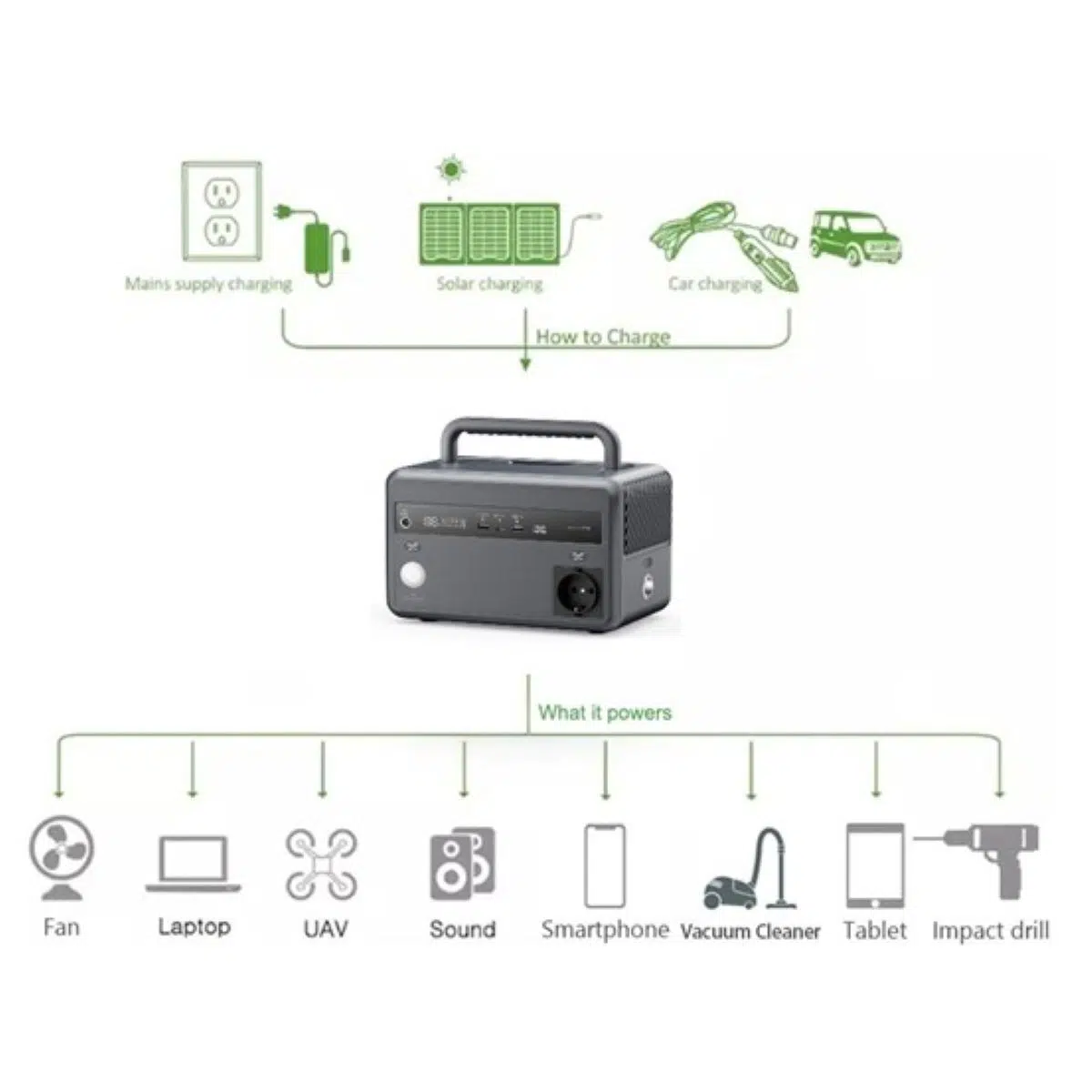
Many people feel lost when choosing between 500 Wh and 2000 Wh: buying more is too heavy, buying less is not enough. Let’s see how it is resolved according to the real case.
Scene A: Light tent camping over the weekend
- Target: mobile phones, tablets, LED camping lights, drones, and electric fans.
- Recommended capacity: 300 Wh – 600 Wh
This type of device is usually as light as a lunch box. You can easily take it out of the trunk and carry it inside the tent. Charge your iPhone more than 30 times or light up the camping light for several consecutive nights.
Scenario B: Advanced play / Car trip
- Target: car refrigerator, coffee maker, projector, and electric blanket.
- Recommended capacity: 1000 Wh – 1500 Wh
This is currently the most popular ‘golden capacity‘. If you take a portable refrigerator to the field, a 1000 Wh battery allows you to operate for more than 15 to 20 hours (with solar panels, the autonomy is unlimited). Imagine drinking a bottle of chilled Coca-Cola in the middle of the most desolate desert: that is the pleasure that technology offers you.
Scenario C: RV life / Long-term off-grid living
- Air conditioning, microwave, electric pot, and general lighting throughout the home.
- Recommended capacity: 2000 Wh or more (with expansion possibility).
For caravan enthusiasts, electricity is the lifeline. The high-capacity model from PIFORZ allows parallel expansion and can supply up to 2000-3000 W of power, allowing high-energy-consuming kitchen appliances to operate smoothly.
4. Industry details: Why does PIFORZ emphasize ‘real efficiency’?
We are often asked: “Why, with 1000 Wh, are there brands that are cheaper than yours?”
The answer is usually hidden in places you don’t see.
Conversion losses:
Inverters generate heat during operation, which represents an energy loss. Low-end brands may have an efficiency of only 70%, meaning that if the nominal capacity is 1000 Wh, you can actually only get 700 Wh. PIFORZ has managed to increase the conversion efficiency to more than 90% by optimizing the circuit design.
Wealth of interfaces:
Does it support 100 W fast charging? Are there enough AC outlets? Is wireless charging allowed? These details will determine whether you need to carry a large number of adapters.
5. Advanced techniques for using solar generators

To make your investment truly worthwhile, here are some tips from camping experts:
“Chasing the light” tactic:
Solar panels are not left unattended. Adjusting their angle every two hours to keep them perpendicular to the sun can increase the charging efficiency by more than 30%.
Charge first, then use.
It is advisable to charge high energy-consuming devices (like power banks and computers) during the day when there is more sunlight, to reduce inversion losses at night when drawing energy from the battery.
Temperature management:
Although batteries are designed for outdoor use, their performance decreases in extreme heat (above 45 °C) or intense cold (below -10 °C). It is recommended to place the device in a shaded area or inside a tent, and only expose the solar panels to the sun.
Pre-charge strategy:
Before leaving, make sure to fully charge the vehicle with household electric current. Solar panels mainly serve as a ‘range extender’ during the trip, and not as the sole energy source.
VI. Conclusion: For a cleaner starry sky
We love camping because we love nature in its most authentic state. Opting for a solar generator not only brings us comfort but is also a gesture of respect towards the environment: no oil stains on the grass, no emissions bothering the forest birds, and no noise breaking the night’s silence.
At PIFORZ, we not only manufacture power sources, but we also ‘recharge’ your freedom. Whether your next stop is the snow of Alaska or the forest of Idaho, take a solar generator with you and let electricity accompany you like the sun.



