



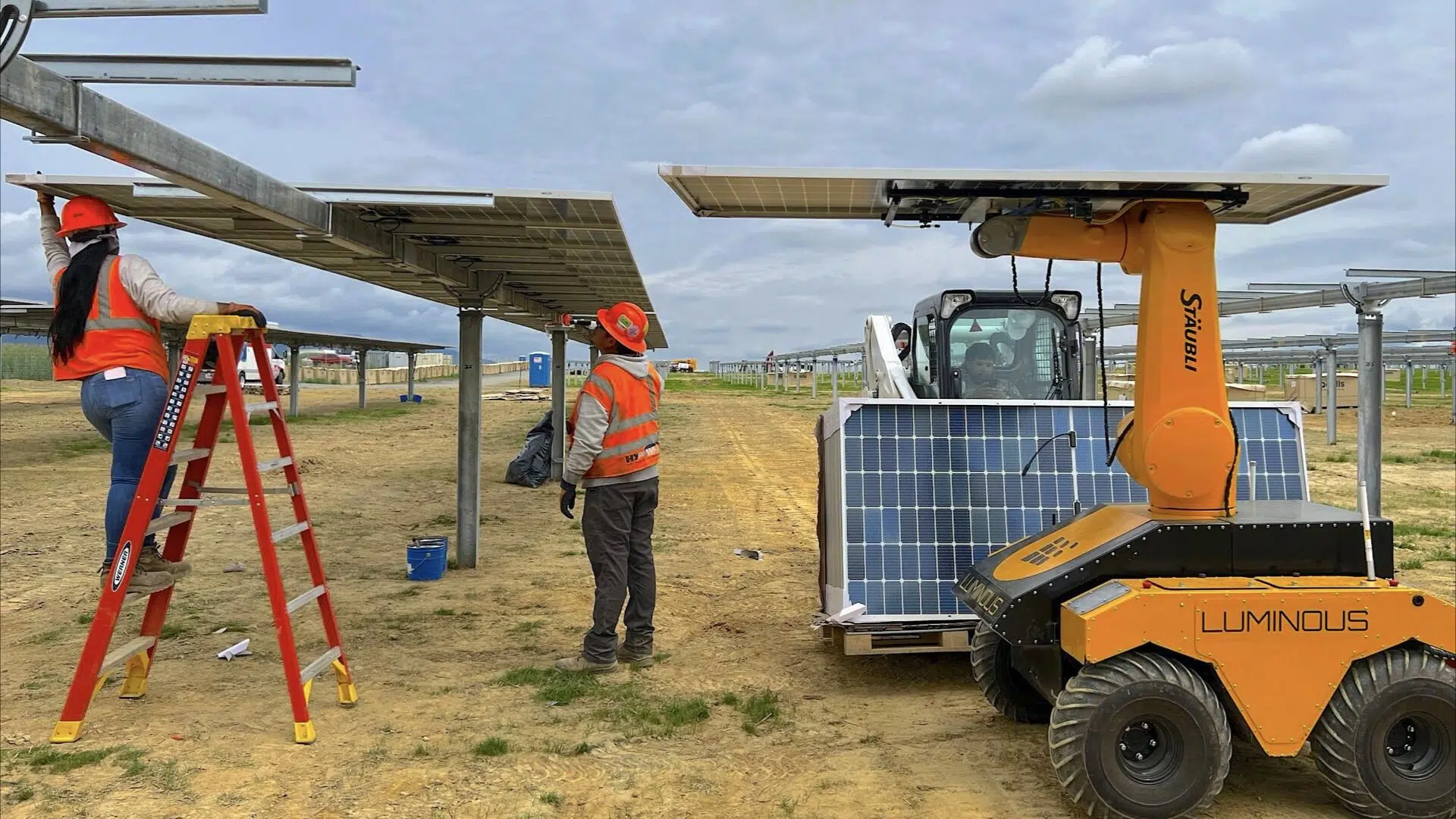
The company Luminous Robotics, based in Boston, is revolutionizing the construction of solar parks in Australia by using Lumi robots, capable of communicating with each other and operating under a system of synchronized autonomy of heterogeneous fleets.
Thanks to grants from the Australian Renewable Energy Agency (ARENA), the company tested its technology on large-scale solar projects in New South Wales and Victoria, including the Culcairn plant (350 MWac) and the Goorambat East project (250 MW).
Remote supervision and safety
Although the robots are autonomous, regulations require them to be deployed with safety technicians nearby, similar to the early trials of autonomous cars. “Today we have the ability to monitor and control these robots from anywhere in the world,” explained Jay Wong, CEO of Luminous.
The company also completed the installation of panels in the Lancaster solar project (80 MW) and is currently working on a project of over 500 MW, with the client yet to be disclosed.
Digital twins and installation records
Lumi robots function like smart vacuums that map a home, but applied to solar plants:
- They map the site and build a shared digital twin.
- They record each installed panel with before and after images and its GPS location.
- The map includes geometries, topography, trenches, piles, and leveling.
This system allows precise control of construction and facilitates future maintenance.
Global competition in solar robotics
Robotics applied to solar energy is being explored by multiple players:
- CSIRO in Australia, with its repair robot Bear.
- Chinese companies like Trinasolar and Leapting, direct competitors of Lumi.
- Built Robotics and Nextracker, which develop automated technologies for pile installation.
Economic and environmental advantages
The use of robots in the construction of solar parks offers key benefits:
- Cost reduction: cheaper and faster than human teams.
- Operation in extreme conditions, where human work would be riskier.
- Resource optimization through digital maps and fleet communication.
ARENA’s goal is to reduce the cost of large-scale solar energy to less than 20 dollars per MWh and achieve 30% improvements in solar cell efficiency by 2030.
The implementation of Lumi robots in Australia marks a milestone in the automation of renewable energy. By combining autonomy, fleet communication, and digital twins, robotics promises to accelerate the transition towards a more efficient, safe, and sustainable energy model.



