



Winter 2025 is shaping up to be one of the driest in the northern Patagonia in the last decade.
According to data from the National Meteorological Service (SMN), the accumulated rainfall between June and August was well below historical values:
- June: 60 mm (average: 140 mm)
- July: 80 mm (average: 140 mm)
- August: only 40 mm to date (average: 120 mm)
This sustained water deficit since December 2024 puts the winter season at risk and anticipates a summer with water scarcity and elevated environmental risk.
Thermal Oscillations and Unusual Phenomena
Although average temperatures remained within usual ranges (between 2.5 °C and 3.5 °C), extreme episodes were recorded:
- Minimums of up to –14 °C, the lowest in five years
- Maximums above 10 °C in August, more typical of September
These fluctuations are linked to cold air masses, subtropical masses, and atmospheric rivers, which caused intense rains but no snow accumulation in high areas.
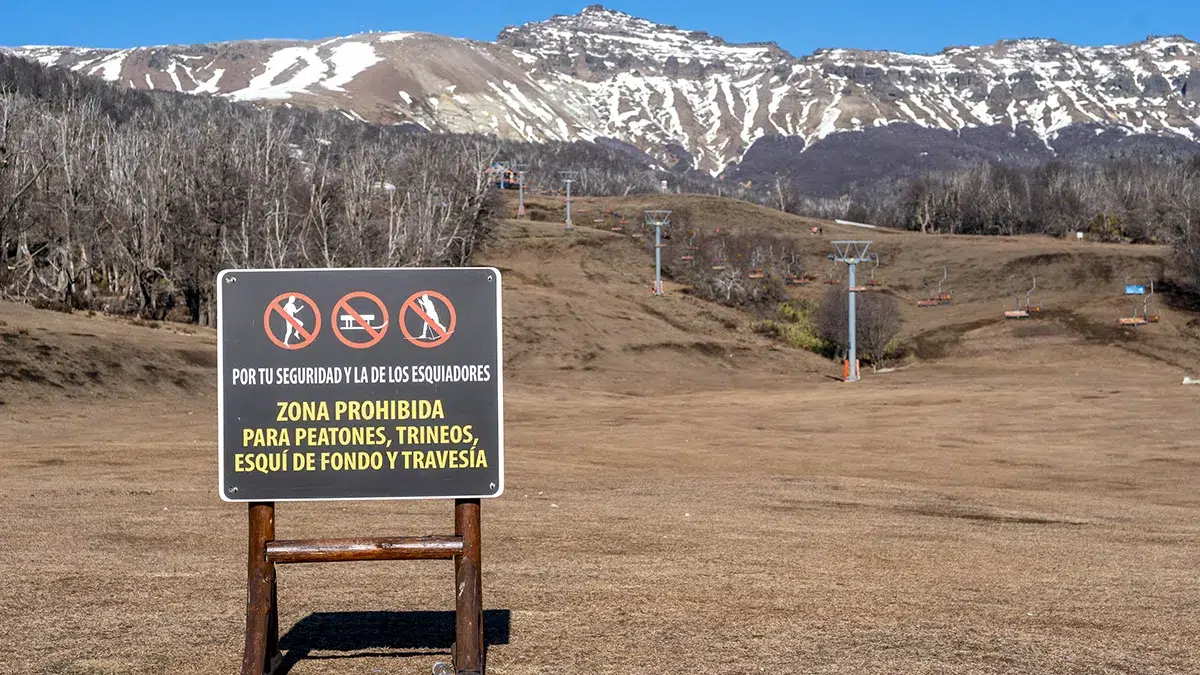
Scant Snow and Accelerated Melting
The mountainous region went through July and August with weak and sporadic snowfalls, ranging from just 5 to 15 mm. Oceanographer Matías de Oto Proschle from the SMN explained to rionegro.com that most of the precipitation was liquid, even in mountainous areas, due to:
- Thermal inversions: higher temperatures at altitude than in the valley
- Persistent fog and low clouds
- Atmospheric rivers with warm and humid air, which accelerated melting
The lack of natural snow led to the use of artificial snow to support the tourist season in Bariloche.
Climatic Perspectives: Prolonged Deficit and Elevated Temperatures
De Oto Proschle warned that, although there could be a slight increase in snowfall in the remaining days of August, it will not be enough to reverse the accumulated deficit. If rainfall does not exceed 60 mm, this will be the driest winter since 2016 and 2021, years that at least had a rainy August.
The forecast for the next three months indicates:
- Temperatures above average
- Precipitations below expectations
- Water deficit of at least 300 mm at the beginning of summer
Patagonia and Climate Change: A More Resilient Region?
Asked about forest fires in the Iberian Peninsula, the specialist pointed out that direct parallels cannot be established, although both phenomena respond to the same structural cause: global warming.
While Europe faced a rainy cycle that favored biomass growth, winter in Patagonia shows a more subtle but persistent trend:
- Less impact due to being surrounded by oceans
- Warmer springs and summers, with frequent heatwaves
- Winters with less snow accumulation and greater thermal variability
Even traditional climatic models are being questioned, as current variability does not match historical indices. “There is a clear signal of global warming,” De Oto Proschle concluded.
Cover photo: Marcelo Martínez



