



The largest feline moves silently, avoiding each branch with an ancestral familiarity. Its movement is so fast that its passage through the undergrowth mimics the thousands of flashes of light and shadow that the treetops, stirred by the wind, draw on the ground.
Nevertheless, it does not run, as it does not need to. It reserves its run for hunting moments, in brief and decisive charges. It almost never uses it to flee. It is the jaguar, the most revered wild animal in any of the habitats it occupies.
Commonly known as the jaguar, it is called various names: yaguareté in Guaraní, uturuncu in Quechua, nawell in Mapuche or Araucanian, and also tiger, American tiger or overo in Salta. Its scientific name is Felis onca, although it has also been classified as Leo onca or Panthera onca.
Jaguars are majestic creatures that have fascinated humanity for centuries. However, in today’s world, these imposing felines face unprecedented challenges.

Main threats to the largest feline in America
In 2025, the situation of the jaguar in Argentina remains critically endangered, with a estimated population of less than 250 individuals. The main threats are poaching, loss of habitat due to the expansion of agriculture and livestock farming, scarcity of natural prey, and direct conflicts with humans.
The largest population inhabits the Selva Misionera, although it has experienced a decline in recent years, dropping from 110 to 93 individuals between 2022 and 2024.
The population in the Gran Chaco is extremely fragile, with fewer than 20 individuals, while in the Yungas de Salta and Jujuy an exact and updated figure is not available. Despite this scenario, it is undeniable that in recent years their reintroduction in places where they had been extinct has been achieved, resulting in new births.
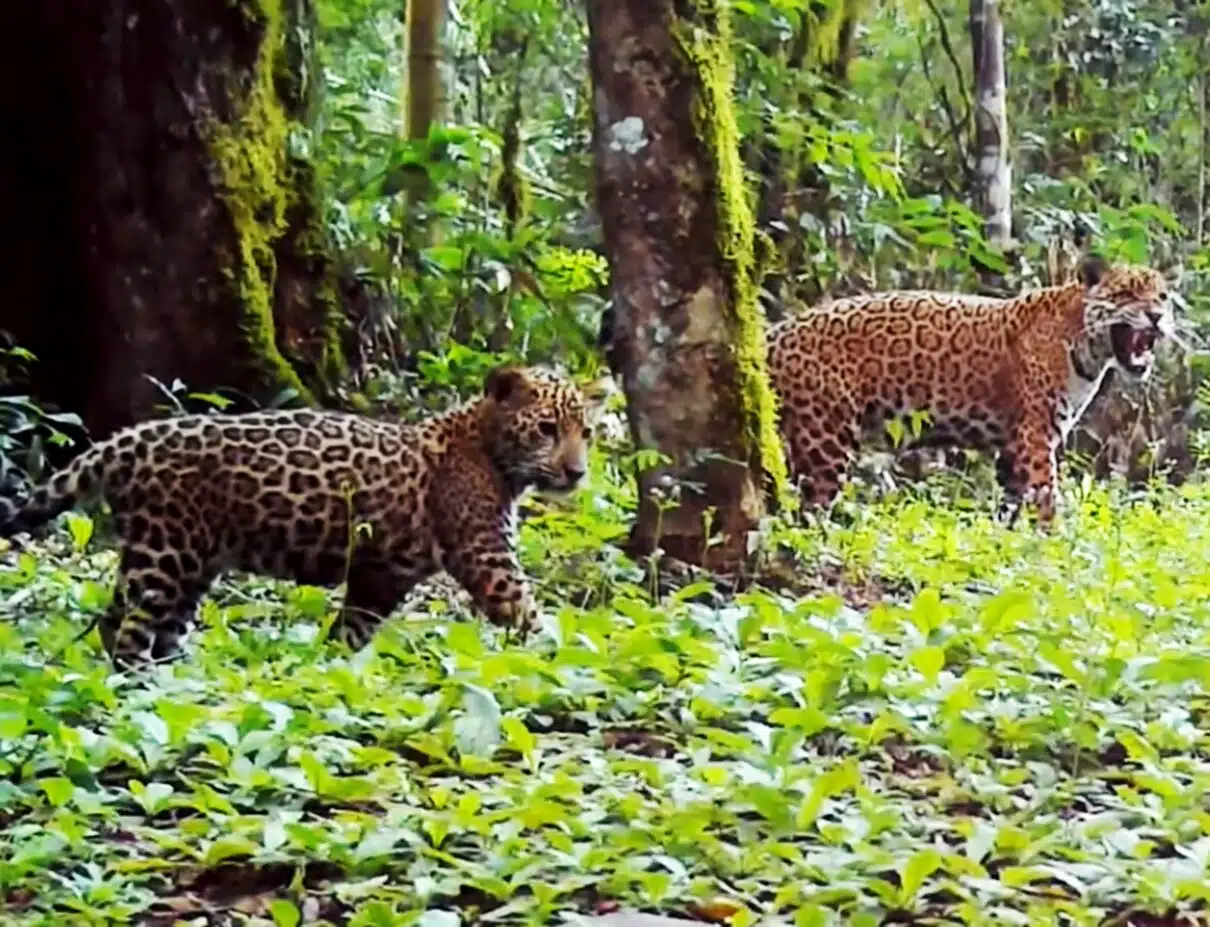
Its original distribution ranged from the southwest of the United States to the banks of the Río Negro in Argentina.
Characteristics of the majestic animal
This animal is characterized by a very wide and large head, with small and rounded ears. Its skull is short and round, with wide zygomatic arches. Its eyes have pupils that contract vertically.
Its body is compact and muscular, with a thick neck and a long, thin tail. The legs are short and powerful, with five toes on the front and four on the back, equipped with curved and retractable claws.
Its coat is short, dense, and soft on the head, back, and legs, but longer on the throat, the lower part of the neck, the chest, and the belly.
The skin has a reddish-yellow background color, except in the inside of the ears, the lower part of the muzzle, the jaws, the throat, and other lower body areas, where the tone is paler. The inner face of the legs is predominantly white.
Its coat is covered with black spots that can be round, elongated, or form irregular stripes that separate on the cross and join on the back, creating more or less parallel lines on the sides. These spots are smaller on the head, neck, and legs.
The tail has rings on its posterior third. The arrangement and shape of the spots are unique in almost every individual. Females usually have a more pale coloration.
Occasionally, melanistic specimens are found, with a black coat on which, against the light, spots of an even more intense black can be distinguished. Although albino specimens exist, they are extremely rare. The jaguar can reach a length of 270 cm from head to tail and a weight of 135 kilograms.
Armed with a powerful set of teeth and retractable claws, the jaguar uses various hunting techniques. One of them is the stealthy approach to its prey. Once at an appropriate distance, it launches into a short and swift charge, grabbing its victim with its front claws.
At other times, it positions itself in ambush at a strategic location, waiting for an animal to appear to pounce on it with quick and accurate movements.
If the prey is small, a simple swipe is sufficient. If it is large, its technique varies. In these cases, it usually jumps on the scapular region of the victim to bring it down with its weight; then, it bites the neck seeking to fracture the cervical vertebrae.
Alternatively, it breaks the neck with a violent tug backward. If its first attack fails, it usually does not persist and abandons that prey.
The decline of the largest feline in America was extremely rapid. In the mid-20th century, it could still be found in the vicinity of the Buenos Aires lagoons and even on the banks of the Colorado River, with the Paraná Delta as a safe refuge.
Its continuous retreat to the north is due to multiple factors, mainly the alteration of its natural environments and the persecution it has been subjected to since colonial times, both for the value of its fur and its reputation as a dangerous animal for humans and livestock.
National Law declares it a Natural Monument
In 2001, National Law 25,463 was enacted, declaring the feline a Natural Monument, establishing a crucial legal basis for conservation actions. That same year, the Red Yaguareté was founded by naturalists and volunteers dedicated to the protection of the species and its habitats.
The Yaguareté Project began in the country in 2002, in the province of Misiones, as an inter-institutional initiative to coordinate conservation efforts through research and education.
In 2007, the Rewilding Argentina Foundation launched the Iberá Project, which successfully reintroduced the jaguar in the Province of Corrientes, where it had become extinct 70 years earlier.
The goal of the Iberá Project was to reintroduce the jaguar in the Esteros del Iberá, providing the animals with the necessary



