



In the ecosystems of Colombia, the second most biodiverse nation on the planet, an unprecedented strategy has been put into action: members of the national Otus network use camera traps to generate key information for species conservation, recording the fauna inhabiting jungles, mountains, and plains.
The project brings together scientists, environmental authorities, local communities, and private sector organizations. Over 1300 devices will be installed in strategic points throughout the country, providing thousands of images and videos that will document wildlife in its natural environment.
The novelty lies in the fact that this network will use artificial intelligence to process the captured information. With the Wildlife Insights platform, it will be possible to identify species quickly and accurately, reducing processing times and facilitating decision-making in environmental policies.
This initiative not only seeks to obtain data but also to strengthen the relationship between communities and biodiversity. By recognizing the animals living near their territories, people develop a greater awareness of the value of their surroundings.

Technology as an ally in conservation
The use of camera traps and recognition algorithms represents a significant advancement compared to traditional methods. Previously, processing images could take months, limiting the ability to respond to environmental threats.
Today, thanks to artificial intelligence, records are turned into useful statistics almost in real time. It is possible to know which species move through an area, how many individuals appear, or which pathways are most used by animals like jaguars, tapirs, or spectacled bears.
Furthermore, this information is not only in the hands of specialists. By sharing it with communities and authorities, technology allows for the design of joint management strategies for territories, such as protected areas or biological corridors.
The benefits also extend to environmental governance. By involving farmers and local organizations, a participatory scheme is created where the inhabitants of the territory play an active role in conservation.
Benefits of using technology in preservation
The application of artificial intelligence in projects like the Otus network offers advantages that go beyond the speed of data analysis. Firstly, it allows for the creation of accessible information databases for different actors, expanding collaboration capabilities.
Secondly, it generates tools to monitor the effectiveness of protected areas. Knowing if key species are still present or if ecosystems maintain their connectivity allows for timely adjustments to conservation measures.
Another benefit is social awareness. By showing images of the fauna, communities discover species coexisting in their environment and develop a new perspective towards them. This change in perception fosters protection and reduces conflicts with animals that were often seen as threats.
Finally, technology contributes to shaping stronger environmental policies. With reliable data, governments can prioritize territories, allocate resources, and strengthen the fight against illegal activities such as deforestation or poaching.
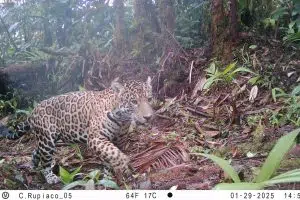 Scientists use camera traps to gather more information about Colombian biodiversity. Photo: Conservation International.
A network to fill information gaps
The Otus network is not limited to national parks or official reserves. It also includes private territories, management districts, and understudied areas such as the Amazon, the Orinoco, and the biogeographic Chocó.
These spaces, known as “information gaps,” are crucial for endangered species and for the connectivity of ecosystems. By integrating cameras in them, a window is opened towards areas where research has been scarce.
The challenge is not only scientific but also logistical and social. Armed conflicts, extractive activities, and land pressures make monitoring difficult in various locations. However, the joint effort of communities, institutions, and technology presents a path towards real solutions.
The initiative of using camera traps with artificial intelligence marks a before and after in conservation in Colombia. More than just a record of images, it is a commitment to uniting science, society, and technology in defense of biodiversity.



