



The illegal wildlife trafficking has once again raised environmental alarms in Mexico following the rescue of 350 turtles that were being transported clandestinely under the guise of a shipment of children’s toys.
The discovery was made thanks to the intervention of personnel from a parcel delivery company, who detected irregularities during the handling of the packages and notified the competent authorities. As a result, an operation was launched, led by the Federal Attorney for Environmental Protection (Profepa).
During the inspection, agents confirmed that the animals were traveling in extremely precarious conditions, hidden in small containers and wrapped in socks, a situation that seriously compromised their survival.
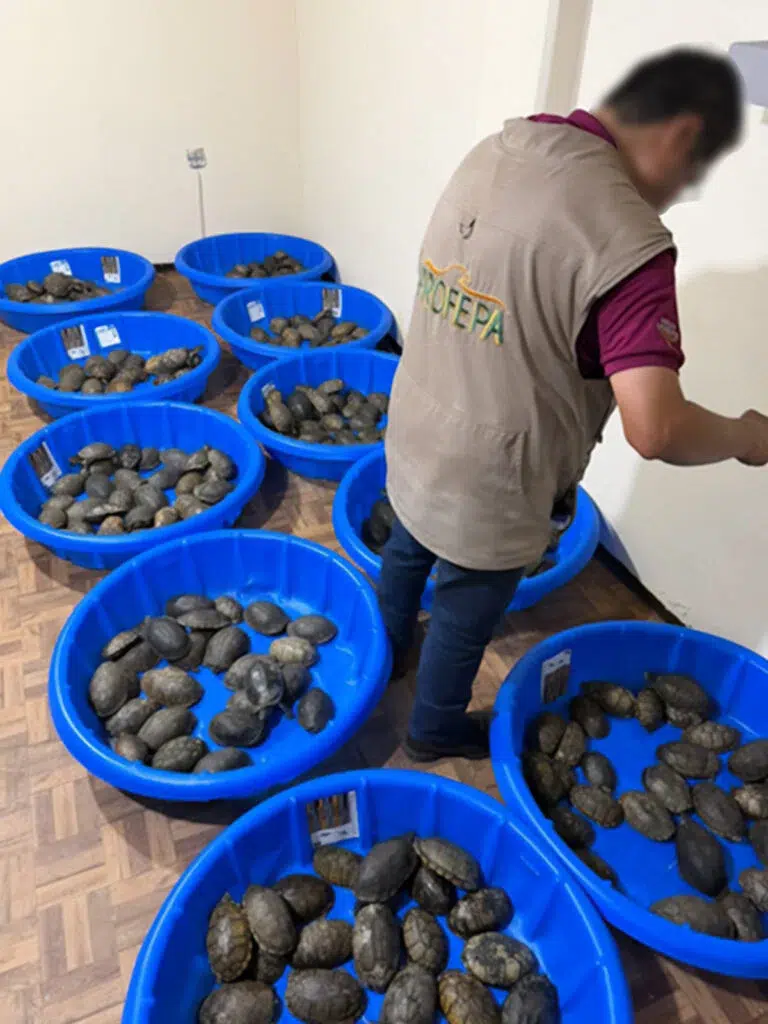
Extreme conditions and loss of specimens during transport
Authorities identified among the secured specimens 344 casquito turtles (Kinosternon spp.), two ornate turtles (Terrapene ornata), and four Mexican turtles (Terrapene mexicana).
However, the rescue did not manage to avoid all the consequences of mistreatment. Before the official intervention, 25 reptiles had already died due to overcrowding, lack of ventilation, and inadequate transport conditions.
Subsequently, the surviving specimens were transferred to an authorized Management Unit, where they receive specialized veterinary care and remain under observation. The procedure also involved personnel from the National Guard and the Mexican Army.
Turtles, among the species most affected by wildlife trafficking
Turtles are among the most pursued animals by illegal trafficking networks due to their high demand in the exotic pet market, the commercialization of their shells, and the clandestine sale of wild specimens.
Moreover, many species have slow reproductive cycles and reach sexual maturity after several years, so the extraction of individuals from the wild generates long-lasting impacts on populations.
On the other hand, habitat destruction, pollution, and climate change further aggravate their situation. As a result, numerous turtle species are threatened or subject to various levels of international protection.

Conservation and monitoring on the Gulf of Mexico coasts
While authorities confront illegal trafficking, conservation programs continue to show encouraging results in various regions of the country.
On the coast of Veracruz, more than 600 sea turtle nests were recorded during the current nesting season. This progress reflects the joint work between environmental organizations, turtle camps, academic institutions, and civil organizations.
Likewise, monitoring and protection tasks cover species such as the Kemp’s ridley turtle, the green turtle, the hawksbill turtle, and the leatherback turtle, all fundamental for the ecological balance of marine ecosystems.
A permanent challenge for biodiversity
The case demonstrates that trafficking networks continue to seek new strategies to evade controls and obtain economic benefits at the expense of wildlife.
In response, Mexican legislation contemplates severe penalties for those who capture, possess, transport, or commercialize protected species. Penalties can reach up to nine years in prison, in addition to significant economic fines.
Faced with this scenario, specialists emphasize that strengthening controls, protecting breeding sites, and promoting environmental education are essential tools to ensure the survival of turtles and preserve biodiversity for future generations.



