



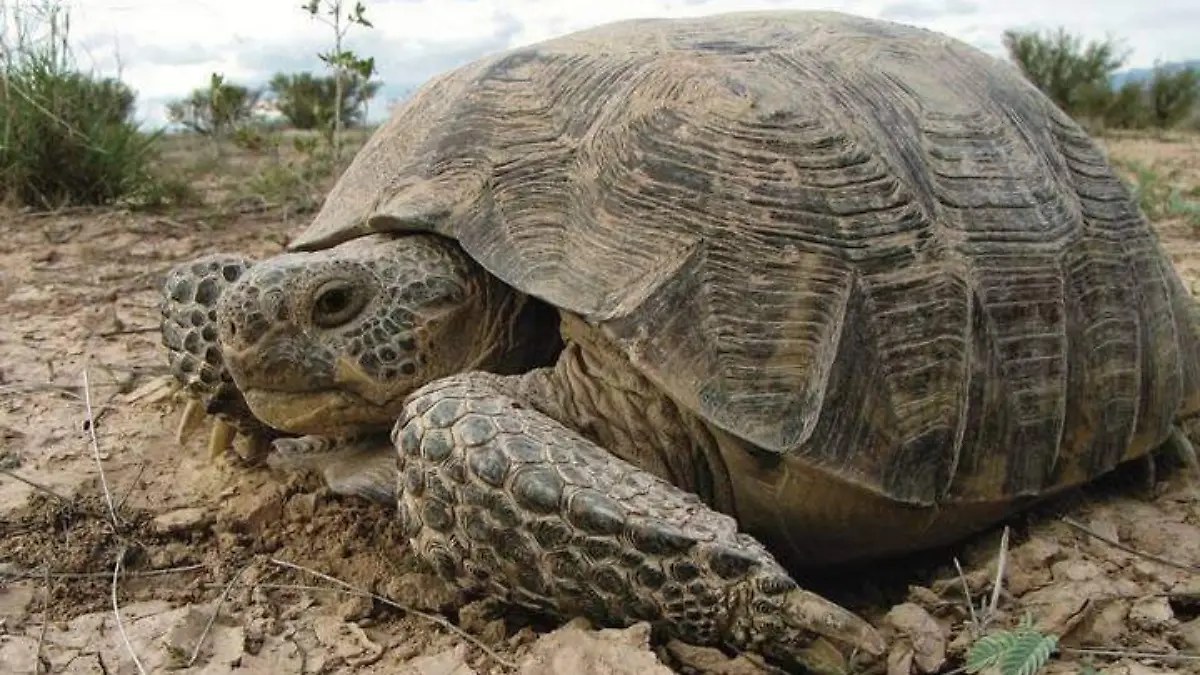
The Bolsón tortoise (Gopherus flavomarginatus) inhabits altitudes ranging from 1,000 to 2,000 meters above sea level, with an average of 1,500 meters, especially in areas near volcanic slopes.
This species is endemic to the Nearctic region, particularly to the Mapimí Basin in the Chihuahuan Desert, where the states of Durango, Coahuila, and Chihuahua (Mexico) converge.
An extreme and unique habitat
The environment of this tortoise is characterized by a semi-warm desert climate, with winter temperatures close to 2.8°C and summers reaching 36°C, along with an average annual precipitation of 145 mm.
The dominant vegetation includes microphyllous scrub, rosette scrub, and arid grasslands. The tortoise inhabits gentle slopes, where it digs burrows up to 2 meters deep and 15 meters long, allowing it to regulate its body temperature and shelter from extreme heat.
Evolutionary history and scientific discovery
After the end of the Pleistocene, about 12,000 years ago, the distribution of this species drastically reduced. It is presumed that human predation and climatic changes contributed to its confinement in the Mapimí Basin.
In 1959, biologist John Legler formally described it, naming it Gopherus flavomarginatus for the yellowish edges of its shell, after observing it in an unusual scene: hens pecking at its shell.
Ecological role and diet
The Bolsón tortoise is completely herbivorous, and its activity contributes to the dispersal of grass seeds.
Moreover, its burrows offer shelter to various desert species, such as hares, rabbits, burrowing owls, snakes, and invertebrates, making it a key ecological engineer for the ecosystem’s balance.
Conservation and community involvement
Since 2008, environmental authorities and international organizations have promoted the monitoring and conservation of its habitat, with the active collaboration of local communities.
The Mapimí Biosphere Reserve, managed by CONANP, is the main refuge for this species. Thanks to these actions, 28 colonies, 1,784 active burrows, and almost 700 individuals have been identified.
A species at risk, but not forgotten
The population has decreased by 50% in three decades, and its current status is endangered.
The Bolsón tortoise faces an alarming population decline, estimated at more than 50% in the last 30 years.
Its inclusion in conservation programs and recognition as a flagship species of the Mexican desert are fundamental steps to prevent its disappearance and preserve the region’s biocultural richness.



