



The Sahara Desert could undergo a radical transformation in the coming decades.
New climate projections indicate that its precipitation would increase by 75% by the end of the 21st century.
This is an unprecedented change that would alter the lives of millions of people in Africa.
The research, published in the journal npj Climate and Atmospheric Science, was conducted by the University of Illinois at Chicago.
The study analyzes how climate change will modify rainfall patterns across the African continent.
“The Sahara is projected to almost double its historical precipitation levels, which is surprising for a region that is so dry climatologically,” said Thierry Ndetatsin Taguela, leader of the research team.

Rain in the Sahara: why it would change precipitation dynamics
The increase in global temperatures allows the atmosphere to hold more moisture.
In most of the continent, the increases are due to vertical thermodynamic processes activated by high humidity.
The decrease in rainfall in southwestern Africa is related to the weakening of the ascending branch of the Hadley circulation.
This factor is key in the distribution of regional precipitation.
How the study was conducted to analyze precipitation in the Sahara
The Climate Research Lab team used 40 climate models to simulate the evolution of summer rains in Africa.
The analyzed period spans from 2050 to 2099, compared to historical data from 1965 to 2014.
The scenarios considered both moderate and very high emissions of greenhouse gases.
In both cases, the projections show a general increase in precipitation across the continent.
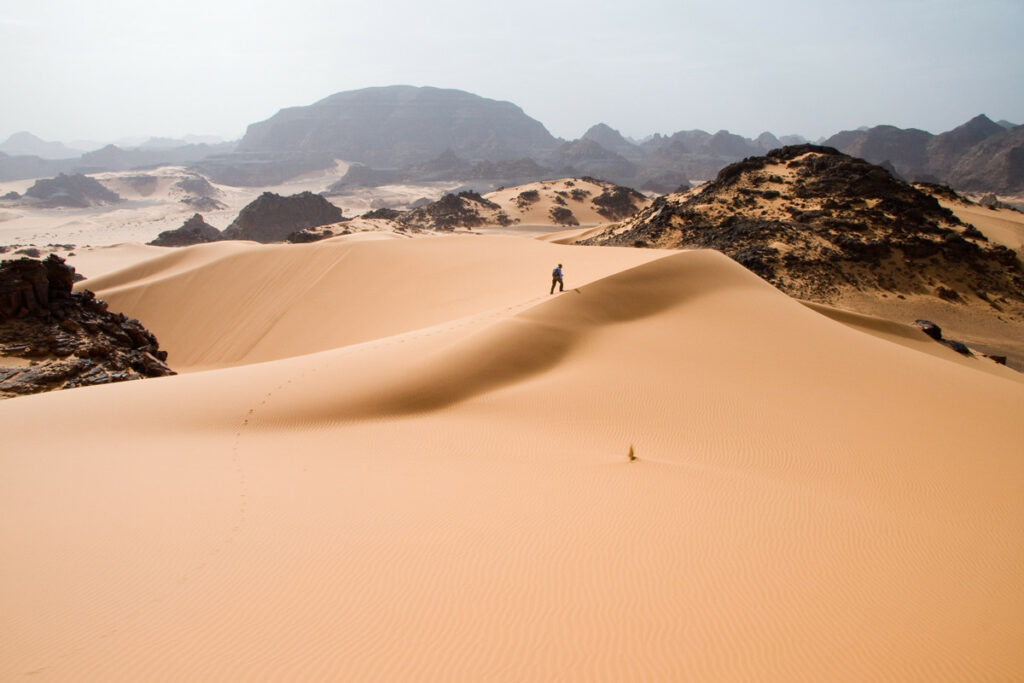
The impact of changes in rainfall would occur across all of Africa
The Sahara leads the increases with a 75% rise, but other regions will also experience significant changes.
Southeast Africa, for example, would see a 24% increase in rainfall.
Central-southern Africa, on the other hand, would experience a 17% increase in precipitation.
In contrast, southwestern Africa could experience a 5% decrease.
In Africa, millions of people depend on rainfall for their livelihood on the continent.
Previous studies estimate that a 3°C increase in global temperature could lead to food deficits.
These deficits would affect more than 1.5 billion Africans, mainly in East and West Africa.
Thus, the dependence on food imports would increase significantly, implying a greater expenditure of resources.
The challenges and risks of increased humidity in the Sahara
Central Sahel would experience an increase in precipitation, driven by the strengthening of moisture flow.
Western Sahel could face a reduction in rainfall due to increased atmospheric stability.
Meanwhile, southern Africa would face more severe droughts, especially in summer.
Eastern Africa anticipates an increase in precipitation, with short but intense rains between October and December.


