



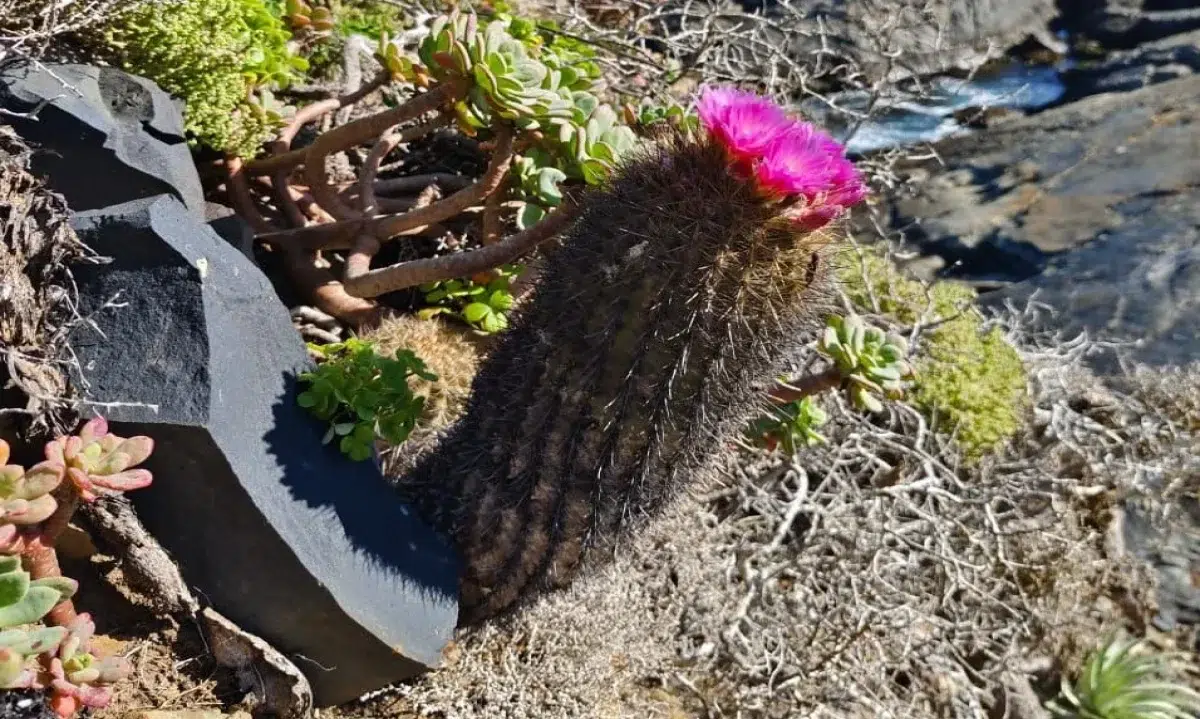
The Chilenito (Eriosyce chilensis) is an endemic cactus that does not inhabit deserts or high plateaus, but rather the rocky cliffs of the central coast of Chile, between Los Molles (Valparaíso) and Pichidangui (Coquimbo). Its distribution is so limited—just about 10 kilometers—that any alteration in the environment can compromise its survival.
The Ministry of the Environment (MMA) classifies it as an endangered species. Urban expansion, human traffic, illegal collection, and climate change have drastically reduced its chances of persisting in the coastal ecosystem.
Strict Endemism: Strength and Vulnerability
The Chilenito depends on a very specific habitat: coastal rocks with thin soils and the constant influence of the sea.
This specialization, known as strict endemism, makes it an evolutionary treasure but also a highly vulnerable species. Unlike other plants with wide distribution, it has nowhere to move if its environment degrades.
Conservation Plan with International Support
The MMA, along with the United Nations Environment Programme (UNEP), presented a Conservation Plan to protect the Chilenito and monitor its populations. The project brings together scientists, municipalities, local organizations, park rangers, and communities, with long-term conservation measures.
Los Molles and Pichidangui are part of the AZE (Alliance for Zero Extinction) sites, internationally recognized for hosting species with very limited distribution and high risk of disappearance.
Ecological and Evolutionary Importance
Conserving the Chilenito is vital for multiple reasons:
- Ecological support: it offers nectar and pollen to native pollinators like bees and insects, strengthening the balance of the coastal ecosystem.
- Evolutionary adaptation: its flowering, which varies between fuchsia and white tones, is a case study on how pollinators influence the creation of new species.
- Habitat protection: by growing in crevices and rugged areas, it helps stabilize the terrain and prevent erosion in vulnerable coastal areas.
Current Threats
- Urban expansion: construction in coastal areas that reduces its habitat.
- Climate change: alters the humidity and temperature conditions necessary for its survival.
- Illegal collection: extraction of specimens for collecting or ornamental trade.
These pressures have prompted the joint intervention of Chile and the United Nations to ensure its survival.
The Chilenito is more than a cactus: it is a unique evolutionary link that supports the coastal biodiversity of Chile. Its conservation requires urgent and coordinated actions that integrate science, local communities, and public policies.
Protecting it means preserving an irreplaceable natural heritage and ensuring that the cliffs of the central coast remain a refuge for life.



