



An investigation by the Ulsan National Institute of Science and Technology (UNIST) achieved what seemed unfeasible until recently: generating clean hydrogen from ammonia (NH₃) using silicon (Si) recovered from recycled solar panels.
This breakthrough not only allows for the production of hydrogen without emissions or additional separation but also generates silicon nitride (SiN), a key material for the manufacturing of rechargeable batteries.
A clean, efficient, and low-temperature process
The system operates in a closed and emission-free environment at a temperature of just 50 °C, much lower than current industrial methods that require between 400 and 600 °C.
This thermal efficiency opens the door to decentralized installations, adaptable to small or medium scale, without the need for complex infrastructure.
Revalorization of solar waste: a solution to the recycling challenge
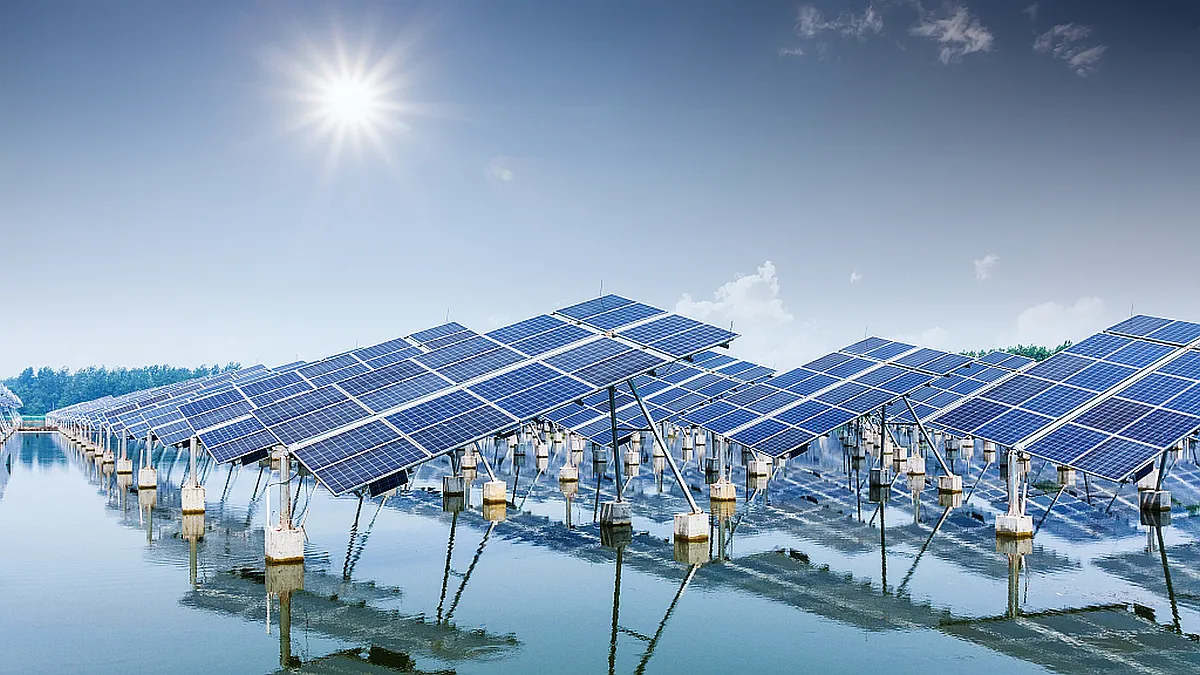
With the exponential growth of photovoltaic energy, out-of-service solar panels have become an emerging problem. It is estimated that by 2050 there will be more than 80 million tons of this waste. Although the silicon present in them is recoverable, its recycling has been limited by costs and technical barriers.
The method developed by UNIST turns that silicon into an active agent in the hydrogen production process. By reacting with ammonia in a ball mill, the silicon releases hydrogen and transforms into SiN, without generating harmful gases or contaminating by-products.
Most notably, the recycled silicon works just as well as commercial silicon, breaking a key barrier in the circular economy of the solar sector.
SiN: a high-value-added by-product
The silicon nitride generated is not waste but a functional material for lithium-ion batteries. In recent tests, the batteries incorporating it maintained more than 80% of their capacity after 1,000 cycles, which is crucial for applications such as stationary storage and electric mobility.
This reduces the dependence on critical raw materials like cobalt and lowers the costs of the process.
Economic and environmental impact
Economic analyses indicate that, considering the sale of SiN, the cost of hydrogen production can be negative (around –6.75 € per kilogram).
In other words, the process self-finances, making it a viable alternative without the need for subsidies.
A solution aligned with the global energy transition
This type of innovation fits perfectly in the current context, where the pressure to decarbonize the energy and industrial sectors is increasing.
The European Union promotes the use of green hydrogen and the recovery of strategic materials through regulations such as the Critical Raw Materials Regulation.
Moreover, the use of ammonia as an energy vector is gaining ground. Countries like Japan and South Korea are already testing it in power plants and maritime transport, taking advantage of its high energy density and existing infrastructure. However, the release of hydrogen from NH₃ was a bottleneck due to its thermal requirements. This new, milder approach opens up unprecedented technical and economic possibilities.
A concrete proposal for a circular future
UNIST’s approach combines the best of three worlds: renewable energies, recycling of technological waste, and electric mobility. If scaled intelligently, it could:
- Massively recycle solar panels
- Produce distributed hydrogen without emissions
- Provide key materials for batteries
- Reduce costs and generate added value
In short, this is not a laboratory curiosity but a practical, scalable, and transformative solution to advance towards a cleaner, smarter, and circular energy model. Just what is needed to build a livable future.



