



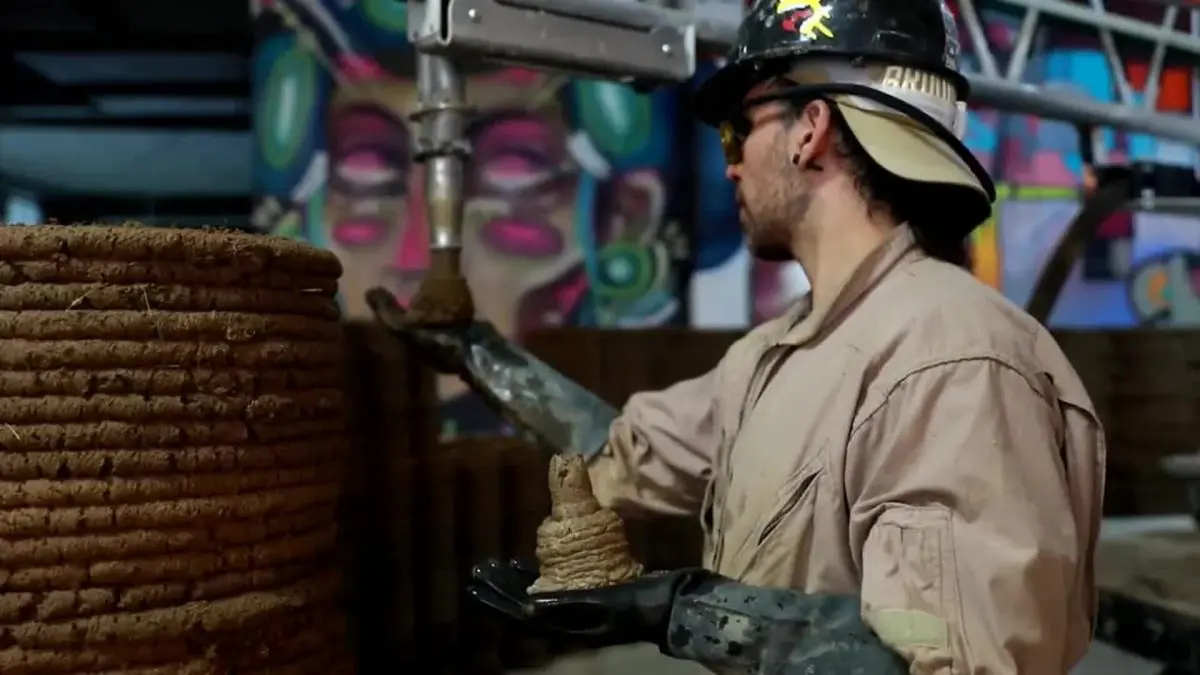
With the goal of solving the housing problem in Mexico and around the world, the national company SEED began this month the construction of the first prototype of a 3D printed house with sustainable materials.
The project is being developed in an industrial warehouse in the borough of Azcapotzalco, Mexico City, where a multidisciplinary team of architects, designers, and artists is working on an innovative alternative to traditional systems based on concrete.
Affordable and Earthquake-Resistant Housing
The model suggests that a family could access these houses for a monthly fee close to 70 euros, making them an economic and ecological option.
Additionally, the houses feature self-supporting walls, capable of withstanding earthquakes up to magnitude 7 on the Richter scale, a key feature in a city like Mexico, located on a seismic fault.
Technological Innovation with Social Impact
The project was born from the idea of “printing with earth” and evolved towards the use of sustainable materials that reduce environmental impact. According to Alan Cohen, one of the promoters, the intention is clear: “solve the housing problem” through a technology that accelerates construction, reduces costs, and offers greater design flexibility.
The 3D printed houses stand out for their potential to:
- Reduce construction times: in some cases, a house can be completed in 24 hours.
- Minimize labor and human errors thanks to the automated process.
- Reduce construction waste through additive manufacturing, using only the necessary amount of material.
- Utilize recycled and local materials, reducing the carbon footprint.
- Design bioclimatic spaces, optimizing natural light and ventilation.
Economic and Design Advantages
The efficiency of the process allows for a cost reduction of up to 35%, opening the door to more affordable housing for vulnerable sectors.
The technology also offers design flexibility, allowing customization, creation of complex shapes, and the possibility of adding extensions or rebuilding modules after natural disasters.
Pending Challenges
Despite its many advantages, 3D construction faces significant challenges:
- Adaptation of regulations and building codes, still designed for traditional methods.
- Limitation in buildings of more than one floor, due to the current capabilities of the printers.
- Need for non-printed components, such as doors, windows, roofs, and plumbing systems.
Future Prospects
The SEED prototype marks a milestone in housing innovation in Mexico, showing that it is possible to combine sustainability, accessibility, and seismic resilience in a single project.
If it manages to overcome regulatory and technical challenges, this technology could become a global solution for the housing deficit, offering quick, economical, and environmentally friendly alternatives.


