



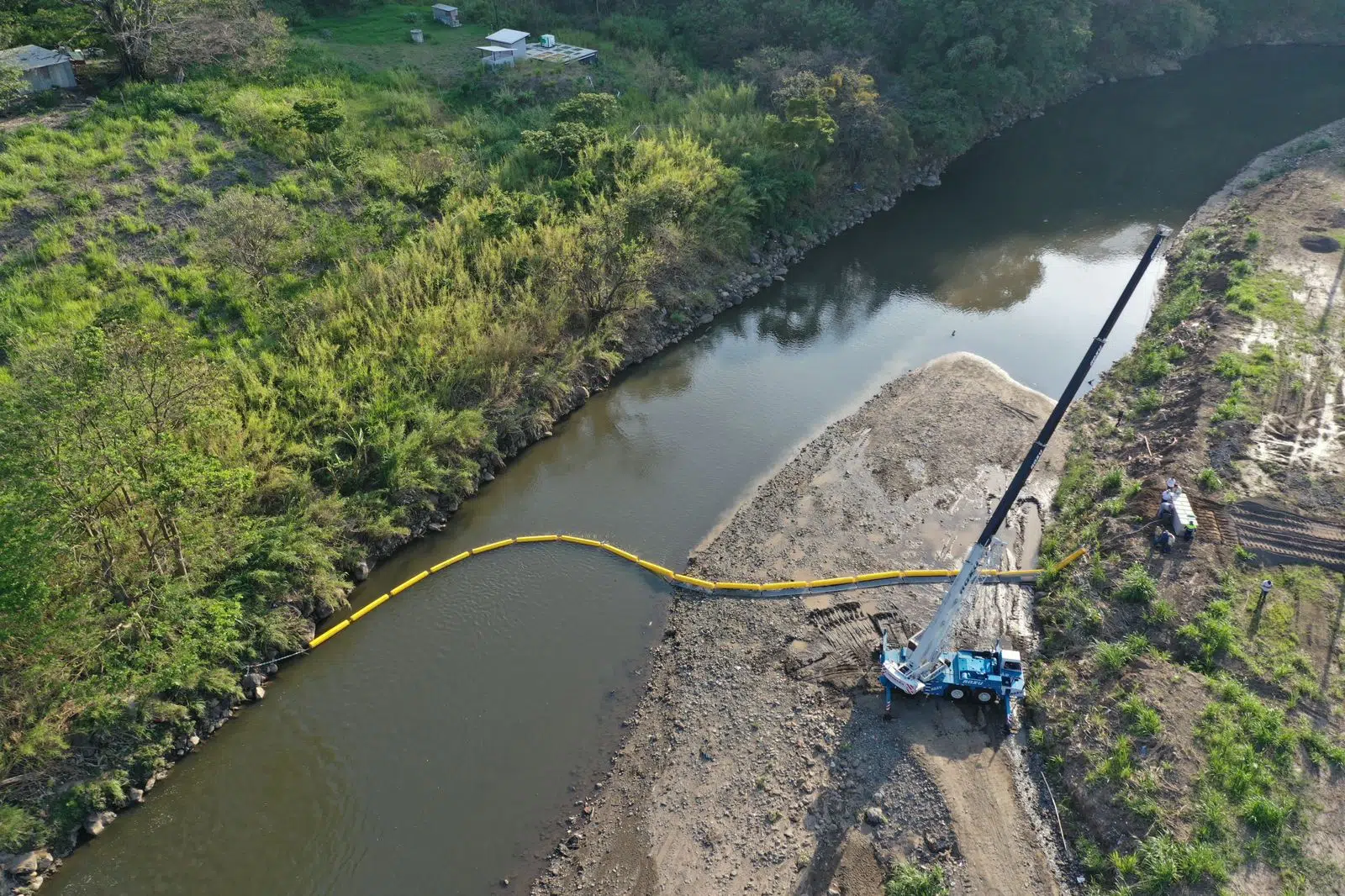
The Virilla River, which collects the waters of the María Aguilar and Torres rivers, is considered one of the most polluted in Costa Rica. To tackle this issue, a floating collection barrier was installed, which has already recovered tons of plastics, preventing them from reaching the ocean.
Plastics are a global challenge: in 2019 and 2020, more than 367 million tons were produced. In Costa Rica, according to the UNDP, a large part of these wastes end up in open-air landfills, contaminating soils, rivers, and seas.
The floating barrier in action
The initiative is part of the Landscapes Without Plastics project, driven by the UNDP, Televisora de Costa Rica, CRDC-PEDREGAL, OneSea Foundation, and Delfino, with support from the OET and the TEVU project.
- Floating barriers: physical barriers with floating modules and submersible nets up to 60 cm.
- Efficiency: they retain up to 80% of floating solid waste before it reaches the sea.
- Ecological safety: they allow the free passage of fish and aquatic fauna.
The installation point was defined by the SINAC, at the confluence of the Virilla and Tiribí rivers, where 80% of the waste from the Greater Metropolitan Area passes through.
Circular economy: from river to concrete
The PEDREGAL Group participates in the operation and processing of the recovered plastics through RESIN8™ technology, which transforms waste into synthetic sand used in concrete and asphalt.
The barrier is located 300 meters from the RESIN8™ plant in Belén. So far, 20 tons of waste have been extracted, of which 3.7 tons of plastics were reincorporated into construction materials.
A replicable model
The experience is inspired by similar projects supported by the UNDP in Guatemala, where good practices were identified to prevent plastics from reaching marine ecosystems while promoting circular economy solutions.
Why cleaning rivers is vital
Rivers are the main “highways” that transport land waste to the oceans. Stopping pollution at its source protects biodiversity and prevents irreversible damage.
- Protection of the oceans: rivers transport up to 80% of the plastic waste that reaches the sea.
- Conservation of fauna: animals mistake plastics for food or become trapped in them.
- Human health: microplastics contaminate drinking water and enter the food chain.
- Disaster prevention: accumulated waste obstructs waterways and increases the risk of flooding.
- Economic impact: pollution reduces recreational value and affects fishing, tourism, and agriculture.
The floating barrier in the Virilla River is more than a technological innovation: it is a symbol of how Costa Rica faces the plastic crisis with nature-based and circular economy solutions.
Protecting rivers means protecting the oceans, public health, and the image of a country that bets on sustainable tourism and environmental resilience.


