



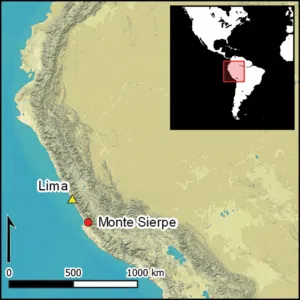
In the arid valley of Pisco, south of Peru, lies the hill of Monte Sierpe. There, a series of perfectly aligned cavities form one of the most fascinating enigmas of Andean archaeology: the Band of Holes.
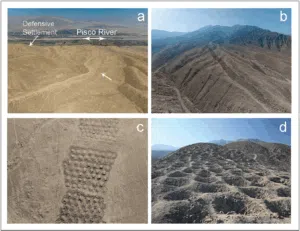
It consists of more than five thousand excavated depressions with surprising precision, visible in their entirety only from the air. For almost a century, their function remained shrouded in mystery, fueling theories about rituals, storage, or defense.
Now, an international investigation published in the Antiquity journal offers a new interpretation that revalues its ecological, social, and cultural meaning: the Band would have functioned as a space for exchange and record-keeping of goods, centuries before the Inca dominance.
A discovery that rewrites Andean history
The study, developed by specialists from universities in Australia, the United States, and Peru, used drones and microscopic analysis to accurately reconstruct the design and content of the cavities.
Aerial images revealed regular alignment patterns and organized blocks, indicating intentional planning. Sediment sampling allowed for the identification of remains of corn, reeds, and plant fibers, essential elements of pre-Hispanic daily life.
These indications suggest that Monte Sierpe was not a ritual or defensive site, but a community space intended for the exchange, storage, and record-keeping of agricultural resources, a practice that would have anticipated the Inca administrative systems.
Ancestral technology and social organization
Researchers found similarities between the structure of the Band of Holes and the quipus —the systems of ropes and knots used by the Incas to account for goods—. This similarity reinforces the hypothesis that the site was part of an economic management network prior to the 16th century.
The strategic location of Monte Sierpe, near ancient roads and administrative centers, suggests that transactions and records related to the agricultural and commercial life of the valley were centralized there.
The precision of the excavations and their geometric order demonstrate an advanced knowledge of territorial planning, land use, and sustainable resource utilization, a legacy of the Andean peoples who harmonized technology and the natural environment.
Ecological implications and benefits of the discovery
Beyond its historical value, this discovery offers an ecological perspective on how ancient civilizations managed their environment. The Band of Holes demonstrates that the control of natural resources could be carried out without deteriorating the landscape, using techniques respectful of the environmental balance.
Understanding how these communities organized the exchange and storage of food without generating overexploitation provides keys to rethink current production systems. Their cooperative and low environmental impact model contrasts with modern extractive practices.
Moreover, the recovery and preservation of the site promote the development of scientific and cultural tourism in the Pisco region, boosting environmental education and the appreciation of Peruvian natural and archaeological heritage.
A legacy that still holds secrets
Despite the advances, Monte Sierpe continues to pose questions. There are no records of another similar structure in the Andes, making the Band of Holes a unique case of pre-Columbian engineering.
Researchers believe that new excavations could determine with greater precision its chronology and successive functions, from local exchange to possible integration into regional trade networks.
Each cavity excavated in the hill is a vestige of a social system based on cooperation and sustainability. Rediscovering it not only clarifies the past but also invites reflection on the human capacity to coexist with nature without destroying it.


