



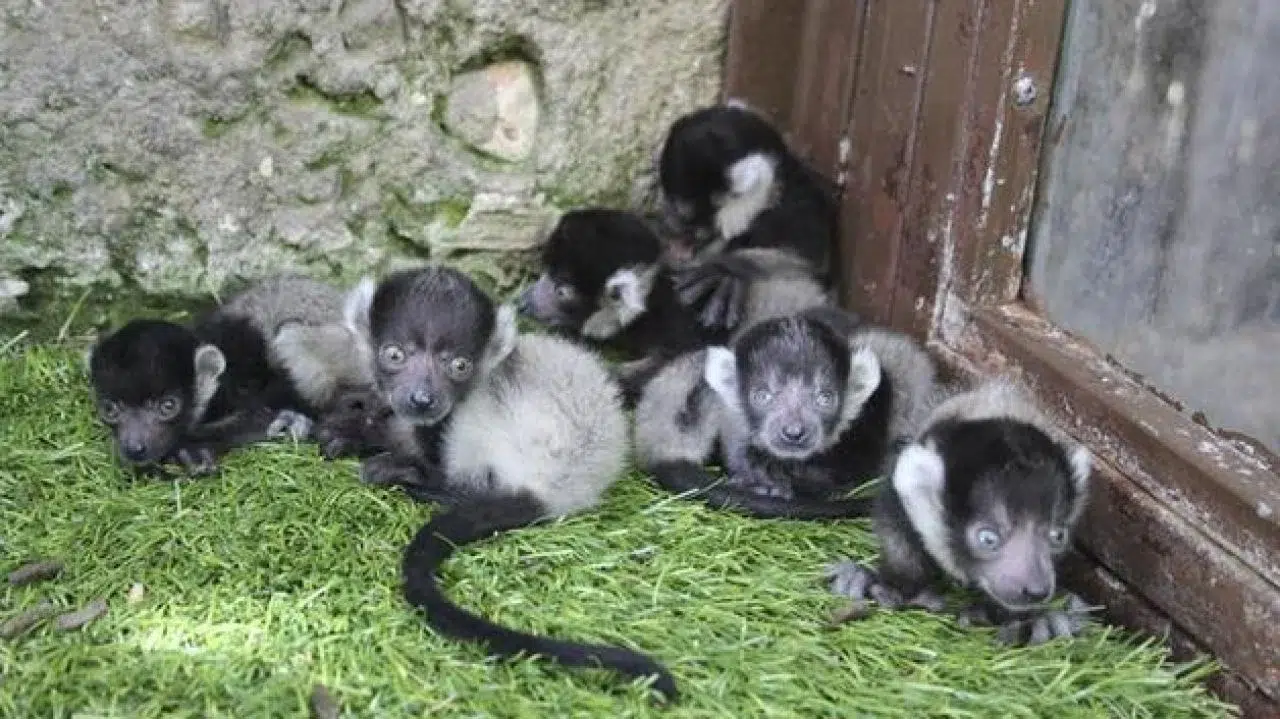
An unexpected surge in the births of black-and-white ruffed lemurs in Ranomafana National Park, in southeastern Madagascar, has raised concerns in the scientific community.
While it could be interpreted as a positive sign for a species in critical danger of extinction, experts warn that this phenomenon could be associated with environmental stress and profound changes in their habitat, possibly related to climate change.
Two decades of scientific monitoring
The team led by Andrea Baden, a biological anthropologist at Hunter College (New York), and Randy Junge, vice president of conservation medicine at the Columbus Zoo and Aquarium (Ohio), has been monitoring this lemur population for almost 20 years.
Since 2005, alongside Malagasy technicians and students, they have recorded reproductive patterns characterized by long intervals between births.
However, in 2024 they observed an unprecedented change: females reproduced for two consecutive years, and in 2025 field ultrasounds confirmed new pregnancies, suggesting up to a third consecutive year with offspring for some mothers.
An extremely brief reproductive window
Black-and-white ruffed lemurs have a fertility window of just 24 to 72 hours a year, which explains the irregularity in their births.
Under normal conditions, between 80% and 100% of adult females give birth in October, with litters of two or three offspring. But in 2024, births were advanced to September and only some females became pregnant, breaking the typical pattern of synchrony.
In the latest campaign, researchers examined seven adult females: four were pregnant, three with twins and one with a single offspring. One of the fetuses was noticeably larger, suggesting conception outside the usual reproductive period.
Scientific hypotheses: climate change and nutrients
The main hypotheses point to the impact of climate change and the alteration of plant fruiting and flowering cycles.
“We are witnessing a strange moment in reproduction, and plants are fruiting and flowering in atypical periods. It is probably due to climate change. The wet seasons are much drier,” Baden explained in bioGraphic.
Meanwhile, Junge is investigating whether the variation in essential nutrients provided by certain trees affects fertility.
“If there is a crucial nutrient they get from a specific tree and it does not bear fruit, the entire reproductive cycle could be altered,” he noted.
A critical outlook for Madagascar’s lemurs
The conservation situation is alarming. According to bioGraphic, the population of black-and-white ruffed lemurs has decreased by at least 80% in the last two decades.
Threats include:
- Logging and deforestation.
- Mining.
- Hunting.
- Pressure from local communities dependent on the forest.
The conservation director of Wildlife Madagascar, Tim Eppley, warned that lemurs live “in a very precarious situation,” with a significant portion of the island’s more than 100 endemic species threatened with extinction and populations restricted to forest fragments.
Next steps: monitoring and conservation
The team of Baden and Junge plans to continue with ultrasounds and biomedical studies in future expeditions to identify the environmental and biological factors determining the fertility of these lemurs.
Detailed monitoring of pregnancies and offspring survival will be key to determining whether the increase in births is a warning sign or an exception.
If the new offspring survive, one of the females could reach her third consecutive year of reproduction, something never recorded in the species.
The reproductive surge of black-and-white ruffed lemurs in Ranomafana reflects an extremely fragile balance between the species and its environment. In a context of climate change and habitat loss, each birth is both a hope and a reminder of the urgency to protect Madagascar’s unique biodiversity.



