



The discovery of a tiny species once again shook the understanding of the health of the marine ecosystem of Galápagos. A scientific team located colonies of a solitary coral that was believed to have disappeared since the beginning of the 21st century.
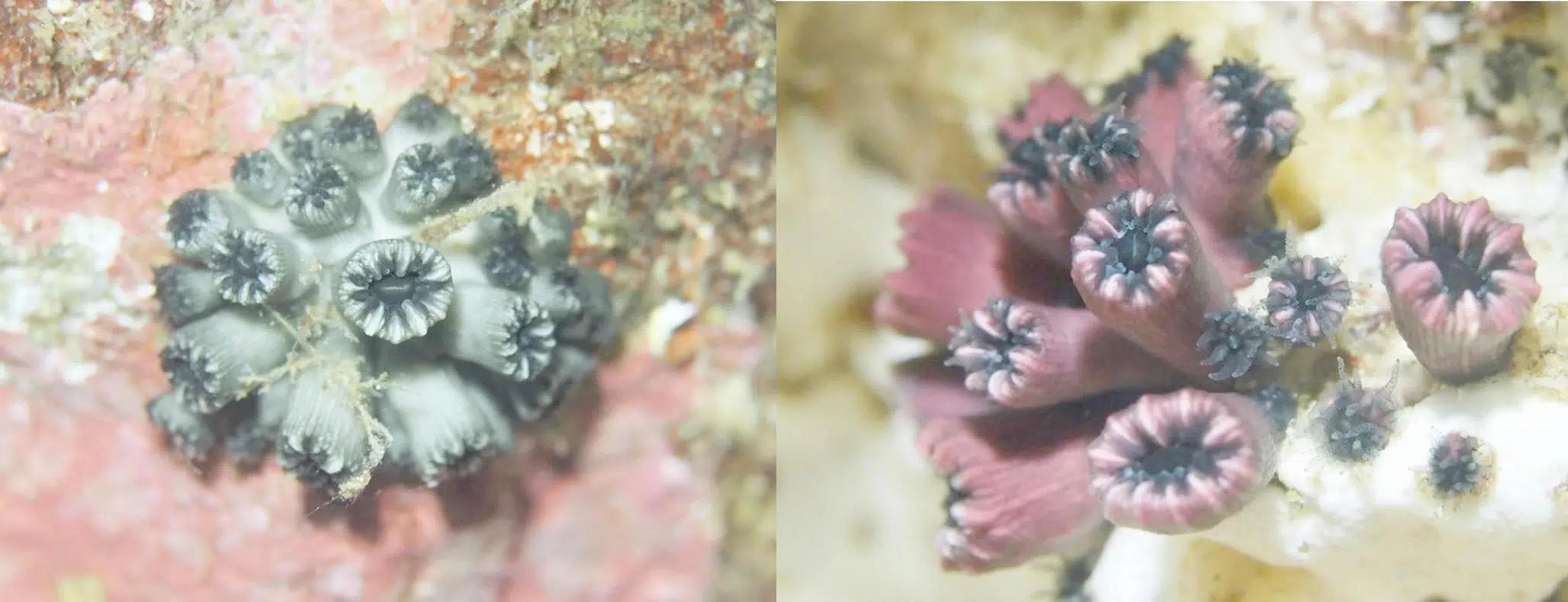
The researchers dove around Isabela Island with the mission of tracking elusive species, and among the cracks in the rocky seabed, tiny white, purple, and black dots appeared.
That brief flash was enough to rewrite a story that had been considered closed for 24 years. The solitary coral Rhizopsammia wellingtoni was not only alive but forming colonies in previously unrecorded sites.
A discovery that opens new lines of research and demands urgent measures to protect its fragile habitat.
A tiny species that survived oblivion
The first dives revealed more than a hundred colonies on a ledge near Caleta Tagus, just 12 meters deep. The discovery quickly expanded to other areas of Isabela and Fernandina, where the presence of the coral had never been documented before.
In total, more than 250 living colonies were recorded, with dark purple and reddish-black tones. Their size, just a few millimeters, explains why they went unnoticed for decades even by expert eyes.
The discovery prompted new expeditions to verify the real distribution of the species, whose presence seems more widespread than previously believed.
Who are the solitary corals of Galápagos
The Wellington solitary corals are endemic to the archipelago and build small structures formed by independent polyps that share a common skeleton. Although they do not form massive reefs, they are an essential part of the ecosystems that surround them.
Their microscopic size makes them invisible to most visitors and means they depend on stable conditions to survive. Small variations in temperature or nutrient availability can make the difference between their expansion and collapse.
Their reappearance not only demonstrates their resilience but also the complexity of the processes that allow an extremely vulnerable species to persist silently in the depths.
Causes that led to their apparent extinction
The Wellington solitary coral was declared extinct after a series of events devastated the marine ecosystems of Galápagos. The El Niño phenomena of 1982 and 1997 abruptly raised sea temperatures and destroyed about 97% of the corals in the archipelago.
The progressive increase in ocean heat further limited their recovery capacity. The warm waters reduced the nutrient supply and altered the chemical balance essential for the polyps to build their skeleton.
Additionally, their distribution in small and scattered colonies made detection difficult and increased the risk of losing connectivity, a key factor for their reproduction and survival.
The combination of thermal stress, extreme weather events, and fragmented habitats generated the perception of an extinction that, fortunately, was not total.

Silent adaptation in a changing ocean
Despite the impact of global warming, some colonies managed to adapt by moving to greater depths, where temperatures are lower and more stable. Recent records located specimens between 50 and 200 meters.
The cold currents that run through Galápagos provided nutrients that allowed the survival of small isolated groups. Thanks to them, the species resisted changes that eliminated other surface corals.
This adaptive behavior explains their survival but does not guarantee their permanence. The sustained increase in sea temperature still threatens the corals that depend on cold waters to thrive.
The global coral crisis
Warm-water corals are among the first victims of ocean warming. A significant portion of the planet’s species is now at risk of disappearing due to recurrent bleaching, pollution, and habitat loss.
In recent decades, the proportion of threatened corals has grown rapidly, reflecting the pressure of an unstable climate and human activities that degrade the marine environment.
In this context, the reappearance of the Wellington coral offers a sign of hope but also a reminder of how close it came to extinction forever.

Conserving to not lose what has been recovered
The monitoring project in Galápagos aims to generate continuous information to guide conservation decisions. The areas where colonies were found might require access limits and reinforced surveillance.
The annual record will allow the evaluation of the recovery or regression of this species and the adoption of timely measures in case of new threats. The protection of fragile habitats remains fundamental to avoid another collapse.
The goal is to ensure that this coral, rediscovered after decades of silence, can become a stable part of the ecosystem and contribute to the biological balance of the archipelago.
A discovery that prompts new questions
The return of the Wellington solitary coral not only corrects a misclassification but also opens the door to deeper investigations into the biodiversity hidden in the islands.
New dives are already scheduled to search for other species that might have survived in unknown refuges. Each discovery reinforces the importance of systematic monitoring in a world where the ocean is changing at an unprecedented pace.
The resilience of this coral demonstrates that life persists even in extreme scenarios, but also that its continuity depends on immediate human decisions.



