



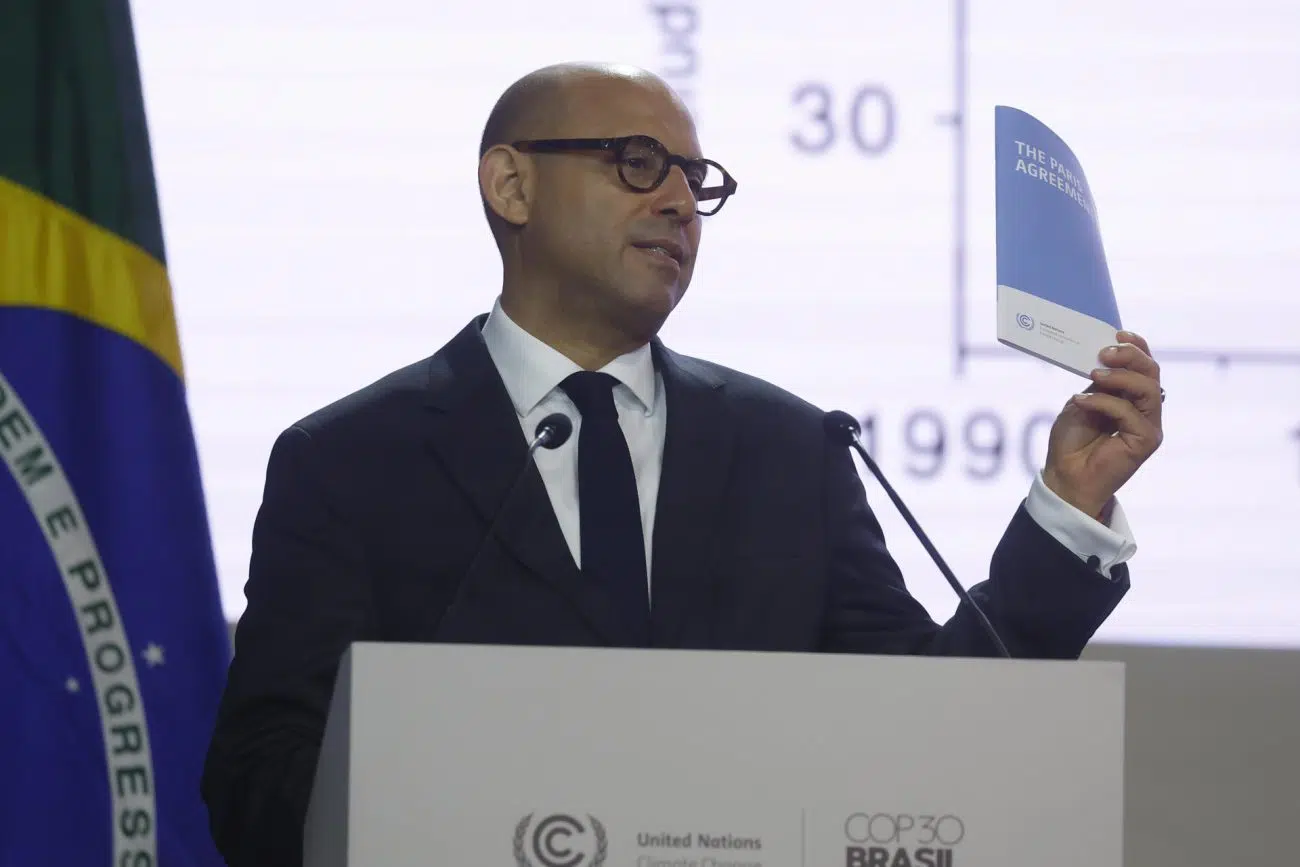
El secretario ejecutivo de la Convención de Naciones Unidas sobre el Cambio Climático (CMNUCC), Simon Stiell, afirmó que la COP30 de Belém (Brasil) debe demostrar que la cooperación climática sigue firme en un contexto global marcado por la fragmentación política y económica.
“We need to show that climate cooperation is firm in a fragmented world. I see great determination to build on the fundamental progress of COP30 and to show, once again, that climate cooperation works to deliver real progress,” Stiell said during the opening of the high-level plenary meeting.
Urgency and Criticism of the Pace of Negotiations
Stiell reiterated his call for speed and urgency in the negotiations, warning that the current pace “does not reflect the speed and magnitude of the transition already taking place in the real economy.”
“The will is there. But the speed is not,” he emphasized.
The official urged ministers and negotiators to address the most difficult issues without delay:
- Avoid tactical delays and evasions.
- Overcome “performative diplomacy” and move to concrete action.
- Recognize that every delay implies losses for everyone.
A New More Sustainable Economy
Stiell celebrated that a new sustainable economy is advancing faster than expected, driven by private initiatives mobilizing trillions of dollars towards clean energy and climate adaptation projects.
“Last year, more than 2.2 trillion were injected into renewable energies, which is more than the GDP of over 180 countries,” he highlighted.
Voices from the UN and Brazil in the Plenary
The president of the UN General Assembly, Annalena Baerbock, reminded that the climate crisis has real impacts on the population, beyond the denial of skeptics.
Meanwhile, Brazil’s Vice President, Geraldo Alckmin, called for moving from words to deeds:
“This must be the conference of truth, implementation, and above all, responsibility with the planet,” he stated, paraphrasing President Luiz Inácio Lula da Silva.
Alckmin emphasized that:
- Every additional fraction of a degree of global warming represents lives at risk.
- Climate change generates more inequality and losses for those who have contributed the least to the problem.
- Every political decision at COP30 must contribute to preserving life, protecting biodiversity, and ensuring environmental justice.
A Tribute to the Amazon
Before giving way to the speakers, a video about the Amazon was shown, made with footage by Brazilian photographer Sebastião Salgado, who passed away this year and was globally recognized for his environmental advocacy.
The Decisive Week of COP30
After six days of debates, COP30 enters its critical phase with the arrival of ministers, who take command of the negotiations. The pressure from Amazonian indigenous peoples and civil society is felt, demanding concrete commitments and immediate actions in the face of the climate crisis.
COP30 in Belém is shaping up to be a decisive summit to demonstrate that international cooperation on climate matters is still alive despite global tensions. The warnings from Stiell and Alckmin set the tone: the time for promises is over, and every delay implies greater risks for humanity and the planet.
Cover photo: EFE Verde


