



South America is home to famous deserts such as the Atacama in Chile or the Patagonia in Argentina. However, there is another lesser-known one that has become a privileged destination for astronomical observation: the Tatacoa Desert in Colombia.
Located in the department of Huila, this tropical dry forest is the second largest arid zone in the country and is distinguished by its eroded landscapes, geological richness, and the exceptional quality of its night skies.
A landscape from another planet
The Tatacoa Desert is divided into two main areas:
- Red Desert: with clay rock formations that create canyons and intense-toned reliefs.
- Gray Desert: characterized by eroded terrains and lunar-like landscapes.
Although it is called a “desert,” it is actually a tropical dry forest. Its temperatures range between 27°C and 34°C, although they can reach up to 45°C on the hottest days.
The biodiversity is surprising: cacti, lizards, snakes, and arachnids coexist in this arid environment. The name “Tatacoa” comes from an indigenous word meaning “snakes”, reflecting the fauna that inhabits the region.
Geological history and fossils
The desert formations originated over millions of years due to water and wind erosion, as well as tectonic movements. In ancient times, the area was a large lake and a humid jungle, before the formation of the eastern mountain range.
The Tatacoa is also rich in fossils, some of which are displayed in community museums, making the region a place of interest for archaeological and paleontological exploration.
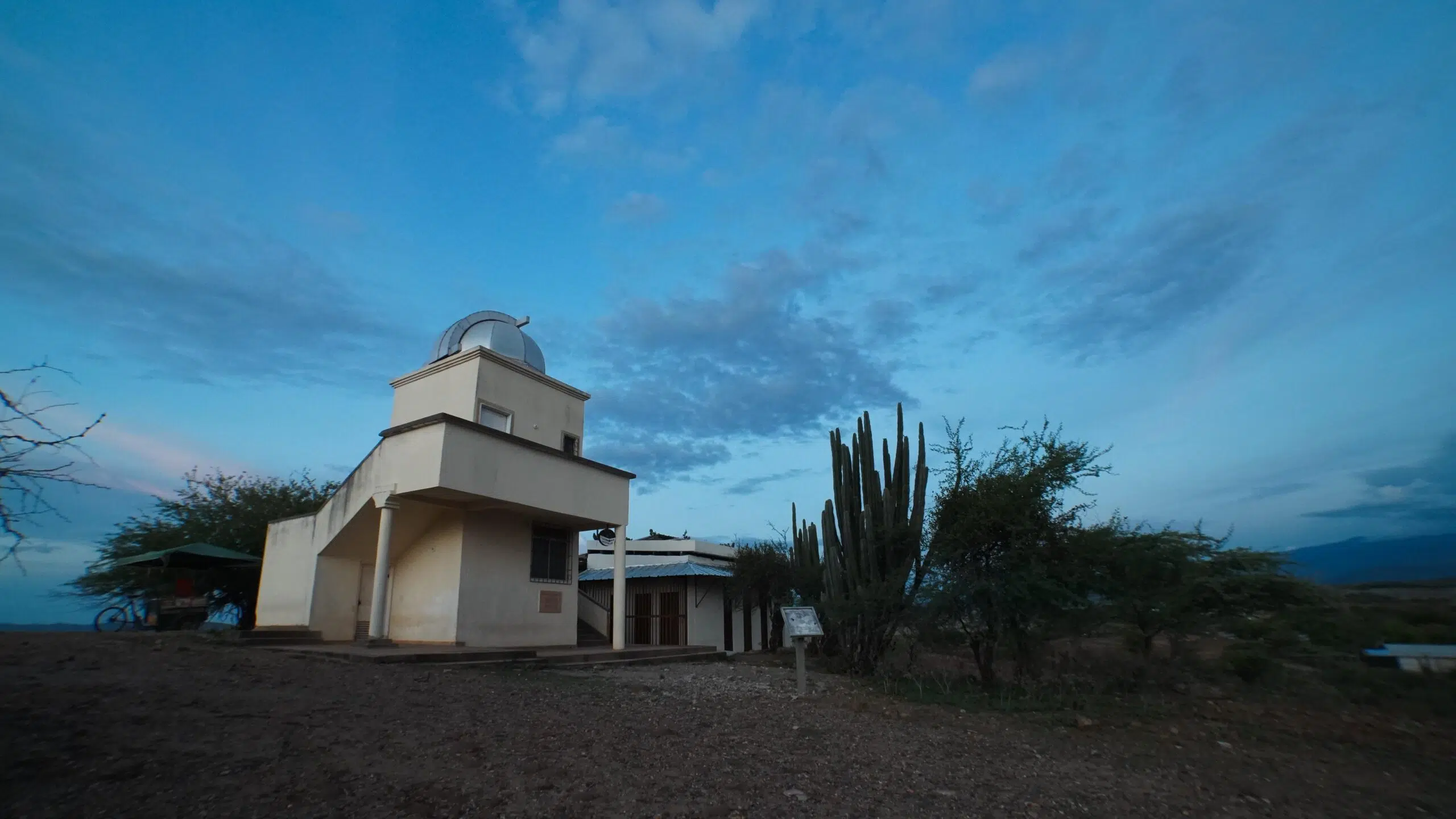
A certified sky for astronomy
Thanks to its low light pollution, the Tatacoa Desert is one of the best places in Colombia to observe the night sky. In 2019, it received the international certification “Starlight Tourist Destination”, granted by the Starlight Foundation, which guarantees the quality of its skies as a natural resource to protect.
Among the astronomical phenomena that can be observed are:
- The Milky Way, planets, and constellations visible to the naked eye with great clarity.
- Meteor showers such as the Perseids (August) and the Geminids (December).
- Solar and lunar eclipses, like the annular solar eclipse of October 2023.
- Uncommon planetary alignments, possible thanks to the clarity of the sky.
Astronomical observatories in the Tatacoa
The region has several observatories offering educational and scientific activities:
- OATA Astronomical Observatory: located in Villavieja, offers talks in English and Spanish from Monday to Sunday, from 18:00 to 22:00 hours.
- Astrosur Astronomical Observatory: led by Professor Javier Fernando Rúa, provides talks and access to professional equipment from 19:00 hours.
- Other spaces: the La Tatacoa Observatory, Orion Interstellar Camp, and Vyctoria Stars also offer astronomical observation experiences.
A natural and scientific treasure
The Tatacoa Desert is much more than an arid landscape: it is a natural laboratory for astronomy, a space of adapted biodiversity, and a site of geological and paleontological interest.
Its certification as a Starlight Tourist Destination positions it as one of the best places in the world to observe the night sky, while its observatories bring science closer to visitors from all over.
Protecting this unique environment is essential to preserve both its natural heritage and its scientific and cultural value, ensuring that future generations can continue to marvel at the clear skies of the Tatacoa.


