



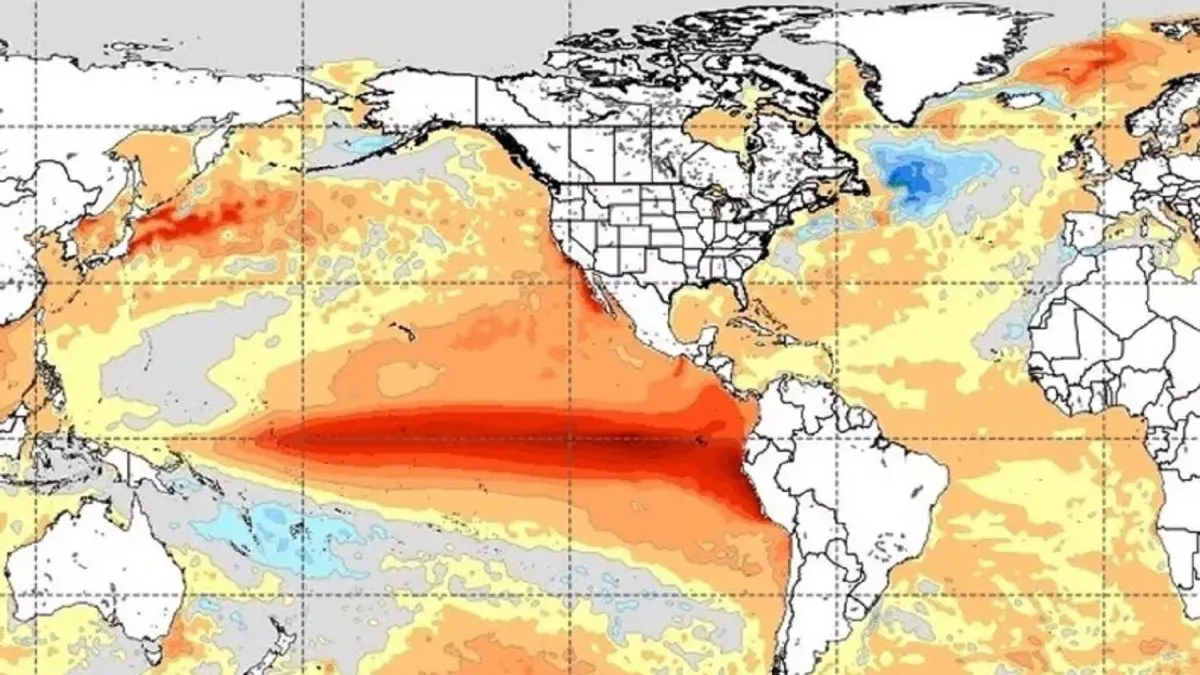
The Sentinel-6 Michael Freilich satellite, a joint project of NASA and European partners, recorded the arrival of a massive mass of warm water in the Pacific Ocean, positioned off the coasts of Peru, Ecuador, and Colombia. This behavior anticipates the development of the climate phenomenon El Niño towards the end of the year.
Scientists use the rise in sea level as an indicator of ocean temperature increase. In May, measurements confirmed that the sea level in Peru was 15 cm above the historical average.
Kelvin Waves: the engine of the phenomenon
Satellite monitoring follows the so-called warm Kelvin waves, underwater waves that form when trade winds change direction or weaken. These waves carry warm water from the western Pacific towards South America.
Chronology of the current event:
- January: small Kelvin wave detected near Micronesia.
- March: new wave with greater strength moved eastward.
- May: impact in Peru with a significant rise in sea level.
The phenomenon consolidates when multiple Kelvin waves occur over months, accumulating warm water off the South American coasts.
Global impacts of El Niño
El Niño alters atmospheric patterns and has far-reaching socioeconomic consequences:
- Torrential rains and floods in some regions.
- Severe droughts in other areas of the planet.
- Changes in the jet stream and variation in storm trajectories.
Historical examples:
- Moderate events (2018, 2023): impacts confined to the tropical Pacific.
- Major phenomena (2015-2016): extreme droughts in Africa and floods in California.
A scientific legacy since 1992
The Sentinel-6 Michael Freilich, launched in 2020, maps water height every 10 days with millimeter precision. It continues the legacy started in 1992 by the TOPEX/Poseidon mission. Its successor, the Sentinel-6B, will be launched in November 2025 and will assume the definitive replacement in 2026.
The mission is part of the European Copernicus program and is supported by ESA, EUMETSAT, NASA, NOAA, and the technical support of the French space agency CNES.
The advance of this warm mass confirms that the El Niño phenomenon is in the process of activation. Although it began later than the devastating events of 1997 and 2015, scientists warn that its magnitude could reach similar levels.
The coming months will be key to assessing the intensity and global impacts of this climate phenomenon.



