



More than a decade ago, China initiated a strategy of territorial expansion in the South China Sea, which involved dumping tons of sand on reefs to create artificial islands.
Although this technique is not exclusive —Japan used it to build an airport— the Chinese case stands out for its massive scale and geopolitical objectives.
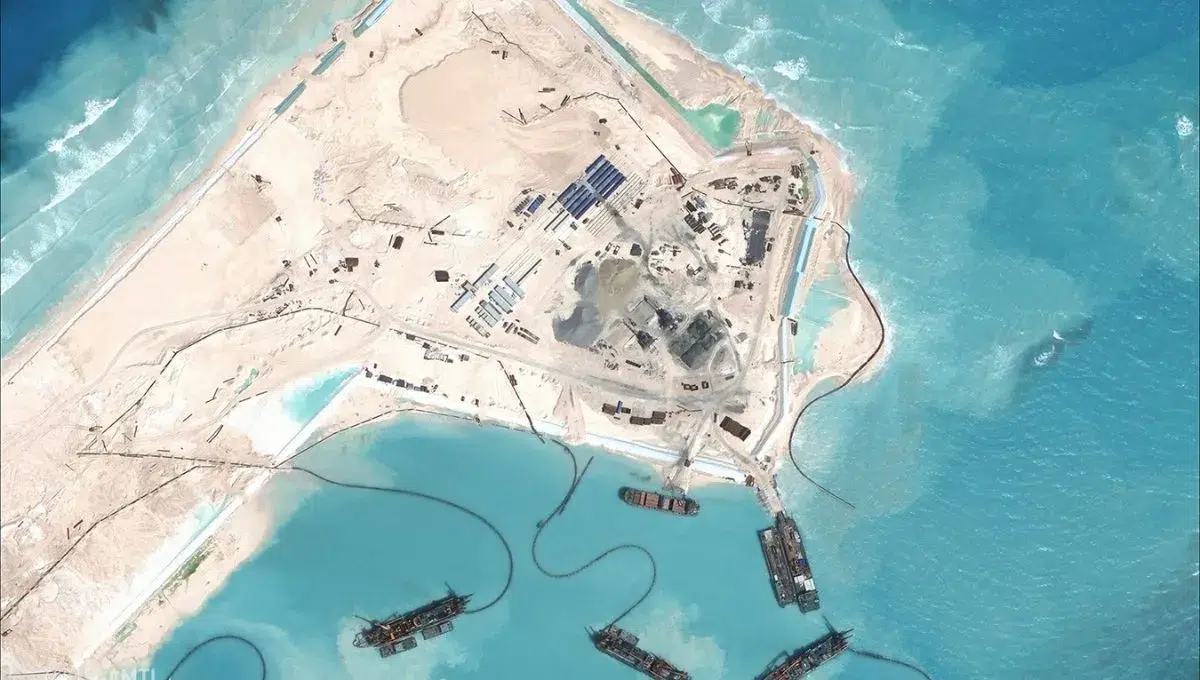
The first phase: massive reef filling
In 2013, China began filling seven reefs of the Nansha (Spratly) and Xisha (Paracels) archipelagos. Between December of that year and June 2015, the first phase was completed: the sediment filling.
The process included:
- Cutting the coral seabed.
- Pumping sediments to shallow areas.
- Construction of dikes and retaining walls.
- Compaction with heavy machinery.
- Paving and creation of runways, roads, and other infrastructure.
The result was the creation of more than 12 km² of artificial land, a figure that represents “17 times more land reclaimed in 20 months than achieved by other countries in 40 years.”
Consolidation of the territory
Since 2015, China has consolidated these islands with strategic infrastructures:
- Runways and hangars.
- Ports and radars.
- Underground facilities and missile platforms.
According to reports from the CSIS (2025), these constructions allow for almost permanent activity by China in the region, with offensive and defensive capabilities.
Motivations and regional tensions
The Chinese government maintains that the islands serve for:
- High-sea rescue missions.
- Support for fishing and scientific research.
- Navigation and meteorological data collection.
- National defense.
However, neighboring countries such as Vietnam, Taiwan, Japan, and the Philippines consider it a strategy to claim disputed territories. Japan, for example, asserts that these infrastructures consolidate a permanent military presence in waters that do not belong to China.
Vietnam has even replicated the strategy since 2013, dumping land into the sea to expand its presence in the area.
Environmental impact
Beyond political motivations, the environmental impact is undeniable:
- Loss of between 12 and 18 km² of reefs, some of the best preserved in the region.
- Alteration of currents and sediment patterns.
- Formation of sediment “clouds” affecting distant ecosystems.
- Complete elimination of ecosystems in the occupied areas.
Chinese scientific articles acknowledge the degradation, although the State Oceanic Administration of China argues that the projects were evaluated and that the damages are due to global trends such as ocean acidification and climate change.
The construction of artificial islands in the South China Sea reflects a long-term geopolitical strategy that has transformed the regional balance. While China defends its legitimacy and utility, neighbors denounce a covert military expansion.
The environmental damage, however, is the common point that no narrative can hide: the loss of reefs and marine ecosystems is already a fact, and its consequences extend beyond the disputed borders.


