



European researchers, led by SINTEF in collaboration with the Swiss company COWA Thermal Solutions, have developed thermal batteries 85% more efficient than conventional ones.
These solutions, based on recycled aluminum and special salts, allow storing heat with greater density and stability than hot water, paving the way for more autonomous and sustainable homes and energy communities.
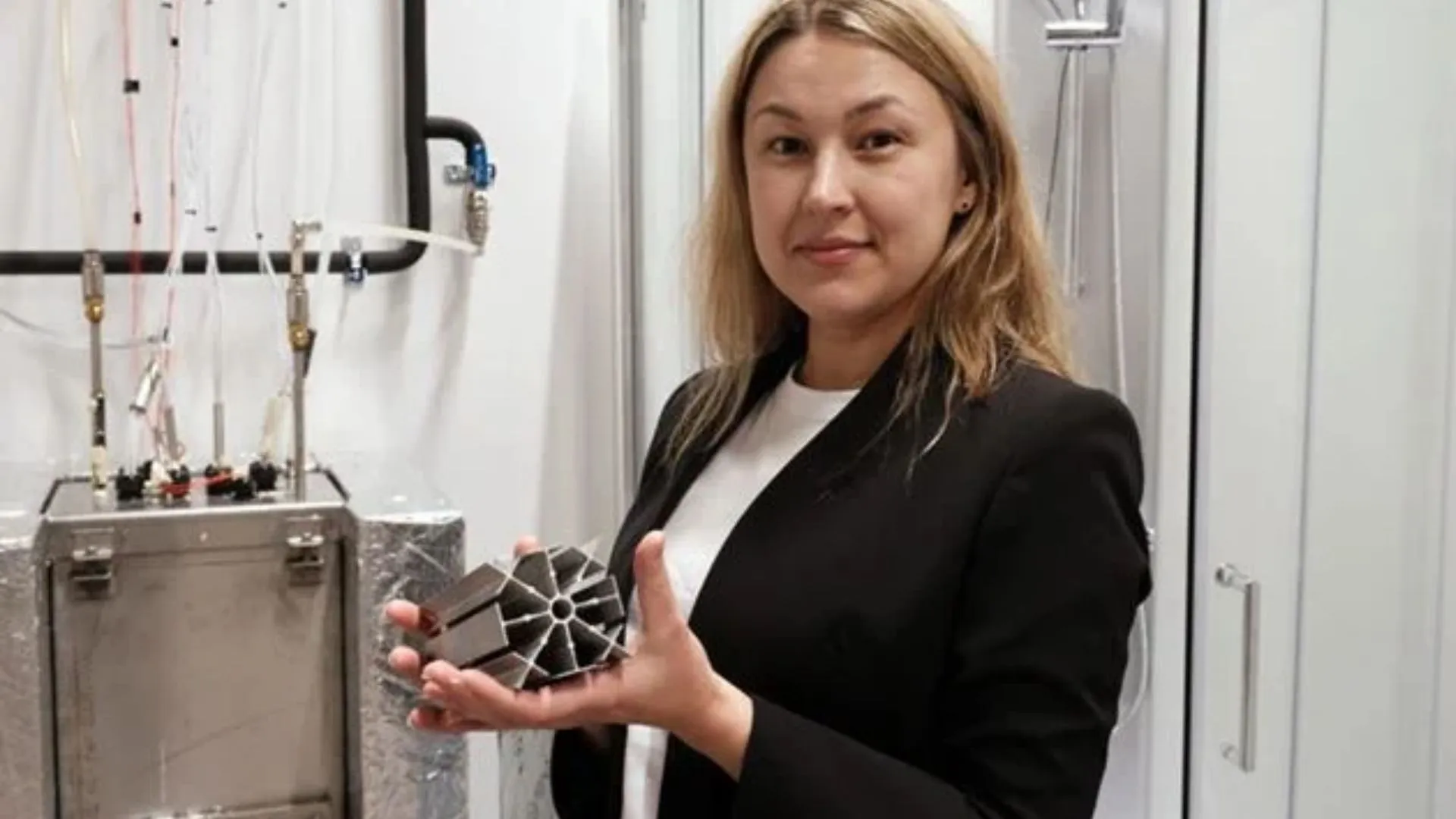
Researcher Galina Simonsen assures that this technology is ready to move from laboratories to homes, thanks to its accessible scale and low cost.
The problem with heat pumps
Heat pumps are a key tool for decarbonizing heating, but they have a limitation: they produce heat only when electricity is available, not necessarily when it is needed.
The new thermal batteries solve this challenge by storing excess heat and releasing it at the right time, improving comfort and energy efficiency.
How the system works
The secret lies in salt hydrates, phase change materials that:
- Trap water molecules in their crystalline structure.
- When heated, they change from solid to liquid and absorb large amounts of energy.
- When cooled, they solidify and release heat in a controlled manner.
This behavior allows storing several times more heat per volume than water, keeping it stable for longer and reducing the size of systems, which is crucial in homes with limited space.
Main advantages
- Greater energy efficiency: each kilowatt-hour is better utilized.
- Improved comfort: consecutive showers without temperature loss and heating available at critical times.
- Circular economy: use of recycled aluminum and abundant, non-toxic, non-flammable materials.
- Emission reduction: less dependence on gas and a smaller carbon footprint.
- Stability of the electrical grid: heat is produced when it suits the system and used when it suits people.
Technical innovations
One of the challenges was achieving fast and uniform thermal charges and discharges. To address this, the team designed thermal fins made of recycled aluminum, which efficiently distribute energy.
The corrosion problem, common in the contact between salts and recycled aluminum, was solved through plasma electrolytic oxidation (PEO), which creates an ultra-thin protective ceramic layer. This ensures durability, less maintenance, and fewer waste in the long term.
Impact on homes and communities
In a scenario of electrified cities, these thermal batteries can become a key component:
- Homes: each home acts as a small renewable energy storage.
- Collective buildings: combined with shared photovoltaics, they cover a large part of the hot water and heating demand.
- Cold climates: they facilitate more flexible and resilient neighborhood heat networks.
The innovation by SINTEF and COWA demonstrates that sustainability can be quiet and everyday.
These thermal batteries do not seek to dazzle but to integrate into daily life, storing heat when there is excess and delivering it when needed. A simple yet transformative advancement that brings the energy transition closer to millions of European homes.



