



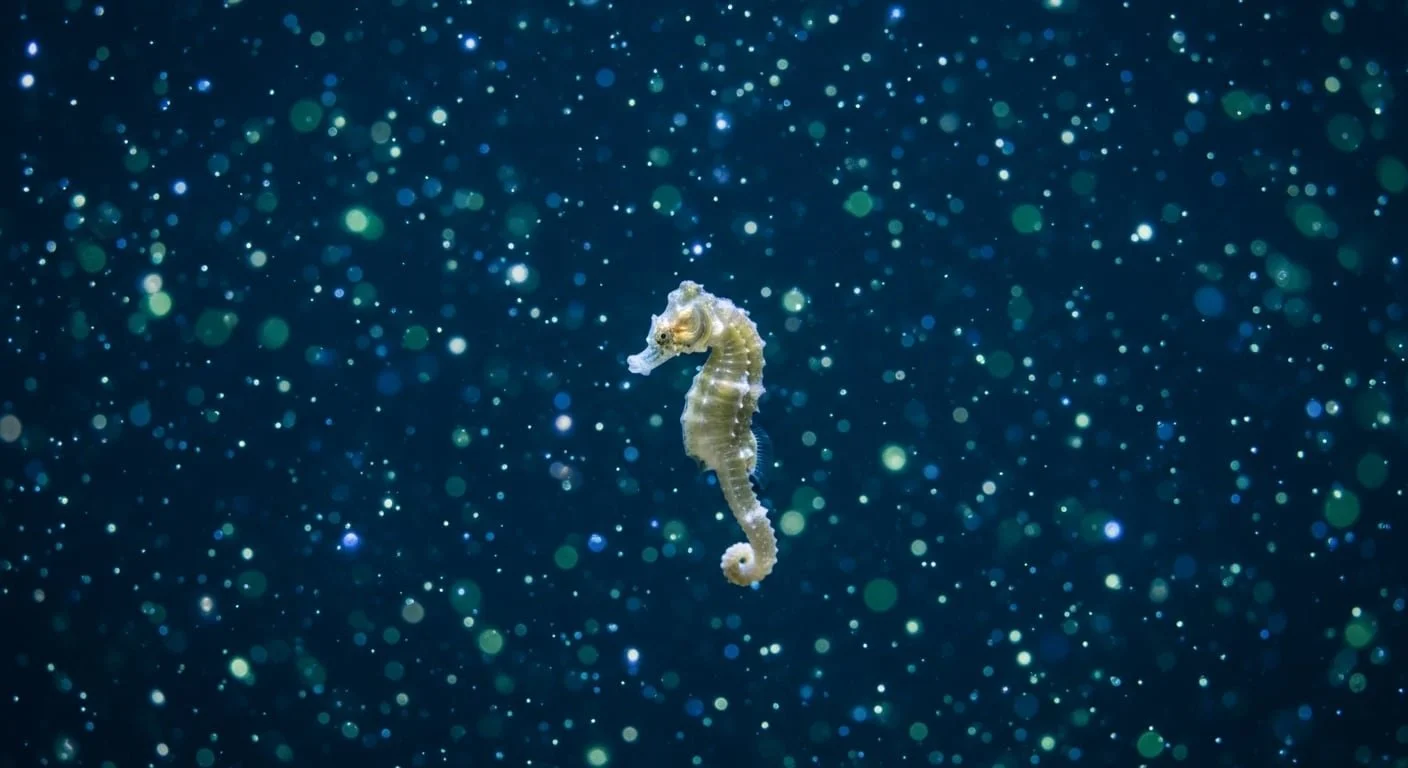
The seahorse is one of the most fascinating animals of the marine world. Its vertical body, prehensile tail, tubular snout, and delicate movements make it the protagonist of legends and myths since antiquity.
However, behind its fragile appearance, it hides unique evolutionary adaptations and a key ecological role in coastal ecosystems.
Unique Morphology and Behavior
Grouped in the genus Hippocampus, seahorses inhabit tropical and temperate waters on almost all continents. They are distinguished by:
- Lacking scales and possessing a bony armor of plates.
- Eyes capable of moving independently.
- Swimming in a vertical position thanks to a tiny dorsal fin.
- A flexible and prehensile tail that allows them to cling to corals and algae, blending in with the environment.
Their reproductive biology is unique: in most species, it is the male who becomes “pregnant”, incubating the eggs in a ventral pouch until birth. Additionally, their specialized diet is based on small crustaceans and plankton, captured with a highly efficient tubular snout.
The Discovery in Sweetings Pond
The real astonishment came in Sweetings Pond, a closed lagoon on the island of Eleuthera, Bahamas. There, a team led by marine ecologist Heather Mason detected the world’s largest concentration of seahorses ever recorded.
In just four nights of research, 800 specimens of Hippocampus erectus were identified in a small area, far surpassing any previous record. Sweetings Pond, isolated from the sea for thousands of years, offers a closed and stable environment, without large predators and with abundant food, ideal conditions for the species.
A Laboratory of Evolution
Isolation has generated a process of accelerated evolution. The lagoon’s specimens have longer snouts, compact bodies, and shorter tails, traits that differentiate them from other Caribbean seahorses. Mason described it as “a laboratory of evolution in real-time.”
Scientists also observed unusual behaviors:
- Adjustment of schedules and positions according to the time of day.
- More active nocturnal routines, with hundreds of specimens visible among the vegetation.
- Strategies to maximize the survival of the young and avoid predators.
Open Questions
Despite the advances, fundamental questions remain:
- How does courtship and egg transfer occur in this particular environment?
- What is the fate of the young after birth?
- How is the social structure of the local population organized?
Sweetings Pond could provide key answers to better understand the reproduction and social dynamics of seahorses.
Global Threats
Worldwide, seahorses face increasing pressures:
- Destruction of mangroves and seagrasses.
- Water pollution.
- Indiscriminate capture for international trade.
These threats have placed many populations in a vulnerable situation. The case of Sweetings Pond, with its record density, is a hope for the species and an urgent call to conserve exceptional habitats.
Conservation in the Bahamas
The international impact of the findings led the government of the Bahamas to declare the lagoon a national park two years ago, under the management of the Bahamas National Trust. The protected area, of 548 hectares, includes the Hatchet Bay cave and maintains restricted public access to preserve both the seahorses and other unique species, such as the spider crab and the bioluminescent plankton.
Park management involves:
- Constant monitoring.
- Collaboration with scientific institutions.
- Environmental education programs for local communities.
The goal is to ensure that Sweetings Pond remains a sanctuary for the seahorse and a replicable conservation model in other parts of the world.
The seahorse, a symbol of mystery and delicacy, finds in Sweetings Pond a unique refuge that reveals evolutionary and ecological secrets. This Bahamian enclave not only represents the world’s largest concentration of the species but also a reminder of the urgency to protect marine ecosystems against global threats.



