



A new study revealed that the terrestrial microplastics released into the atmosphere reach unexpected figures.
The analysis, conducted by the University of Vienna, revealed that the planet’s surface emits around 610 trillion particles per year, an amount twenty times higher than that from the oceans.
The annual volume of these microplastics is approximately equivalent to 18 entire Olympic swimming pools of particles released into the atmosphere.
This is a relevant fact because it challenges the traditional belief that the seas are the main source of pollution by microplastics into the atmosphere.
In fact, the data demonstrated that the land surface, despite representing only 29% of the planet, is a much more active source of microplastics into the atmosphere.
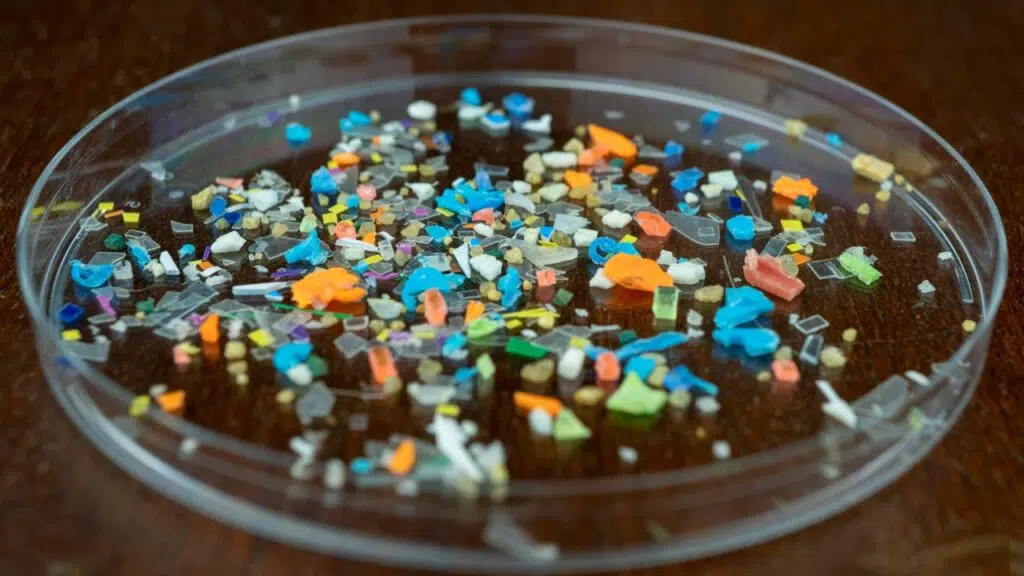
These particles -less than five millimeters- generated by the degradation of plastic today pose a serious risk to human and animal health.
Microplastics in the atmosphere are present in practically all terrestrial and aquatic ecosystems, and can be inhaled or ingested.

The main sources of microplastic emissions into the atmosphere
The terrestrial microplastics that reach the atmosphere originate from various everyday processes. Among the most relevant sources are:
- Tire abrasion during driving
- Wear of synthetic textile fibers
- Resuspension of previously contaminated soils
- Daily urban and industrial activities
Ioanna Evangelou, author of the study, explained that “more than 20 times more microplastic particles are emitted into the atmosphere from land than from the ocean”.
However, she noted that the average size of marine particles is larger.
This means that although the number of terrestrial microplastics in the atmosphere is higher, the total mass emitted by the oceans remains higher due to size differences.
How the study analyzing the sources of microplastics was conducted
The research collected 2782 measurements of microplastic concentrations in the atmosphere from 76 studies.
These were conducted in 283 locations worldwide between 2014 and 2024, and were compared with atmospheric model simulations.
Scientists estimated that the land releases about 0.08 particles per cubic meter. In contrast, the oceans emit 0.003, with sizes ranging from five to one hundred micrometers into the atmosphere.
The figures were two to four times lower than previous estimates. This suggests that earlier models overestimated the magnitude of the terrestrial microplastic problem.
The study also revised downward the total amount of microplastics entering the atmosphere. This would be between 100 and 10,000 times lower than previously thought.
Pending challenges
The authors emphasized that this reduction should not be interpreted as a definitive good news. The presence of microplastics in the air remains global and constant in terrestrial and marine ecosystems.
Andreas Stohl, vice-dean of the Faculty of Earth Sciences at the University of Vienna, warned: “The problem is that we still do not know precisely how much microplastic comes from traffic and how much from other sources”.
Therefore, the research highlighted the need to improve measurements on the distribution and size of these particles.
Better understanding these dynamics will allow assessing their impact on health, ecosystems, and terrestrial climate.
The study thus confirms that the fight against plastic pollution cannot focus solely on the oceans. The land surface is also a major source of microplastics circulating through the global atmosphere.


