



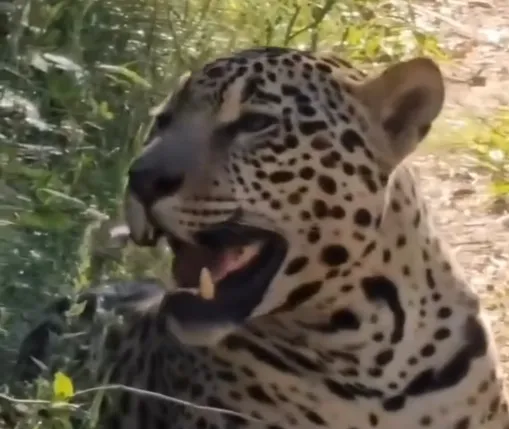
Angujá, a 1-year and 10-month-old jaguar, roams freely through the Correntine wetlands. In this way, its development represents a key advancement in the recovery of the species.
Moreover, it was born without direct human intervention in the Iberá ecosystem. Therefore, its case reflects a sustained ecological restoration process.
However, its presence also highlights the fragility of environmental balance. Consequently, each specimen is crucial to consolidate the population.
A lineage that rebuilds the history of Iberá
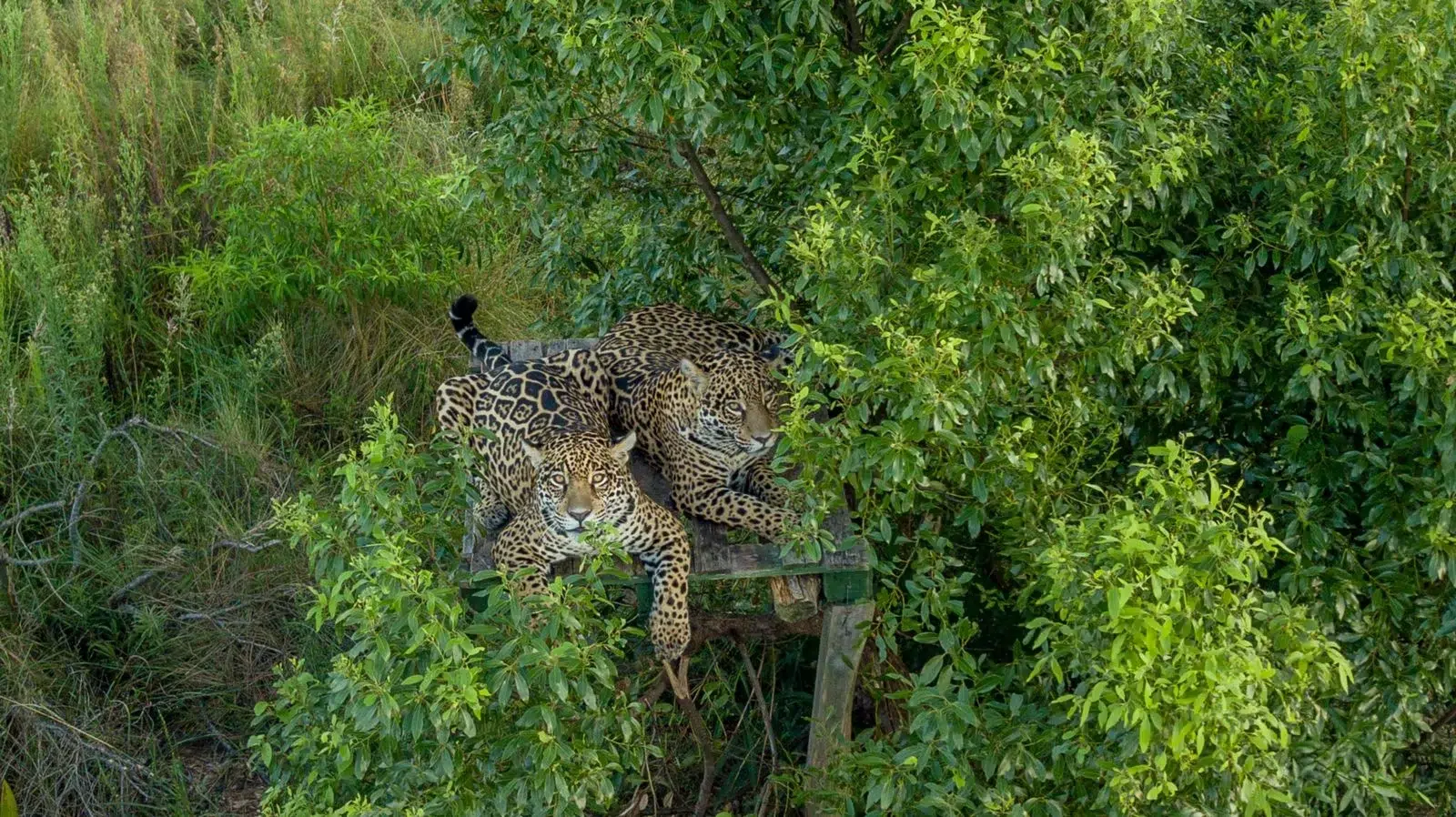
The origin of Angujá is linked to two key specimens of the project. On one hand, its father Sãso was born in 2021 in Iberá.
Likewise, that birth, along with that of its sister Sagua’a, marked a turning point. Since then, the first cases in the wild have been recorded after decades of absence.
On the other hand, its mother Coli comes from Paraguay. Consequently, its story reflects the regional conservation efforts.
Additionally, she was rescued in orphaned condition and reintroduced in October 2023. In this way, she managed to readapt to wildlife.
Iberá as a stage for environmental restoration
The Iberá National Park has become a key space for the recovery of species. In this context, the jaguar plays a central role.
Moreover, the wetlands offer ideal conditions for its development. Therefore, they allow the reconstruction of lost ecological chains.
However, this process requires constant monitoring. Consequently, conservation depends on long-term strategies.
Likewise, the coordination between organizations and projects is fundamental. In this way, the continuity of the program is ensured.
Importance of jaguar conservation
The jaguar is the largest predator in South America. Therefore, it plays a key role in the balance of ecosystems. Additionally, it regulates populations of other species. Consequently, its presence prevents ecological imbalances.
However, its disappearance in many regions has caused significant environmental impacts. Therefore, its recovery is prioritized.
Likewise, its conservation indirectly protects large habitat areas. In this way, it preserves biodiversity.
Finally, the case of Angujá symbolizes an opportunity. Indeed, it demonstrates that environmental restoration is possible with sustained policies.
A process that projects the future of the species
The growth of Angujá opens new expectations for the region. Consequently, it strengthens the viability of a stable population.
Moreover, it evidences the success of reintroduction strategies. Therefore, it reinforces the importance of continuing with these programs.
However, challenges related to territorial expansion persist. In this sense, coexistence with human activities will be key.
Likewise, the monitoring of specimens will allow evaluation of progress. In this way, future conservation actions will be adjusted.
In conclusion, Iberá is consolidated as an environmental model. Thus, the return of the jaguar marks a path towards the recovery of ecosystems in Argentina.



